Post 100! A Solution To Open Boat Shelter

 Two years ago, almost to the day, my daughter suggested that I “blog” my then current building of a cedar strip kayak called the Outer Island. I didn’t give it much thought other than I didn’t want my efforts here to die on the vine from a lack of ideas or happenings to report. Thus far, we’ve found a few things to yammer about. It all has become an interesting and entertaining adventure … well, at least for one person, me.

 And so, I give you post #100, a milestone of sorts, though merely bush league in achievement for many. All in all, it has been enjoyable to share “the process” of messing with these boats.
So, let’s have at it.

 Open boat sailing, while minimal, does require some basic necessities, food and shelter being primary. Especially, if one is to extend one’s cruising grounds. However, as simple as putting a tent or awning could be on such boats, you would not believe the countless solutions out there. Some are quite clever, but most are Rube Goldberg contraptions giving no thought to the frequent, and at times, surprise blow ups on the Chesapeake Bay, or elsewhere for that matter. The proverbial middle of the night fire drill is never welcomed. Sure, you could pitch a tent ashore. In fact, sometimes that may be more prudent. Yet, to anchor one’s boat in a secluded cove can deliver a special satisfaction and comfort if properly done. Camping ashore can leave you wondering if your probable trespass will be discovered. Snakes, or worse, could add to the on shore fun too.
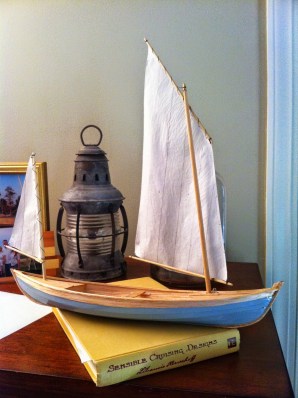
Study model
Initial sketching

 So, a tent for UNA seems necessary. Starting with the KISS principle and with my model in hand we fashioned a few scenarios at small scale. A list of desired design features came to mind:

  1. Quick and easy set up.
  2. Compact for storing.
  3. Room for 2 persons albeit cozy in size.
  4. Reduced windage for a calmer ride in the event of a blow.
  5. Ready access to the anchor rode.
  6. Double as an awning when shade is welcomed at anchor.
 Our first attempt took the fly from our shore tent and fixed that across the cockpit. It was a close fit, but just shy of overlapping the gunwale. Covering only a portion of the cockpit, it had too much windage IMHO. (Some info previously shown discussed here).

Rain fly applied.

 A more obvious option strung a ridge line between the masts for throwing over a tarp. This one was studied quite a bit, but it too gave more windage than I desired and no matter how hard I strung the ridge it still sagged appreciably thereby hindering interior volume where needed. 

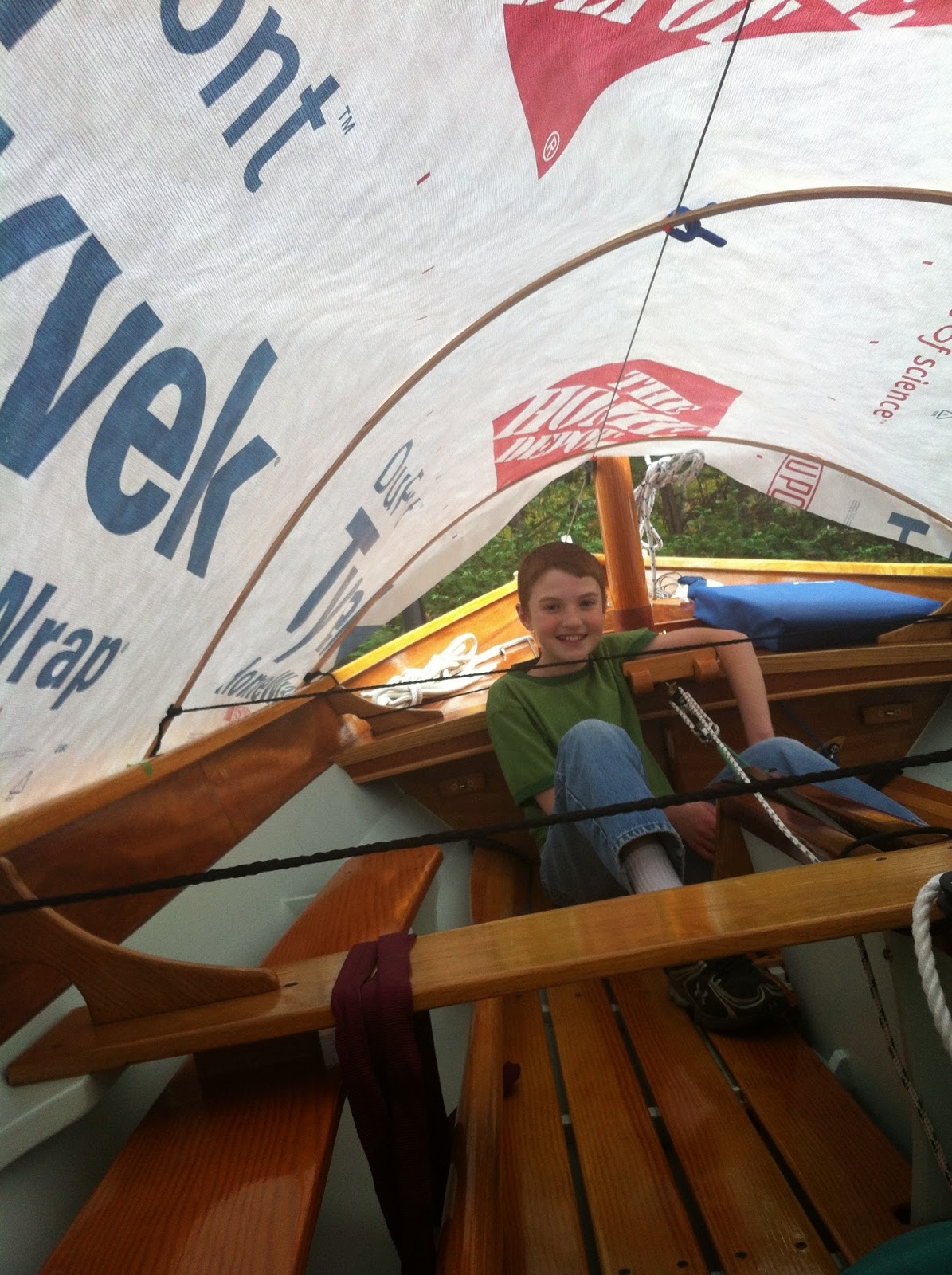
 A third scenario employed house wrap and bowed battens temporarily to make a roomy “cave,” but setting it all up looked to be a pain and while you could use tent poles instead, the pieces seemed too many. Limited storage of “stuff” on a small boat really makes itself evident. Several cruises are still needed to pare down what’s already lugged along.
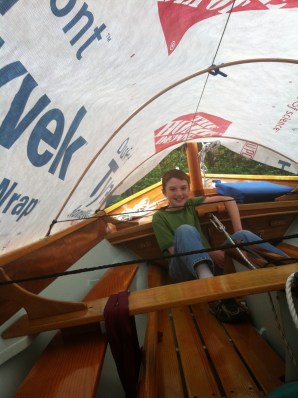
Crew under bowed tent.

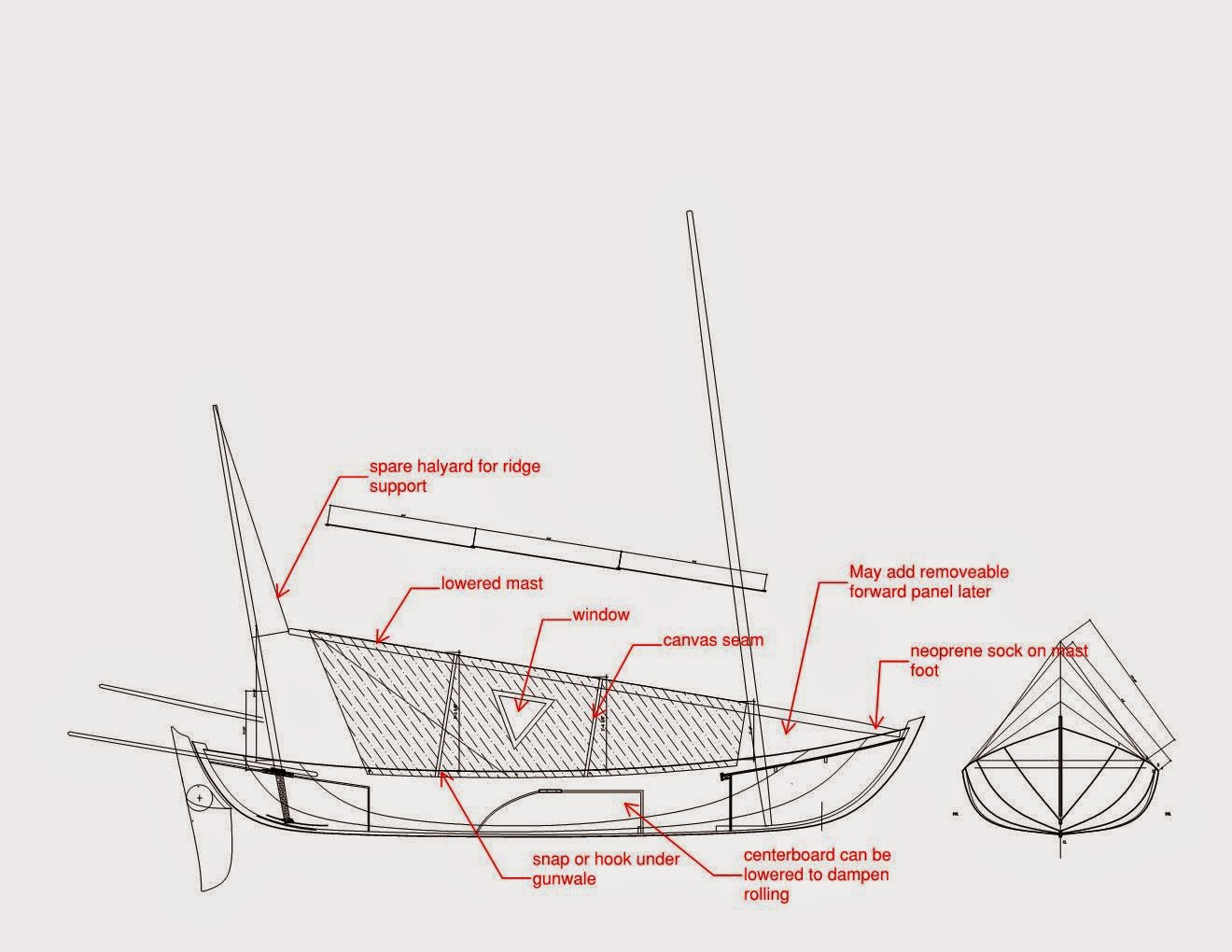
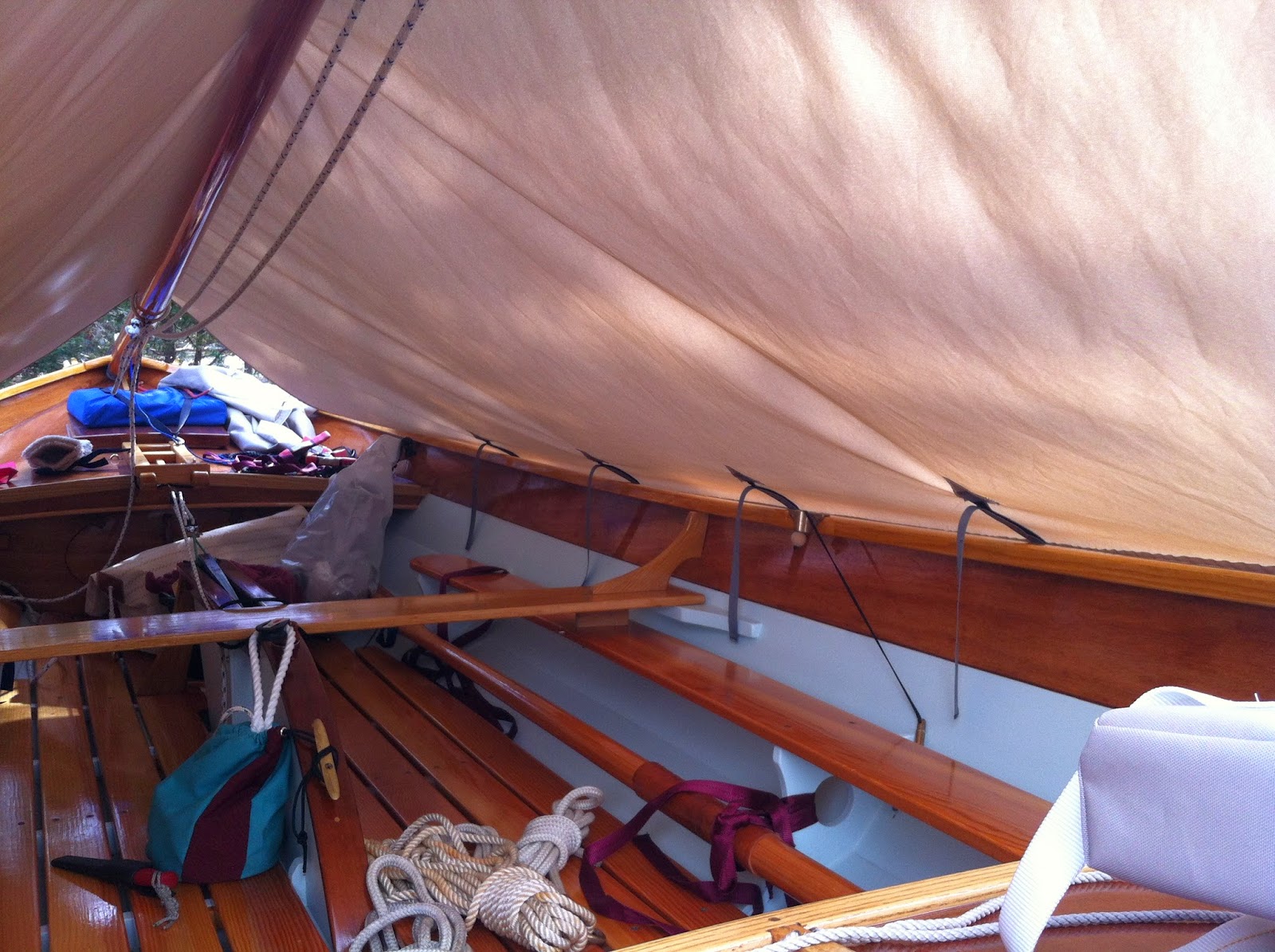
 A final alternative used the light main mast in a lowered position serving as a ridge beam.  If the weather really got howling, you don’t want the mast up anyway. Though the mast may help dampen  rolling, a lowered centerboard will suffice to do the same. Another quick mock-up showed particular promise. Drafting the solution helped with a cloth order of Sur Last. This is a lighter alternative from Sunbrella and is less expensive to boot. The material has served well in the building of UNA’s sail bags and spar covers. While not quite as water repellent as Sunbrella, Sur Last did pass a soaking test from the garden hose.
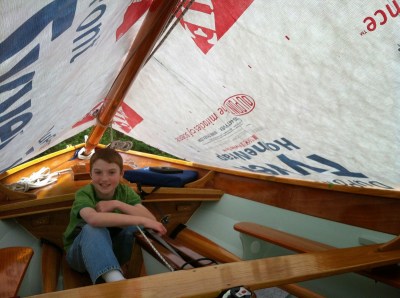
Tyvek and mast ridge pole with the happy crew.

As a better illustration, here is a drafted version:

 Additional canvass or insect netting panels may be added fore and aft at a later time if needed. Otherwise, a nice wedge is formed for easy weathercocking. This will have benefits for ventilation as well as riding a blow.
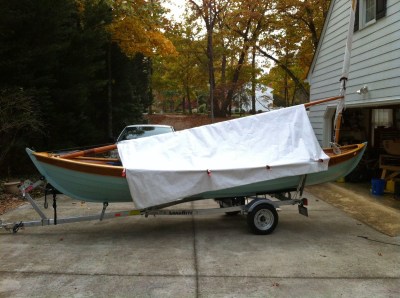
the “weathervane” mock-up.

view from aft.

“escape” corner pulled back.

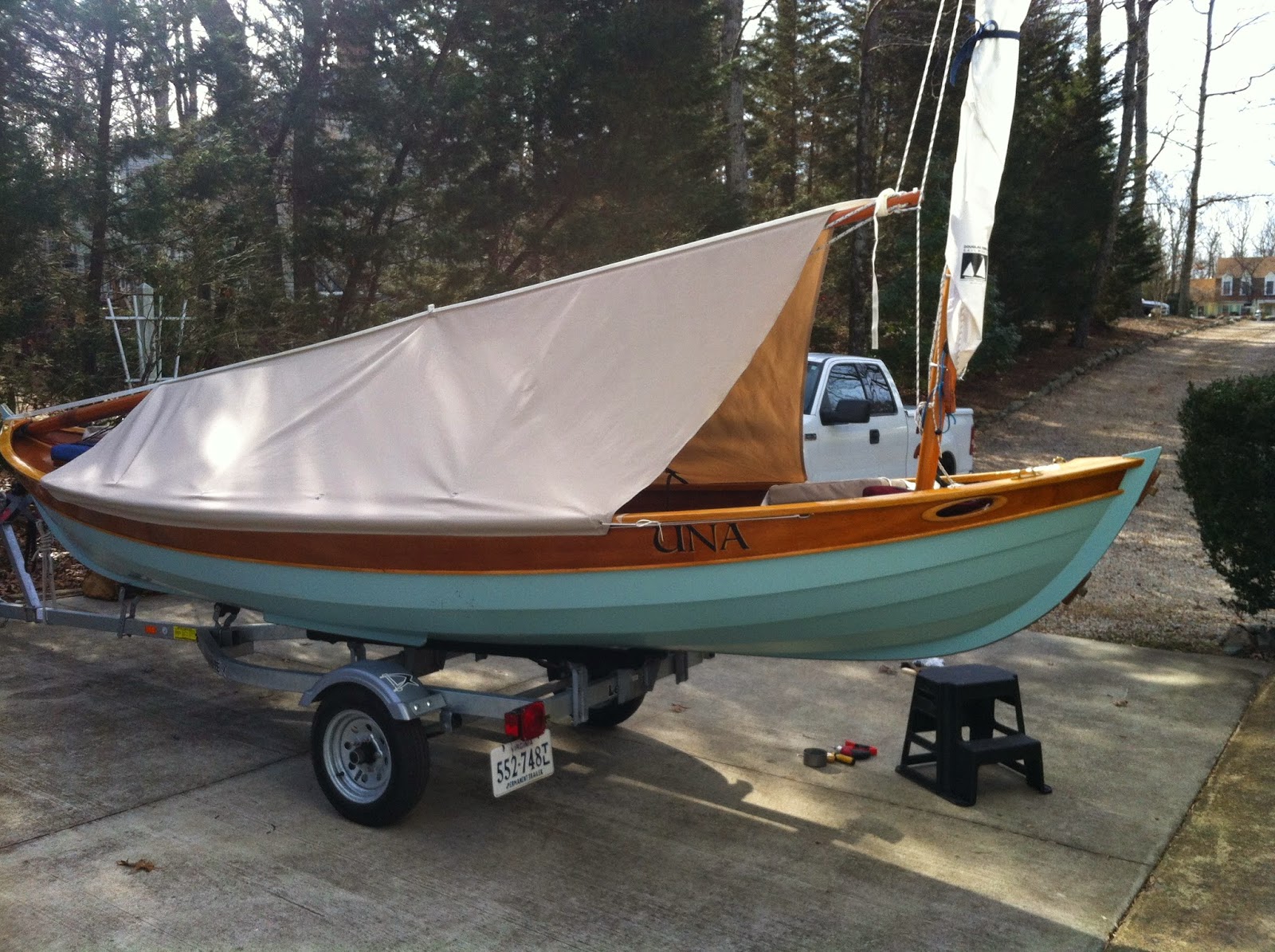
 Now the project is near completion. We’ve good slope to shed rain, ample height for relaxing and cooking in the aft cockpit. The studying took quite some time, but the build actually went rather quickly.

 Some tugging here and there will yank the wrinkles out. The lower edges are secured by Velcro straps through footman loops mounted under the gunwale. No knots! It is hard to see in these pics, but there is a “D” ring sewn in the middle of the ridge if for some reason leaving the main mast up is required. 

Straps every 2′. Four per side.

Velcro strap close up
stainless footmans loop.

 The footman loops are 2′ on center and may double as attachment points for a boat cover down the road. For now, UNA sleeps in a garage.

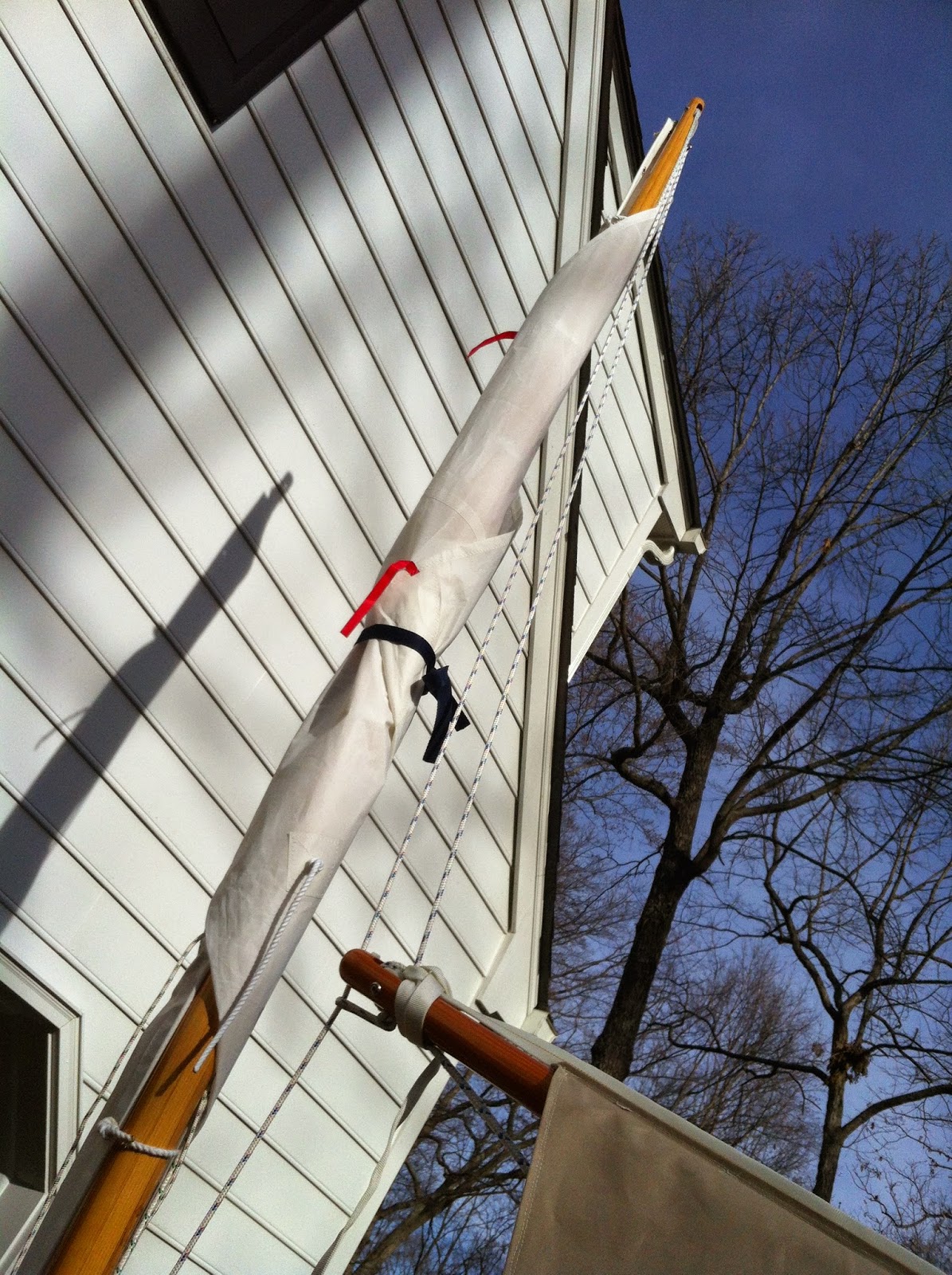
 The heal of the mast wears a small neoprene sock to prevent scaring of the deck. The tent ridge is 1″ tubular nylon webbing with a loop to drop over the stem (again, no knots).
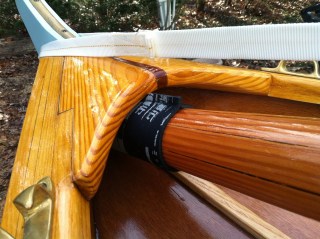
mast sock and ridge webbing loop.

 The mast’s after end hangs from the mizzen mast by a secondary halyard run through a SS ring secured by a loop of Dyneema. Once the ridge webbing and edges are secured, raising the high end of the mast tightens the whole affair.

A secondary halyard from mizzen mast raises ridge pole.
A soft Dyneema loop and SS ring make for the second halyard.

Lastly, a light 1/8″ Dacron line was threaded through a sleeve in the bottom edge to snug the skirt in. Wind and/or rain should not get through here.

Snugged canvass edge with light continuous line.

 With a furled mizzen, most of the windage is held aft. UNA should ride well with this setup. The necessity for any end panels will be evaluated in field later. No doubt a removable shroud forward may be added later. The window shown in the drafted elevation might also be nice. In the field testing is needed now. How long until Spring arrives?

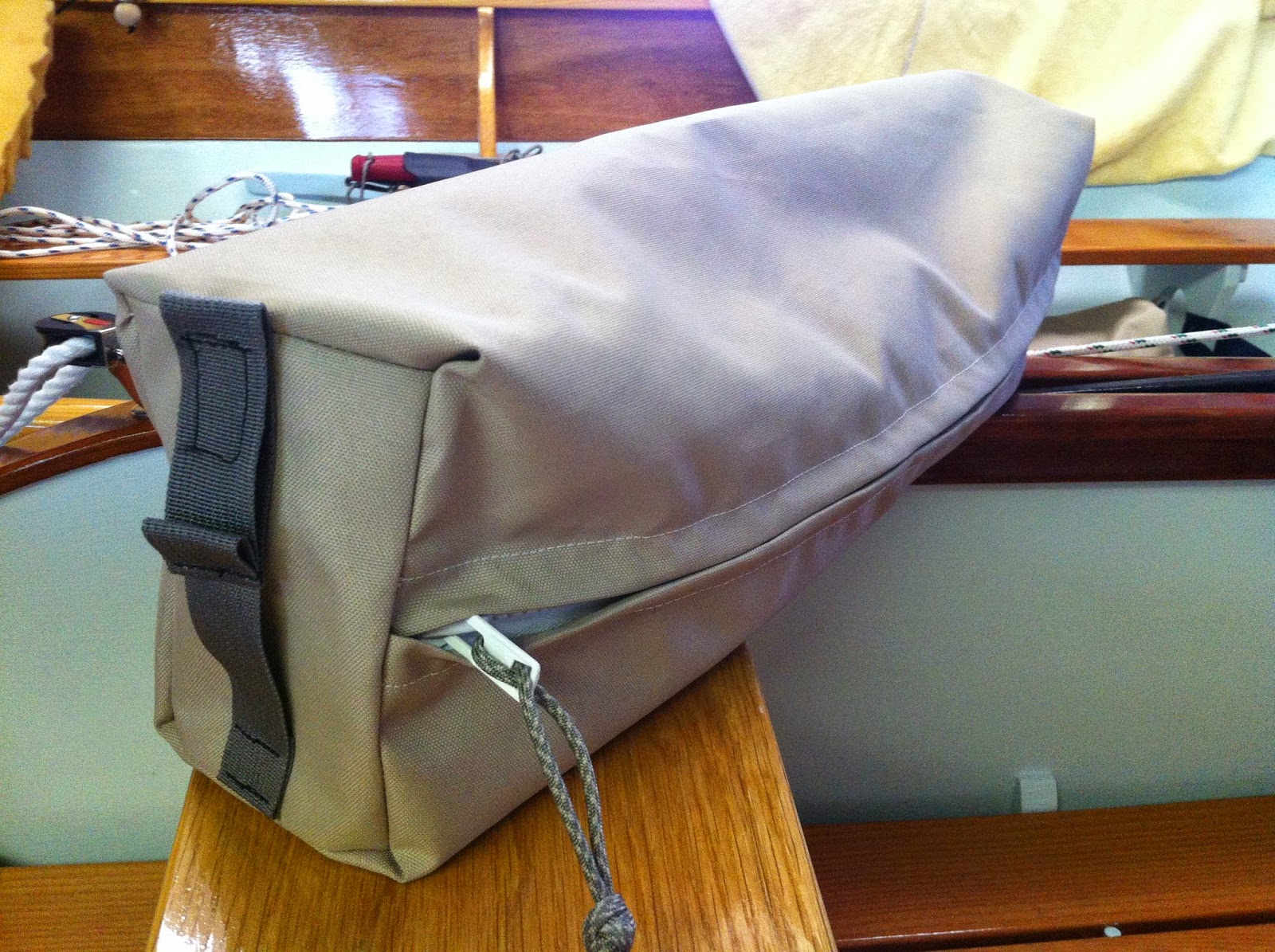
 The whole shebang bundles nicely. We’ll sew a sack for storage later too.
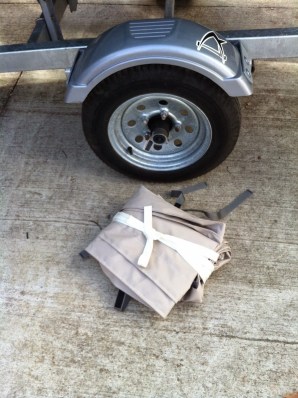
tent bundled.

And there you have it, number 100 in the bag. Thanks for following along.

Another Review: Greatland Laser’s Rescue Flares

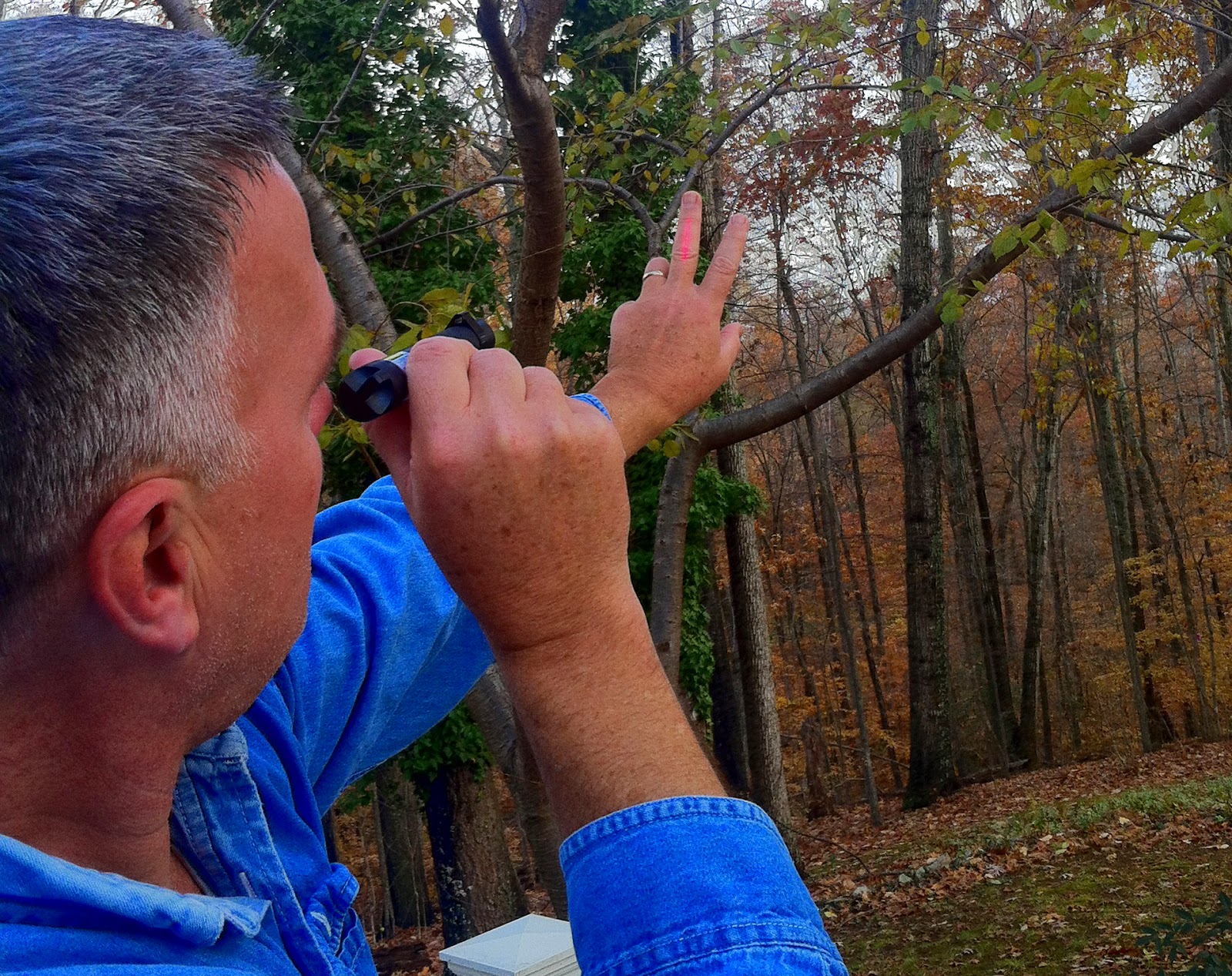
I’ve had yet another opportunity to write for Small Boats Monthly. This month’s issue has my article reviewing some very impressive electronic laser “flares”. Any coastal or offshore sailor should consider these intense directed lights.

Small Boats’ Photo of the flares
Demonstrating the sighting of the flare.

“Keeping a Rescue Laser Flare tethered to your life jacket and at the ready would provide a brilliant, distinctive, and long-lasting emergency signal, a great addition to your survival gear.”

Art

Like many “fine art” museums the Virginia Museum of Fine Arts has its share of “scrambled car parts” and “spilled paint” (I try to be discriminating). Some might accuse me of having a blind (or blinded?) eye for such things. Fine. However, I can tolerate those inexplicable pieces any day of the week if viewed with my lovely daughter. After a good breakfast at the Original McCleans together, we had a brisk winter stroll over to the VMFA. With some interest in building another kayak, I took interest in the Native American exhibit. I was surprised to see a few people we recognized:

Moe
Larry

Curly

As always, it is good to see old friends. Even better, I wasn’t expecting what we found in the adjoining exhibit:

UNA’s grandmama!

For obvious reasons, this painting appeals to me. While not a yawl, the boat in the foreground is a double-ender, and one with fine lines. It is a portion of a larger 1848 painting by Fitz Henry Lane called “View of Gloucester Harbor”. How wonderful an atmosphere the artist conveys here.

Some things are timeless and worthy of being called “art”. My fondness and appreciation for UNA takes another bound.

Gifts and Biscuits

With the onset of the cold weather, we’ve been working toward better equipping UNA for cruising. Top on that list is the boat tent, more on that later. I think we have that one solved to satisfaction.

Gifts from friends and Santa delivered a few key items to make overnights more comfortable.
One is a Neoair Therm-a-rest Camp Mattress. A good video review is here. I’ve the size large which fits very well in the floor of the boat and packs in a small provided sack. Well-made.

Second I’ll confess was a gift to self. Complimenting the pad, a North Face Aleutian 50 degree bag. I have to give Steve Early credit for pointing this one out.
This bag will be perfect for late Spring and early Fall. When slipped inside my existing bag it will extend the sailing season. This is a quality product too.
A final gift, though it has very practical application, I’ll place under the “entertainment” category. It is a portable radio, the Tecsun PL-660It possesses AM/FM/LW/Air Shortwave World Band Radio with Single Side Band. We should be able to find something to listen to. Sailing while catching a good game is on the list.
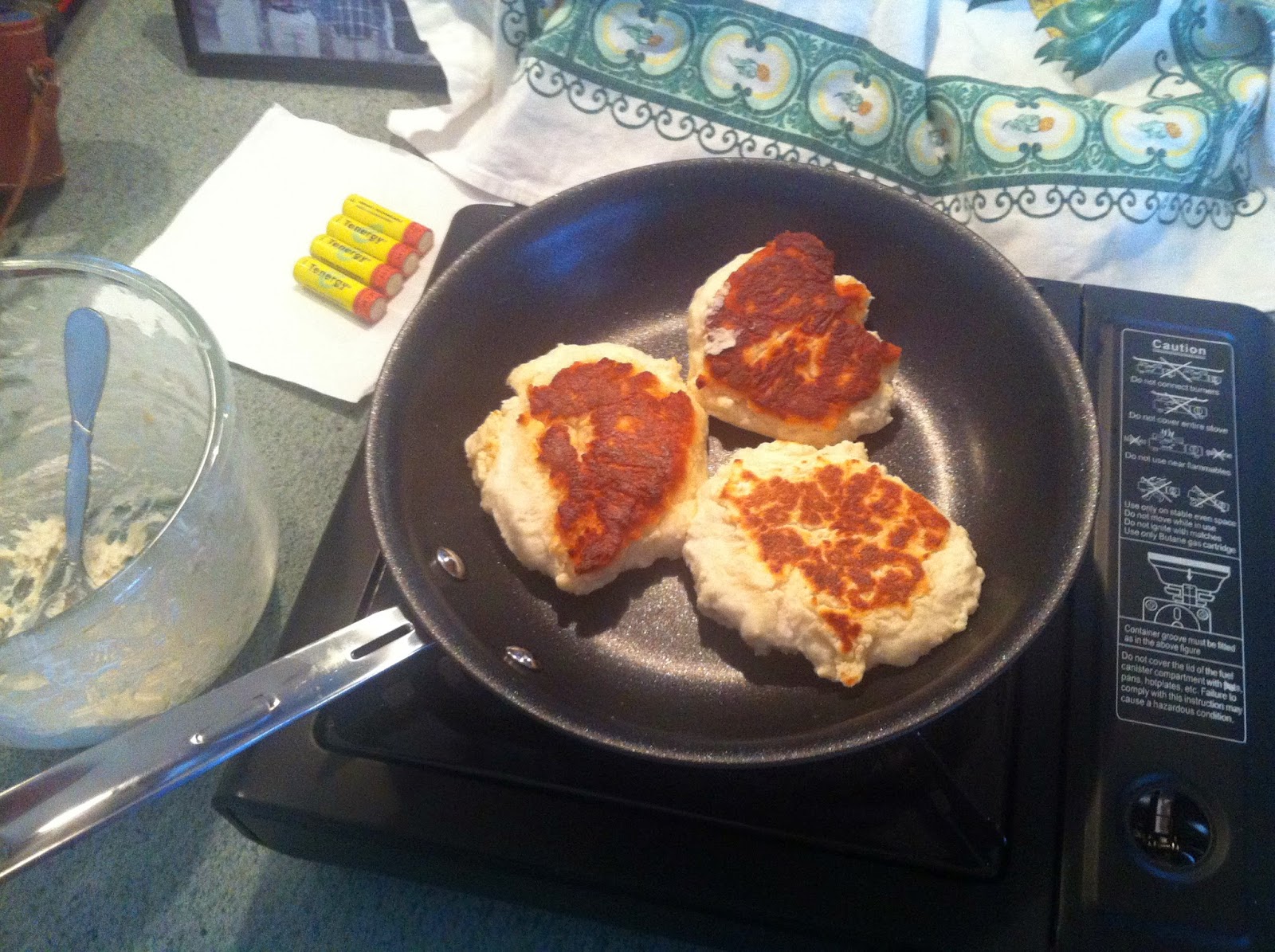
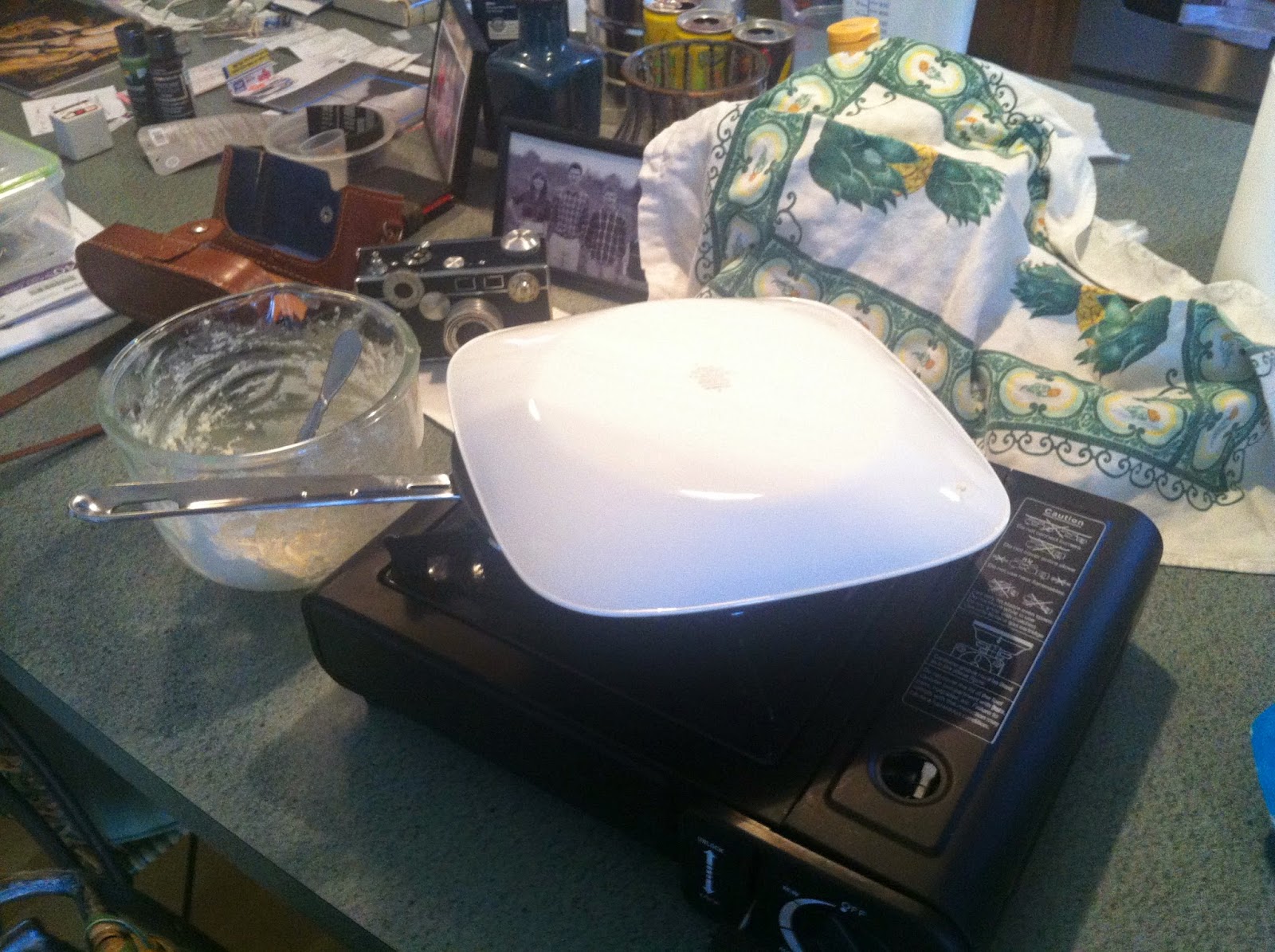
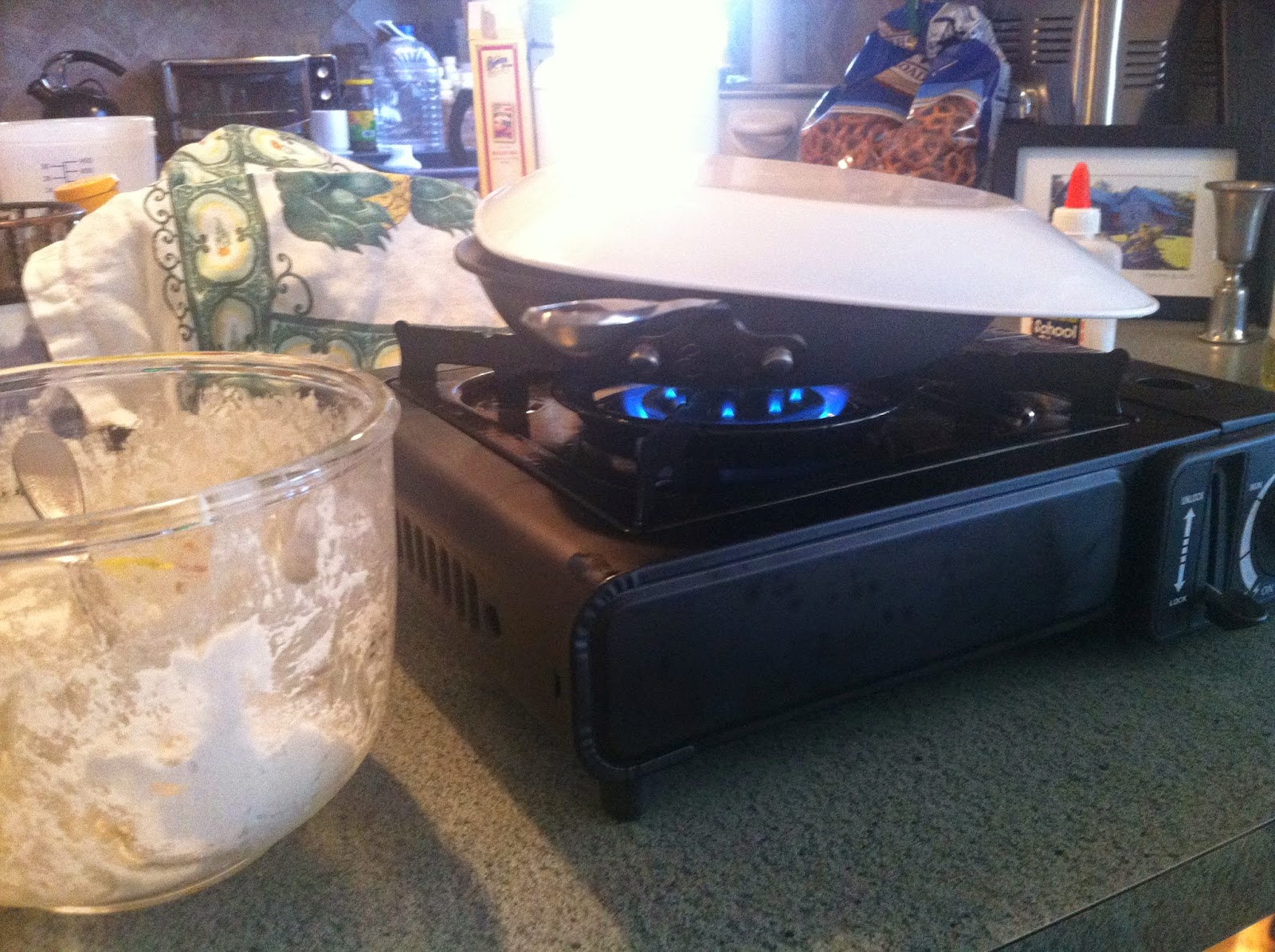
So, what about the biscuits? I’ve been starting to collect menu items. I like breakfast and weather permitting, I’ll open the galley box, set up the stove, and cracks some eggs. Add some drop biscuits and you’ve some sustaining horsepower until evening.

Just add butter!

Plate used as lid.

New galley box stove.

One day, someday, it will be warm enough for a field test. We’ll be ready.


Merry Christmas!

Here’s to a year of many blessings …

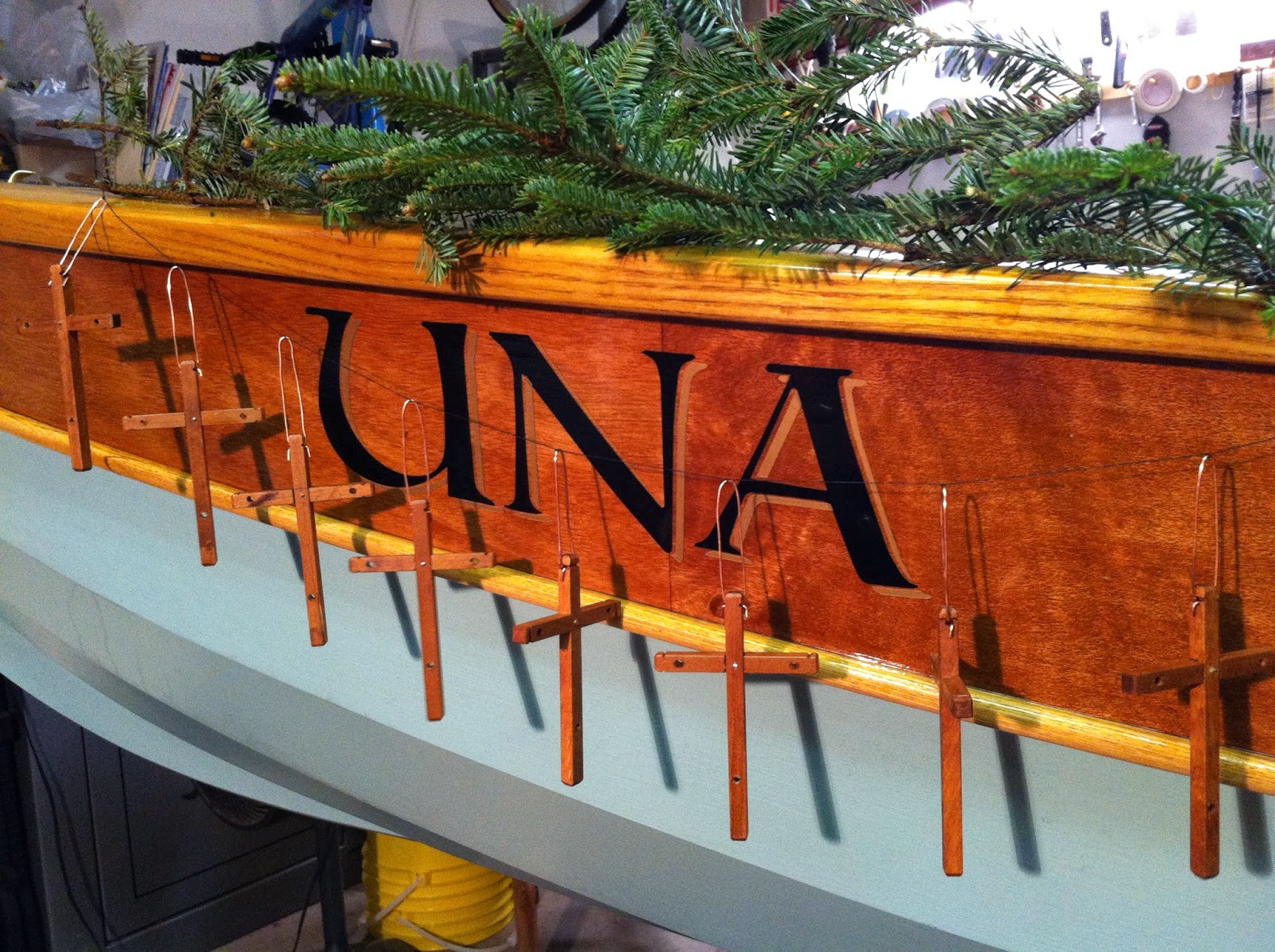
On a whim, we got into full “elf” mode for a spell yesterday, and crafted a dozen of these little ornaments from UNA’s cut offs. Like most things, it seemed to take twice as long as expected. However, it was nice to contemplate the season while traditional carols played in the background. Like boat building, the activity allowed for reflection. We’ve been blessed in so many ways and pray for the humility to realize it. Merry Christmas!

UNA Shines In Small Boats Monthly

Small Boats Monthly is an imprint of WoodenBoat magazine. I met its editor Chris Cunningham at MASCF this past Fall. When he said he’d like to highlight UNA in his digital publication, I was flattered.
Here is December’s issue and my boat is at the bottom of the page. Very cool.

photo by: http://www.agirlnamedleney.com

In addition to the recognition is a review article I wrote for Navlites portable navigation lights. Mag subscription is $3 a month. I’ve enjoyed the tips and products focused on our little boats.

Take a look-

More MASCF 2014

One of my favorite blogs is a creation of Barry Long.

Barry and Aeon.

His Marginalia, an “infrequent repository of mostly new stuff,” shares not only his keen eye through the camera, but also offers reflections on his travels and the occasional observations of beauty we all too often overlook. Barry writes very well and his photos are wonderful. After corresponding for a few years mostly about boats (Barry’s pair of Melonseeds he built in a basement are gorgeous), we finally got to meet in St. Michaels. I didn’t know he had taken photographs of UNA, but I’m happy she caught his eye. Barry’s appreciation of some of her details remind me of what was an enjoyable build.

A Barry pic.

Hopefully, we’ll  get to sail with Barry when warmer climes return.

Galley In A Box

Had hoped to sneak in a sail yesterday, but winds were gusting to 38 mph. Chickened out. Today there is no wind. Hopefully there will be some nice days soon.

The last boat camp trip may have spoiled us. Meals cooked at camp on our small butane stove top opened up a whole new menu. Though the gimballed cup stove still has a place under way, taking every meal in a 20 oz cup might get old fast.  Chris Cunningham at Small Boats Monthly had a box for his galley kit. John Hartman on WFB had his boxes. So, after studying those and many camp cook boxes out there I decided to design my own.

First I wanted it as compact as possible while keeping all the galley necessaries inside it. The final box ended with these specs:

  • 18″L x 12″D x 10″H
  • 8mm okoume plywood sides and interior oak rails.
  • oak cleat/handles
  • neoprene rubber feet
  • removable platform/ storage divider
  • interior paint matches UNA’s hull
closed box

Box was shellacked for color and varnished to protect it. Rope tie-downs keep the lid on.

feet
handles with cleated lid
“Rubber” feet protect the boat and offer an anti-skid box. Cleats will help secure box in the boat too.
opened box with stores


divider/platform removed for wind screen
stove in place


The box is sturdy enough to serve as a seat in camp. A pot, some mugs, a few utensils, and spices need to be added, but all that should fit easily. Joined with a cooler, canned and dry goods, and we are ready for the next trip.
Now on to figuring out the tent scenario …

Janes Island Flottila

Janes’ marsh canal.

The afternoon light on the Bay late Fall can be spectacular. Those foggy mornings can be serene.

marina’s misty morning.

My youngest boy and I got the opportunity earlier this week to day sail with some new friends and their boats at Janes Island State Park. A nice campground with hundreds of sites had maybe 5 visitors. We pitched tents on the edge of the canal and kept the boats in the small marina where slips were $3 a night per boat. What a deal! Both mornings began early with the half dozen or so watermen rumbling by in their deadrise skiffs before a rooster could crow.

Here are our cohorts:

Peter’s “Nip”.
“Nip” is an Oughtred Caledonia Yawl, “Una’s” grandaddy.
Mike’s “Jack-a-Roo”
“Jack” is a Joel White Haven 12 1/2.
Kevin’s “Little T”.
Kevin built his Marsh Cat. Very nice.

Winds were generally light and variable the first day and part of the second, but steady winds came through the afternoon of the second. We had a good reach across the town of Crisfield, MD and beat up the harbor entry to sail in the largely deserted basin. Like many Eastern Shore towns this one has seen better times. Hopefully they will return. Monstrous condos at the entrance doesn’t improve the charm of the town at all. Sadly, it is hard to keep such attraction secret. One has to question how well these outsiders are received and vice versa. It certainly is a clash of cultures. However, there is still much to recommend the “Crab Capital of the World” and that is mostly its location. Hard to beat.

Architecture.
A beautiful workboat.
A valiant fight against eroding tides.


Richmond to Hopewell

Well, I built me a raft and she’s ready for floatin’;
Ol’ Mississippi, she’s callin’ my name.
Catfish are jumpin’, that paddle wheel thumpin’,
Black water keeps rollin’ on past just the same.
“Black Water” – Doobie Brothers

 
It wasn’t the Mississippi, there were no paddle wheels, but I did see catfish and tugboats as I slid down the James River with my “raft” last week. I had hoped to reach Norfolk from Richmond. That is about 80 miles as the crow flies (3 days sailing), however the weatherman seemed to have been correct this time and the threat of cold and rain cut us short. Still had a wonderful 1 day sail and overnight. I certainly felt like Huck Finn. As he’s know to have  said, 
 
“We said there warn’t no home like a raft, after all. Other places seemed so cramped up and smothery, but a raft don’t. You feel mighty free and easy and comfortable on a raft.”
At 10:00 we started at Ancarrow Landing downtown. A concrete ramp and pier sufficed for a quick launching. The wind was setting the boat on the wharf so I shoved off under mizzen only to sail backwards on a close reach across the river to Rocketts Landing.
 
The mark twain.


Landing construction date
Sailing in reverse.


Richmond, VA: Point ‘A’


floating piers at Rocketts.


Archeology of industry downstream.
The sun was perfect, winds from the NW at 15, and UNA sluiced along. The first third of the trip was a tour of tugboats and barges. I lay prone in the boat and watched the world go by. It was hard to believe the state capital was just behind as the waterway got rural fast.
 
gravel crane
tug and gravel barge from Norfolk.


For the most part the trip was a gentle sail off the wind. A few river bends forced some windward sailing.  We went under 3 bridges, passed a number of estates and/or old plantations and rolled into Hopewell against a surprisingly strong tide.
at Falling Creek


Sausage King’s estate (Jimmy Dean RIP)


architecture
power plant? need to look it up.


Benjamin Harrison bridge

I found myself dosing in the cockpit like a cat at points. Snacks and drinks taste better in the open air.

Shortly after Hopewell the winds slackened, tide kept pushing against us, but we enjoyed the scenery from chasing geese to watching the sun drop.
Shirley Plantation
Hopewell
Need I say more?
 
UNA slipped under the Jordan Pt. bridge as the wind nearly quit. I jury rigged some Navlites I was loaned to review for Small Boats Magazine. They are quite simple, but rugged. You can look for the write-up in the next couple of months.
 
Jordan Pt.
Moon over boom
NavLites

I had hoped for a quiet creek just past Berkeley Plantation, but without wind and contrary current, I decided to pull over a mile short after realizing my rowing was making very little headway. After a quick pouched meal of curried spinach and potatoes, I hung out the lantern and crawled into the sack.

Anchorage.

Well out of the channel and tucked under a cliff, the night was relatively calm aside from the few tugs passing in the night. They rocked the boat. 07:00 delivered morning, flat, chilly, and all was dew soaked. (I’m working on  a tent in earnest now). Breakfast was coffee, oatmeal, and snack bar. All stuck well to the ribs. Morning tunes set the mood perfectly.

dawn


breakfast


astern

With the impending gale coming and no wind, I had to choose a pull out point. The closest place downstream was a good day’s sail, if possible. With the tide about to ebb one more time I elected to retrace the last 1 1/2 miles back to Jordan Pt Marina. The sub 3 kt “breath” forced delicate sailing. UNA did fine for half that trip. Eventually, the wind dissipated to require rowing which was pleasant on flat water. While not a rowboat, my fearing does move with purpose once started. My wife came with youngest soon and trailer in tow an hour after we landed. The ladies at Jordan Pt. said I could forget the $10 ramp fee. Out of gratitude we  ate at their Crabby Mikes. Good cheese burgers.

Light air drifting. Hardly a wake, but moving.


buoy passed.


Crabby Mikes


my girl.

So ends this leg of the trip. We’ll have to return to finish the journey another day. Soon I hope-