Sunsets or 30 Knot Winds

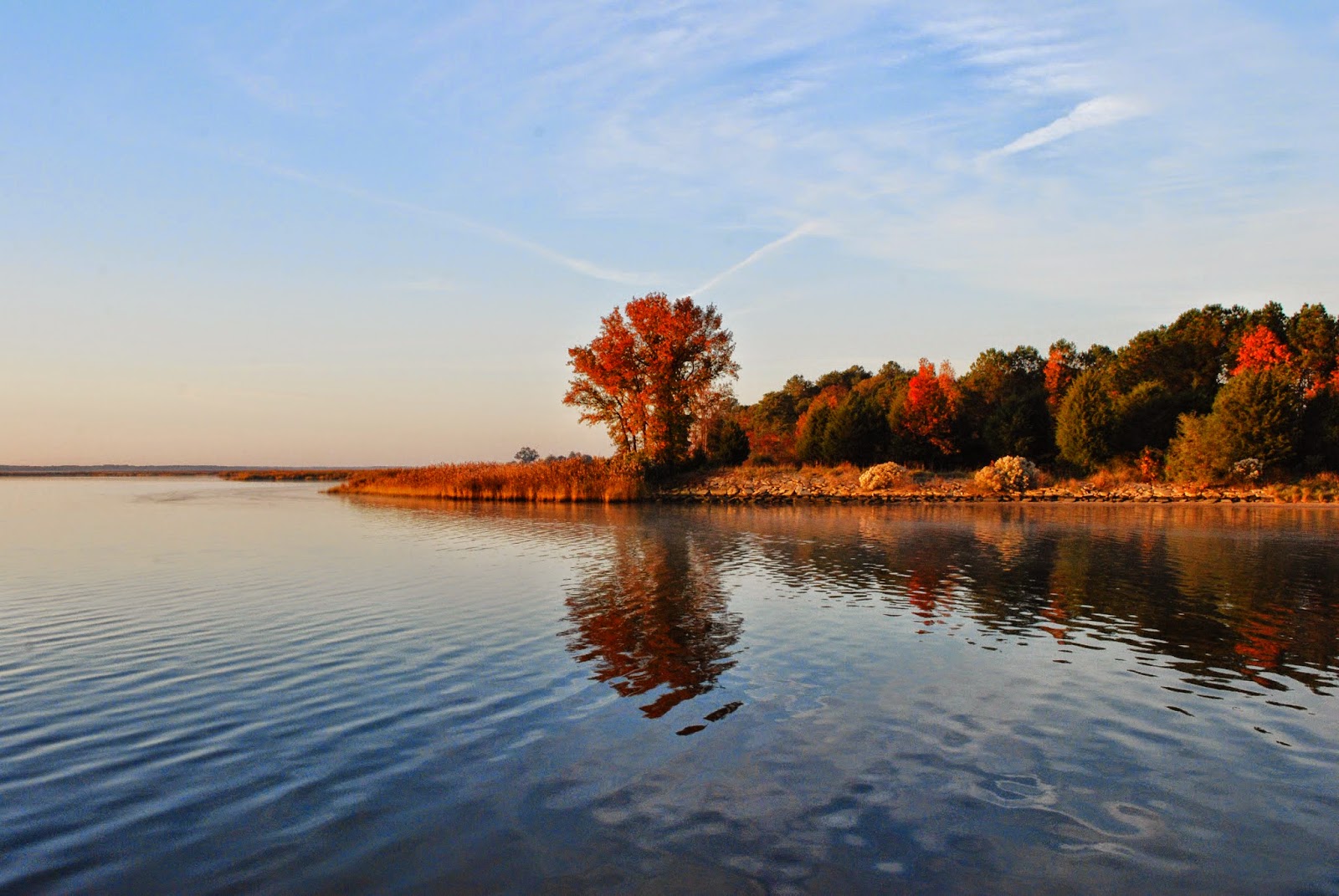
Had a short, but wonderful cruise this past weekend. Sadly, most likely listened to NOAA’s “chance of showers and thunderstorms” warnings and stayed away. This is the final line to just about every single report on the Chesapeake Bay during the summer months. Had we accepted the “prediction” we would have missed this wonderful sunset over Sarah Creek off the York River. Instead we nearly had the place to ourselves.

It was fresh sailing all weekend. We did some fishing, had enjoyable swims, ate too well, and gazed at a near full moon.


Of course there is sailing, and then there is broad reaching in 25+ knots apparent sustained. Gusts hit 30+. Couldn’t resist posting a video from a 10 day trip taken back in May. Here we made a personal, and perhaps boat best, of 70 nautical miles in 10 hrs with a 7 kt average. The 1st 2 hrs were spent bashing our heads against the gale force winds out of the Miles River, but once we turned into Eastern Bay and out into the Chesapeake … we rolled! Saw 9 knots regularly (turn down the sound). We flat out boogied.

This weekend may offer time to make some kayak progress. I’ve scrubbed down the garage in preparation for varnishing. All sanding from here on out will be done outdoors. More sooner than later-

Tools (yes, all necessary)

I’ve made mentioned of the  jig saw, table saw and belt sander, but there are many other tools I need to mention. All have been instrumental at some point or another:

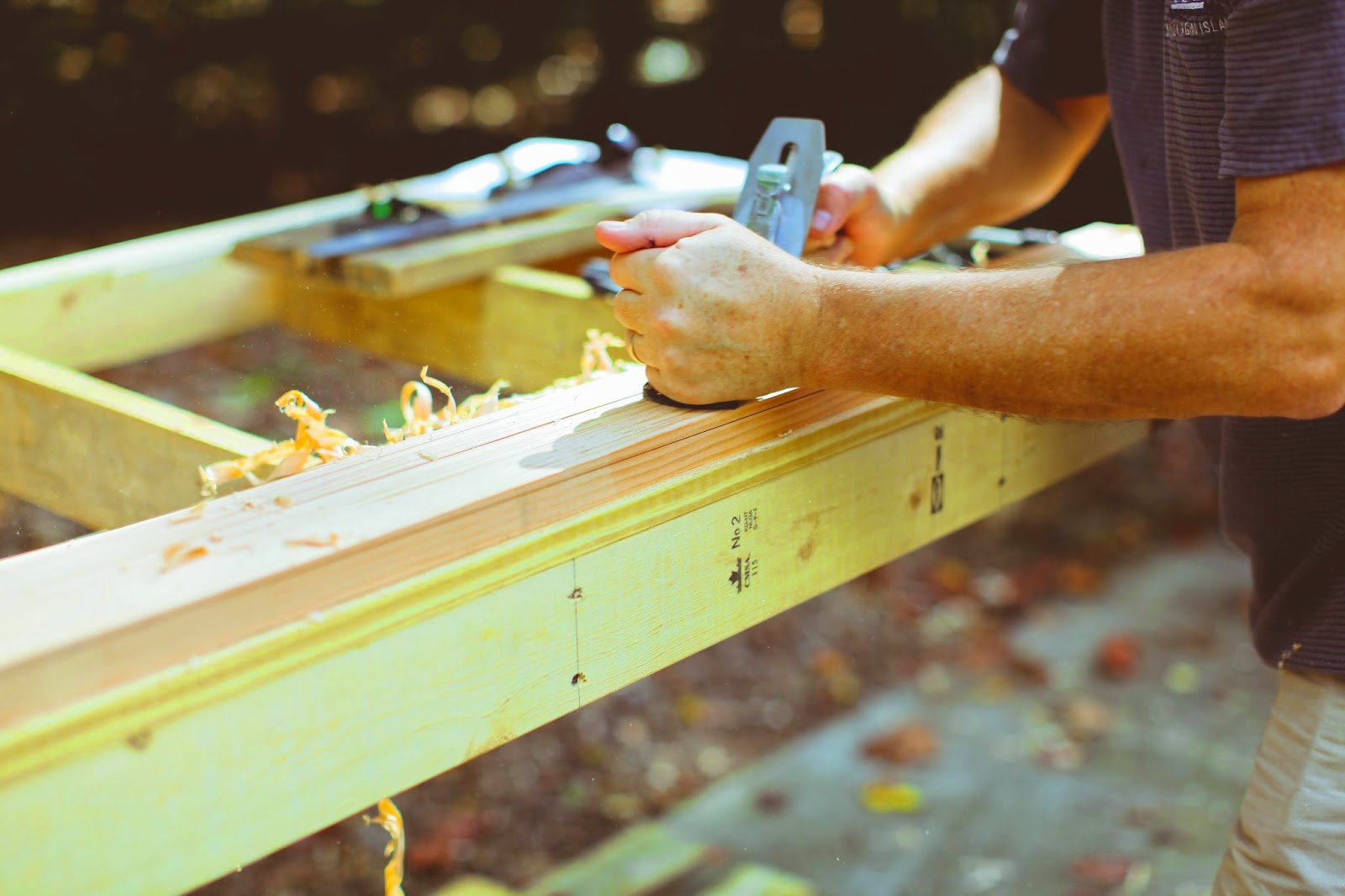
  • jack plane– good help in trimming the inner stems fast. Planes also eliminate the dust a sander makes.
  • low angle block plane– required for fine tuning the edge bevel on each strip and early hull/ deck fairing.
  • spokeshave– good for initial hull faring.
  • japanese pull saw– fine cuts. works for close cut along waterline or keel in my case.
  • X-Acto saw- also found use cutting strips along accents, waterline & keel.
  • clamps & more clamps- of all shapes & sizes.
  • rasps & files- used here & there.
  • cabinet scraper- for interior & exterior surface fairing. Helps eliminates all but last of sanding.
  • cordless drill- perfect for assembling forms to the strongback.
  • staple gun- mine broke after 3 staples and I reverted to 18ga nails. the resulting holes do not bother me. I see it as part of the build archeology.
  • glue gun- used to help hold strips together. I used clamps and masking tape from shear to waterline, but glue from WL to keel.
  • sanding blocks- 10-12″ of belt sander strip glued to 1/8″ ply makes for good use in trimming bevels on strips and fairing. Put a rounded block on the back of ply for a handle.
  • hammer– can any project be completed without one?
  • wood chisels & a way to sharpen them effectively. Chisels used to fair edges of strips along accents.
  • levels- used for the squaring of forms. I’ve a 10″ and 24″ long.
  • string- also used for the squaring of forms. it is also effective in lashing stuff where a bungee cord won’t. Artificial sinue (used for my SOF kayaks) is incredibly strong.
  • pocket knife- used all the time on just about anything, even when another tool is out of reach … chisel, screw driver, etc. (I hear moaning). I most frequently use my Spyderco “Tenacious”. Just awesome.
  • quartz heater– good direct heat in a cold garage. Don’t forget to turn it off when not attended!
  • spongy shoes- some old Merrels have saved my puppies for long spells of standing over the boat on the garge floor.
  • folding saw horses- the plastic variety are great for setting up a temporary work table near the task at hand.

Credit Due

Well, rightly or wrongly, I’ve assigned blame. Now to establish some credits.

For many years, decades really, I’ve made an October pilgrimage to Annapolis, Maryland to wander the United States Sailboat Show. In all honesty most of the boats on display have never interested me too much. Either they are way out of reach and too encumbering or are simply living rooms with a stick. However, the promise of finding the ideal boat and the scene of a harbor full of boats has kept me returning. On one such occasion a modest bateau, a New Jersey gunning skiff (the Melonseed), stood out from the otherwise brash carnival. She was simple, beautiful in form, and to this day represents sailing in its purest form to me. A fellow named Roger Crawford resurrected the 19th century design from extinction. He builds her in glass to this day and a strong and loyal following has resulted. They call themselves, “Melonheads”. Loads of info on the boat is now out there. Perhaps I’ll offer some links later. In any event Roger’s display has always been on the “must visit” list for the show. Every year the boat is the same with hardly a change and every visit is more gorgeous than the last. Why I don’t have one, I can’t figure, but perhaps the stable needs to be thinned first. So, kudos to Crawford Boatworks.

Others to thank for enabling the plunge:

  • Ross Lillistone of Bayside Wooden Boats: He’s an Aussie who’s cat ketch “Periwinkle” re-ignited my small boat interest to the point of seriously considering building (3 yrs ago!). His designs are wonderful and very well thought out. With immense patience he answered countless emails and started my collection of proper tools for the “yak” task here begun. Perhaps there’s a clinker ply boat in my future still.
  • Barry Long: He is the craftsman and dare I say artist of 2 of the most beautiful Melonseeds I’m ever likely to see. I venture to say there is no better documentation on the journey of creating a small vessel as his blog Eye In Hand/ Marginalia. He too has endured many an inquiry and shares in the blame for encouraging my slip from reality here. If this kayak adventure proves as rewarding as I expect, it will be the prelude to a Melonseed build.
  • Ross Leidy: like Barry, he’s an artisan whose site Blue Heron Kayaks shows his prolific kayak builds of which his Outer Island is one of the prettiest out there. I’ve poured over his site to get a good understanding of the build.

Lastly, I credit Jay Babina for his Outer Island design. It is a looker and possesses a form that innately made sense for my use. His plans and manual are well set. An accompanying “free” video will amaze you in demonstrating the kayak’s efficiency of movement and grace. Outer Island

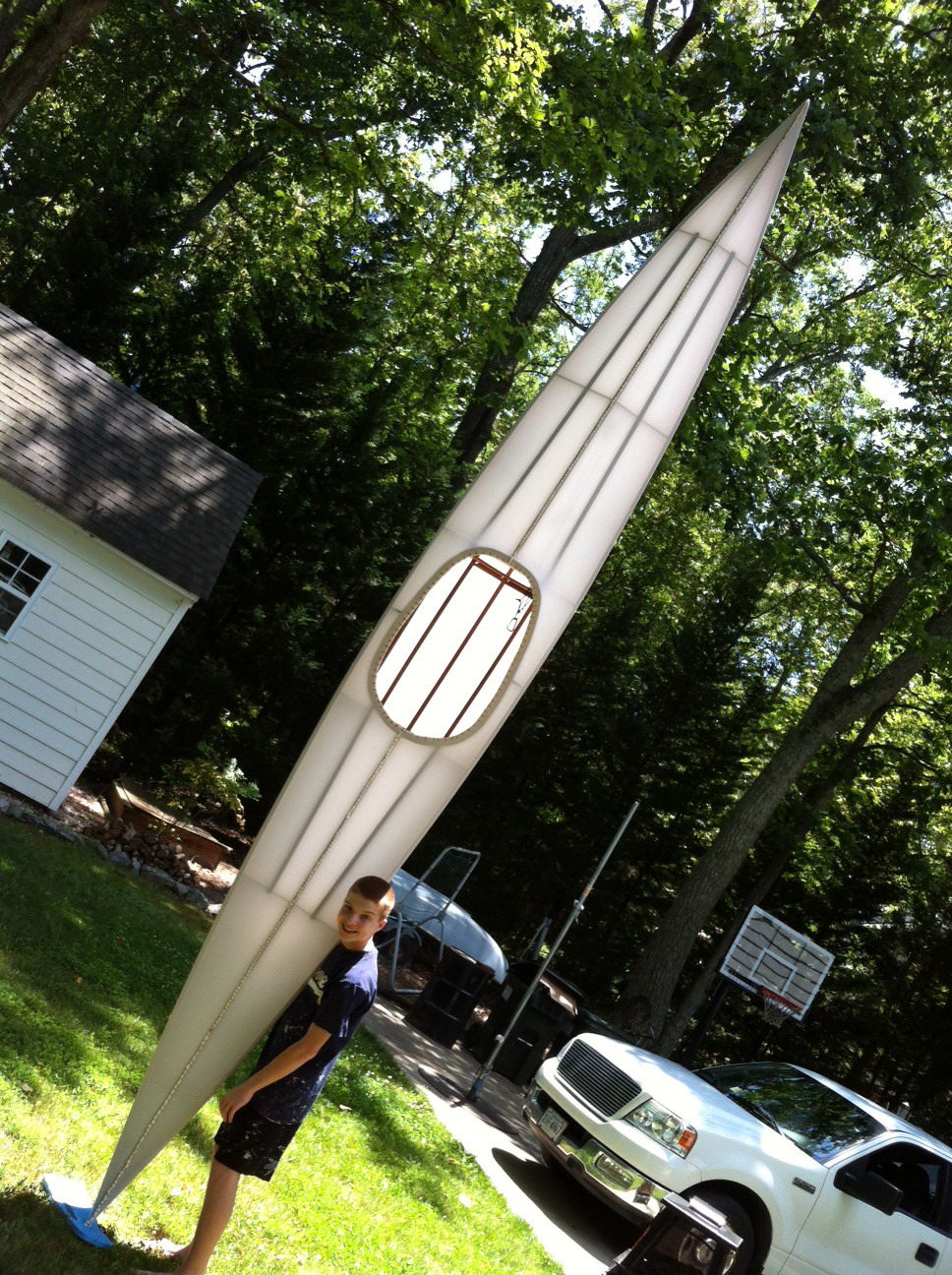
Aside from these 2 skin-on-frame kayaks (below) one of my sons and I built last year as an introduction, I’m no boat builder. I aspire to gain the craftsmanship to pull this new work off.

The “bones” of a slightly altered (deck 3/4″ higher) Sea Tour 17 Explorer. SOF #1.


The ST 17 with skin on frame. All up = 37 pounds.

Pictured is the “japanese lantern” before painting.

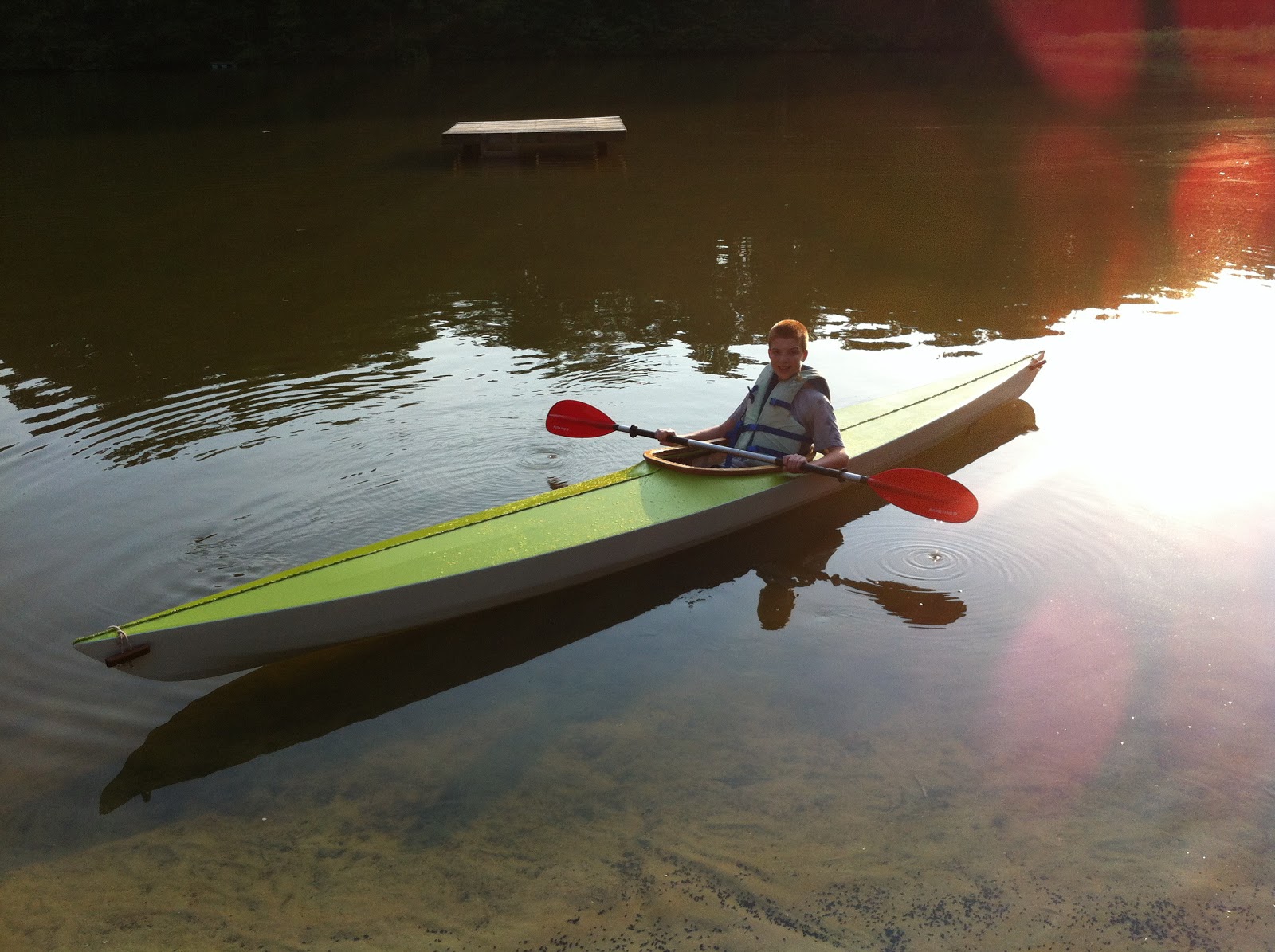
She floats.


Here is the captain in the painted (3 coats of Rustoleum) boat on her maiden trip.

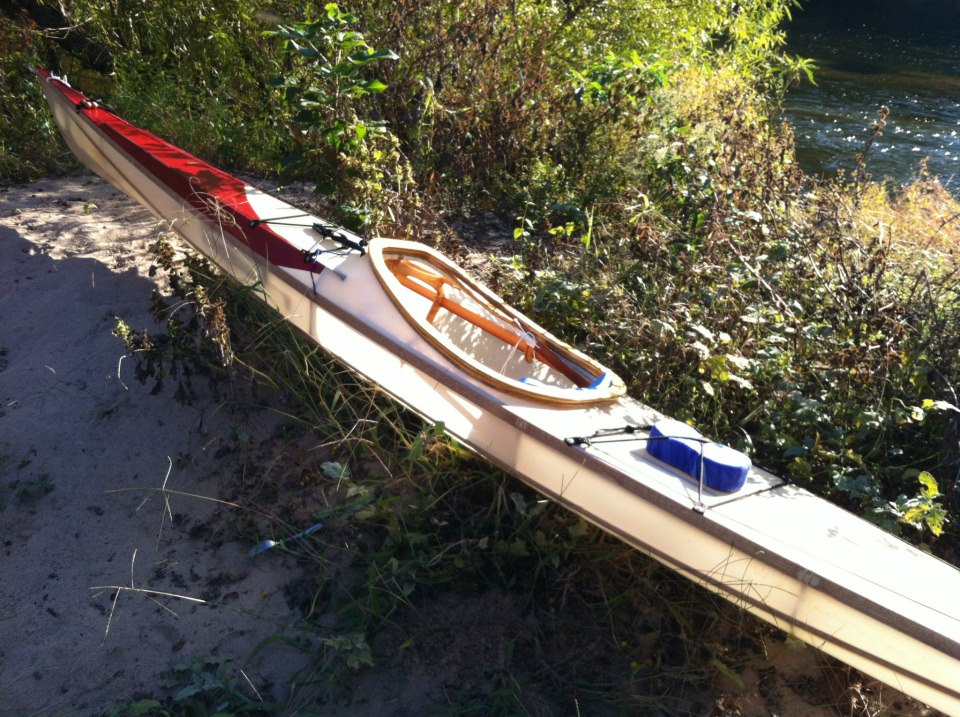
SOF #2: A Siskiwit Bay 17. All up at 34 lbs.

Without further ado, what follows will be the pieces and parts of an actual build. I hope it proves helpful (remember, you can always learn from another’s mistakes).

A Start …

You can’t blame everything on your parents, but of this one thing I am certain I can: my love for “messing about in boats”. Early memories evoke summer evenings at age 3 or 4 lying in the bottom of a small sloop as she slid across the Lafayette River. The warm sea air, the sparkling reflection s of shore lights, and perhaps most infectious, the hypnotic movement of a vessel on the water. This all conspired to lure me in.

Fast forward many years and countless such evenings, I now find myself these recent evenings in a cluttered garage100 miles from the ocean. The purpose? To dream childhood memories and build a boat. Not just any boat (certainly not an Ark), but one of the 3 boats this “sailor” has concluded fit his boating needs. They are an 18′ touring kayak called an Outer-Island, a small 14′ sailing skiff named the Melonseed, and 25′ keelboat known as the Nordic Folkboat. I’ve no illusions of building the latter and have whiled away hours staring at the skiff. However, I have finally put strips to forms for my kayak.

How long will it take? A guess would only be that. Others have approximated 300-400 hours. That alone intimidates. Where does it come from? Do you include the unrecorded hours of investigation, correspondence, gathering of tools and materials, and the dreaming? Surely not, but nonetheless, I have begun to record the actual build time. It all makes no sense … unless you are a romantic, and I was hooked as a baby boy.

So, enough of the “why”. I don’t have an answer, don’t want to be a writer (much less a poet), but I do desire to record my progress and process in hopes that it will force a finish and paddle up some river or across a small bay. I too feel some indebtedness to the many folks who educated me regarding this build and to those who’ve kept me from drowning early on.

30 hours. That’s actual cobbling pieces together for you accountants (who aren’t likely to be so touched as to build a boat). I’m nuts and am going to do this contrary to notions of being reasonable. After all the studying, the learning begins. And so, as I continue to figure things out, … this … is … a … start.