Pitch a Tent

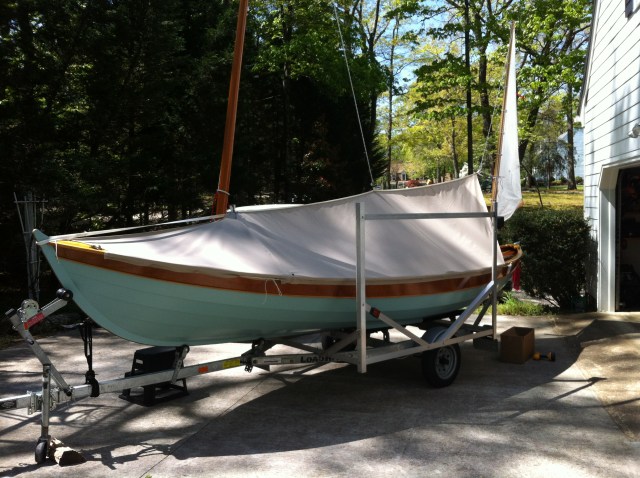
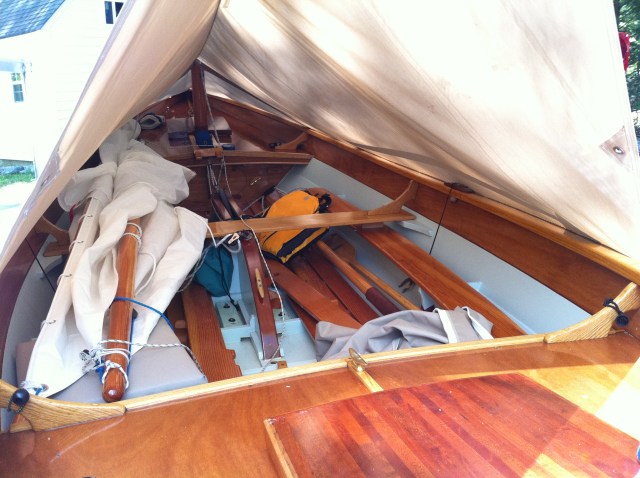
UNA’s tent has gone through a number of evolutions, mostly in details. Originally designed to use the main mast as a ridge pole, it worked well. The wedge shape seems to hang downwind even with the mizzen furled. However there were some sacrifices (aside from not being my bed at home). The biggest loss was a dampening effect the raised mast has on a rolling boat. Even lowering the centerboard left too quick a rolling motion. Also, threading the velcro straps through footmans loops under the gunnel was easy on the pavement, but a hassle on the water. So, I replaced the loops with snaps. This works great. With snaps every 12″ I’ve a good setup for the boat cover I want to build.

I had raised the tent with the main halyard from a D ring while leaving the mast stepped, but there was too much sagging. Now I’ve solved that problem by pulling the tent from loops at both ends.

The last drawback was the amount of air (or rain) that might blow in from the forward opening. This we reduced by stuffing bags in the opening which was temporary at best. Now we have a separate mini tent over the bow which overlaps the main tent.

The end solution leaves only mosquito netting to figure out. In the meantime, we have an army netting that can be hung inside the tent or a Thermocell to repel the pests.

IMG_0770
Tent with bow closure
IMG_0774
leather on bow tent for mooring or anchor line wear

IMG_0771


IMG_0772

IMG_0775

IMG_0776
after end of tent hung by halyard on mizzen and tensioned by string back to mast.
IMG_0777
Interior is a jumble, but has adequate sitting room aft of the thwart.

My sewing technique is not there yet, but with each project we’re improving. I’m happy with this solution. If a real blow is expected one night, hopefully I won’t be aboard, but if necessary, the setup can use the lowered main mast too. And should you need to escape fast, the snaps are not too difficult to release and open. Some mornings I’ll unsnap just a few starboard aft snaps to gain more headroom and scout the horizon while still being largely protected from the breeze while the coffee is brewing. Now we just need to find a new horizon.

0-30 knots Makes a Varied Cruise

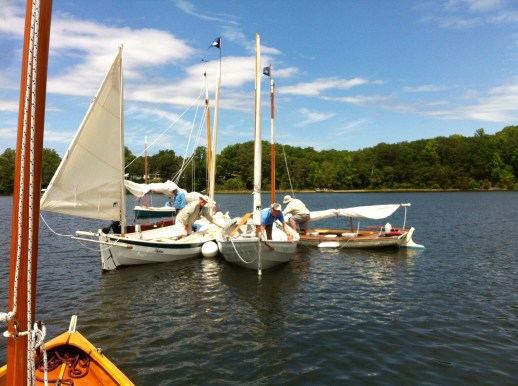
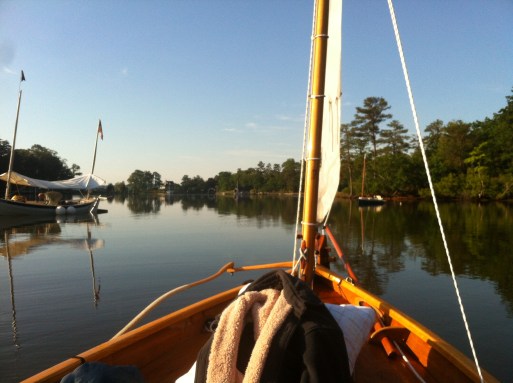
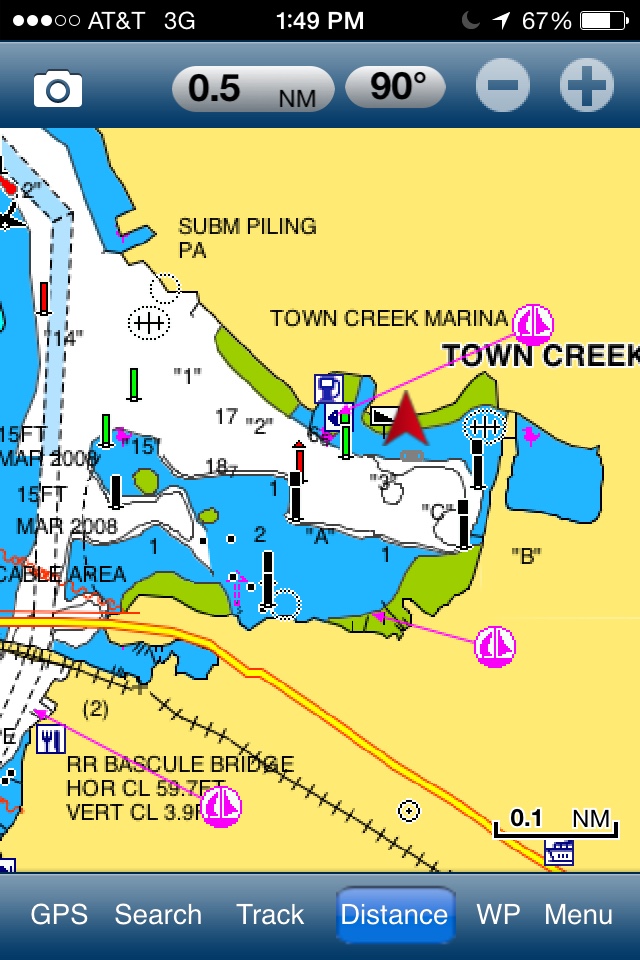
The Old Bay Club is a confederation of sailors who resist rules and shun regulations. As a Traditional Small Craft Association Chapter, we probably agree on little other than, “let’s go sailing”. And, so some of us did this past week. Two Caledonias, a Whisp, one Marsh Cat and UNA hit the water in Beaufort, NC (pronounce Bow-fert. SC says Bew-ert). Our starting point was to be The Straits ramp approaching Harkers Island, but local advice dissuaded us fro leaving trailers there as they might not be there upon our return. Pirates apparently still ply these waters. Given that, we moved to Beaufort’s Town Creek ramp where overnight parking isn’t allowed (thus the reason for considering Straits). Due to a closed road on our approach, we met “Captain Chris”, a skinny hairy chested fellow who has beer for breakfast, not that there is anything wrong with that. He informs us about the museum’s event parking for leaving trailers. So, we thank him and as we head in that direction, the Capn’ adds that he was voted the “number one sailor in America” and that his vessel, a black hulled ketch is moored in the harbor. The only boat matching that description obviously hasn’t set sail in many years, but who’s to quibble?

IMG_0709
ramp location

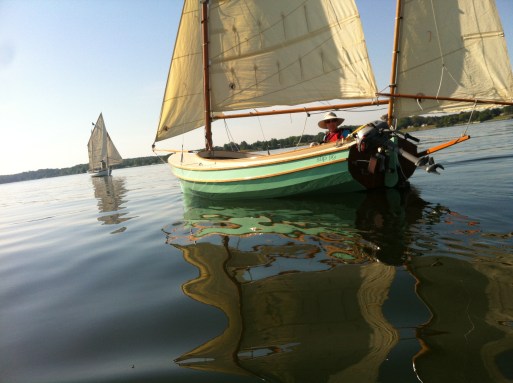
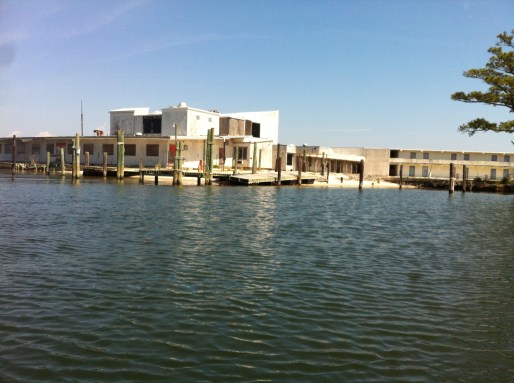
A call to the museum’s director gains us access to their lot and the combo to its lock after hours. After an hour or so later 3 boats hit the water. With a third reef in the foresail and the only one in the mizzen, UNA and I sail in Town Creek for maybe 20-30 minutes. It is blowing maybe 25-28 kts in the gusts. As a group, we elect to hang off floating piers at Homer Smith’s Seafood. Sadly the waterman’s town is changing and Homer is getting out of seafood and into the marina business. That career change allows us to ride out the high winds in relative security. Cocktails and dinner are enjoyed.

IMG_0711
Homer Smith piers


IMG_0710
A Bolger design perhaps?
IMG_0717
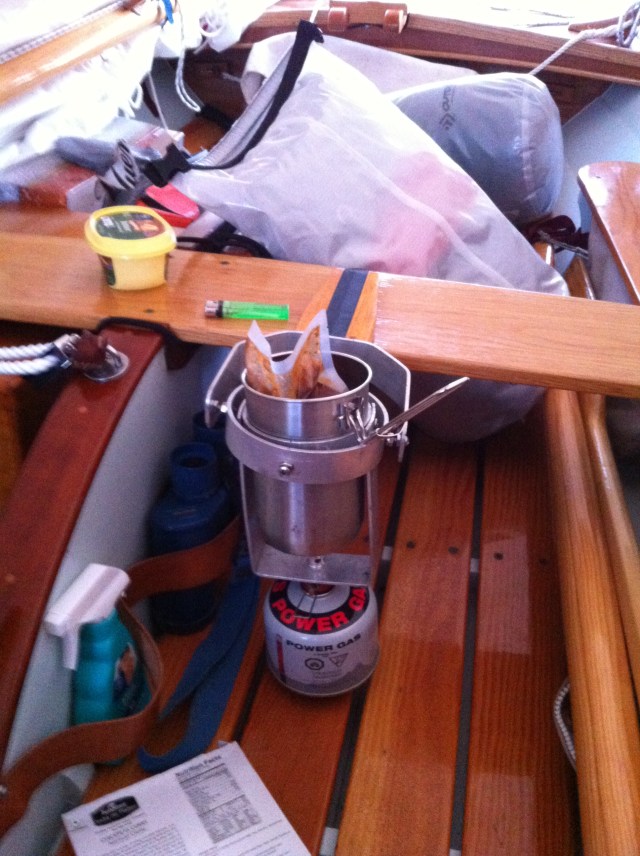
Curried dinner boiling in a pouch. Easy and good.

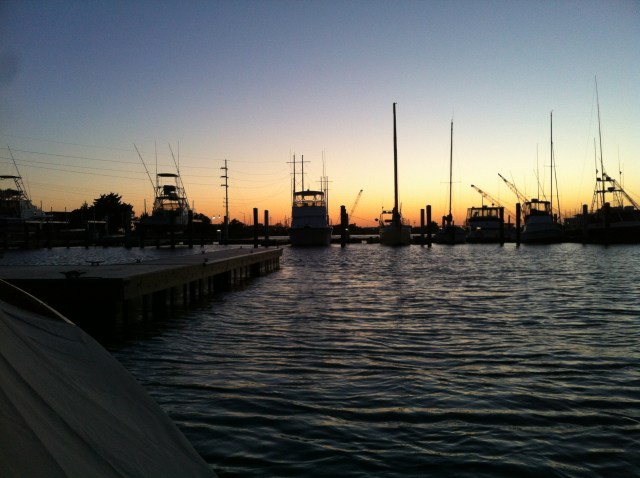
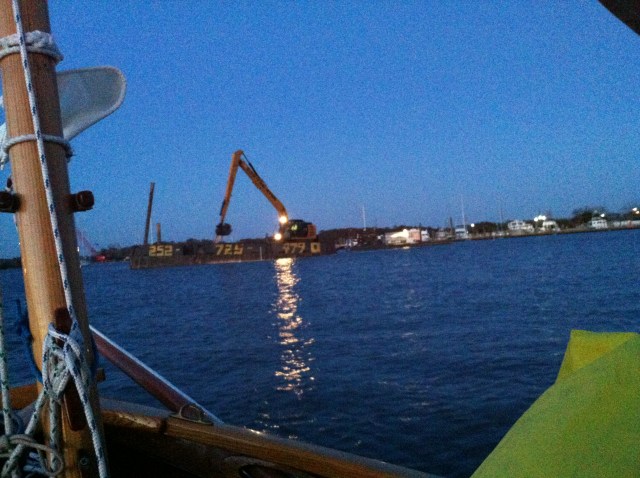
Beyond the sunset, dredging operations continue into the night, all the way until 2:00 AM! Progress? The shovel dredges mud onto a barge, ambulates to the shore by pushing or pulling the barge by grabbing the bottom and off loads into a dump truck to remove the spoils. Primitive, but seems to out perform the dredge vacuum that also has a voice all night.

IMG_0719
Sunset
IMG_0721
dredge shovel on a barge working late.

Late morning, 7:00 AM, the dredge begins again. Not a peaceful anchorage.

IMG_0725
dredging recommences first thing the next morning.

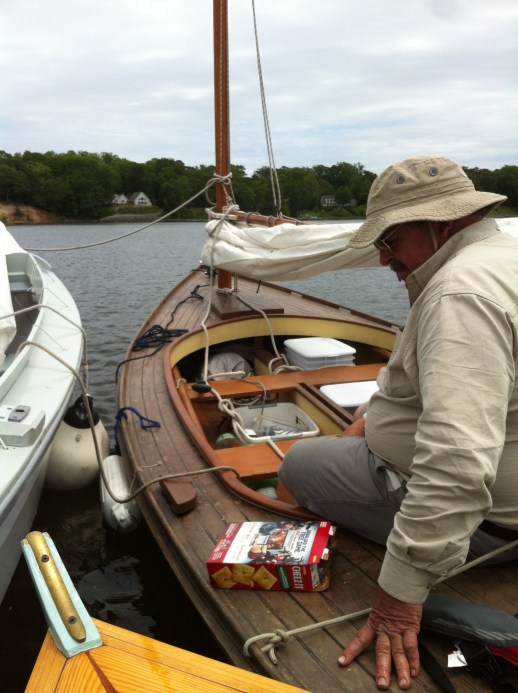
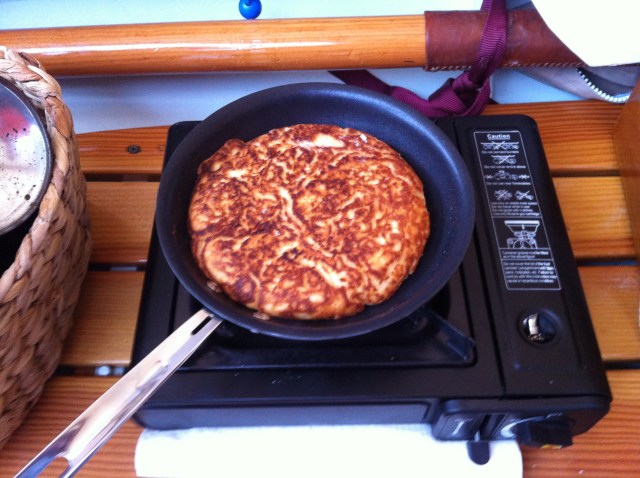
Breakfast is coffee and drop biscuits or, one large brick. With butter and honey, it fills a gap and 1/2 is saved for later.

IMG_0724
biscuits

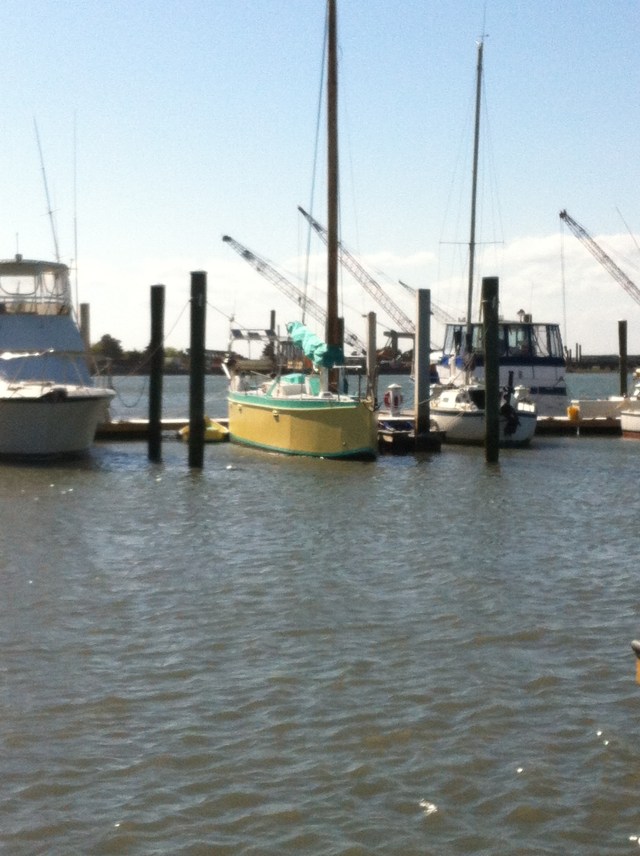
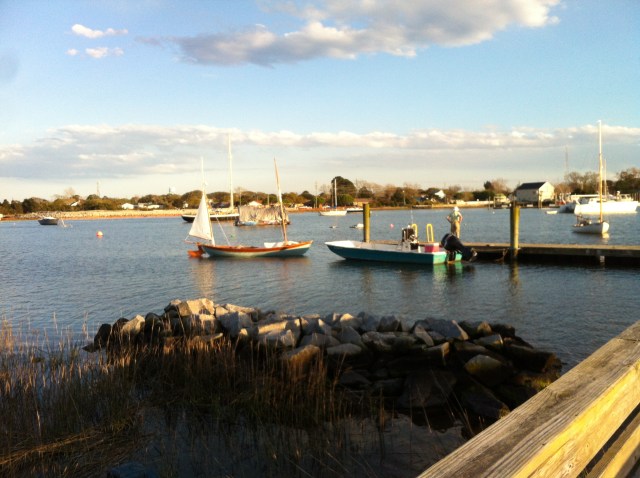
Sailing about the harbor exhibits several boats in various states.

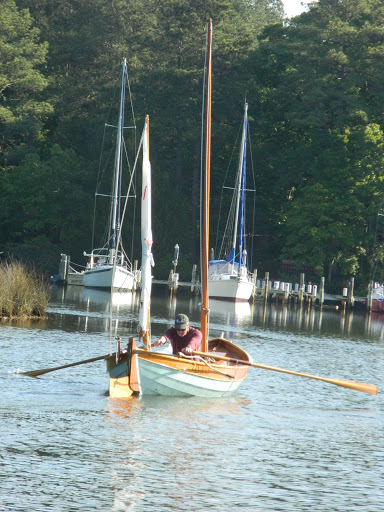
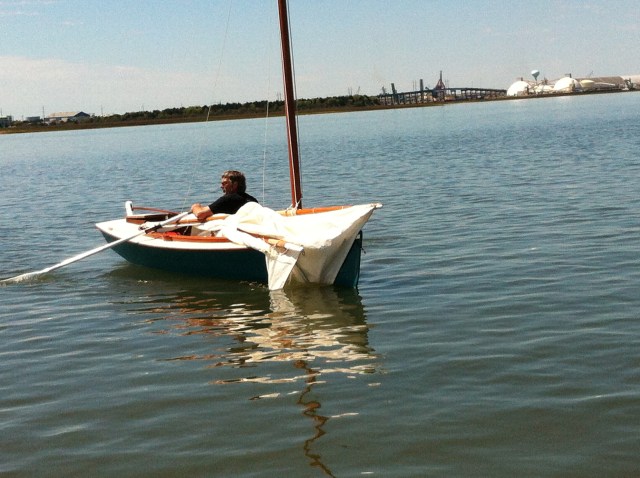
Crossing back to the harbor to meet arrivals John, Peter and Mike, we grow our numbers by 2 boats and head out towards Newport river. The morning breeze dies quickly and oars are broken out. Kevin motors out towards Beaufort Inlet. The rest of us tire from rowing and drop a hook for lunch.

IMG_0731
lunch
IMG_0730
Dennis seins for shrimp

A local kayakers passes in admiration of our fleet. He says the sea breeze would kick in within the hour. It does and UNA reaches with the current around Radio Island to meet up with Kevin and Little T to explore Beaufort’s waterfront. We’re greeted at the museum’s boat shop where we get a tour of the facilities by the director Tim and Grant. After taking in the exhibits, we catch a burger at Finz Grill and watch the waterway traffic from the deck.

IMG_0736
the shop with Kev in and the boats beyond

IMG_0737

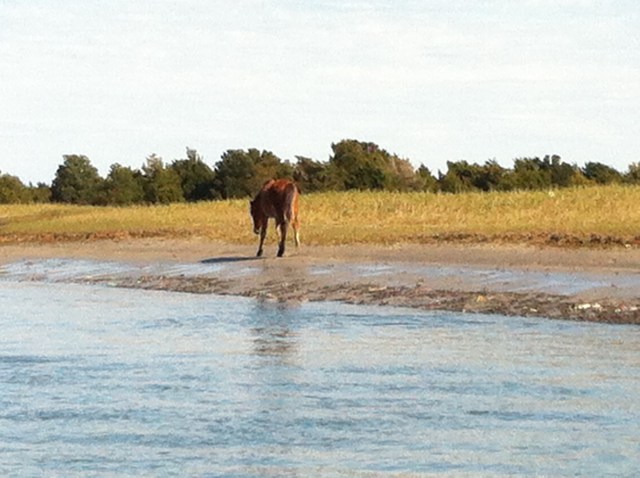
Jumping back in the boats we sail down and back the cut along Front Street. “Wild” horses graze on the facing Bird Shoal.

IMG_0738

IMG_0740
wild?

We pass a Laser on the way back. He comes about and pursues UNA to windward. For 10-12 minutes he gives chase, but can’t close the gap. UNA continues to impress me, but not the bridge tender who at the end of the channel refuses to open per posted schedule when hailed by VHF. The tender’s sign offers openings on the half hour, but at 4:45 the gate keeper says they won’t open until 6:30. Dropping the whole rig and rowing through does not appeal. S0, we do an about face and sail with a small pod of porpoise back around Radio Island and roll with the current at 8.5 kts according to the GPS.

IMG_0751
back at the ramp

Once back at the ramp, we find all other boats have been hauled, but an excellent shrimp boil is on. Master chef Harris delivers with encouragement from the rabble. He made an excellent meal of shrimp clams, sausage, carrots, potatoes, onions, corn and Old Bay. Hardly a drop was left.

IMG_0752
another sunset

Tomorrow’s weather is forecast to be 30-40 kts. I too decide to pull my boat and take the long road home. All but Kevin leave in the morning. He stays on to sail out to Cape Lookout two days later. He gets the trophy. Until next time … here is a collection of short videos:

USS McFaul (DDG-74)

Passed her this morning as she moved through Hampton Roads bound for the Arabian Sea. I grew up in Norfolk and to this day I’m still stirred to see these ships go and hopefully return. It’s always an impressive site. May God bless the men and women who serve on her in our defense.

IMG_0551
The Chamberlain beyond and Ft. Monroe
IMG_0552
quickly turning on the speed

It’s the Rub

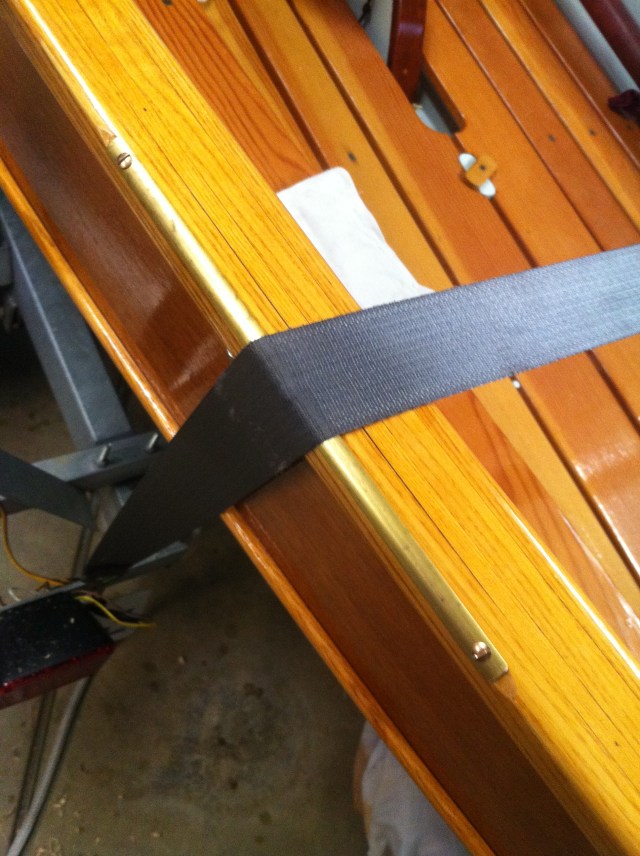
I’ve use terry cloth, folded felts, carpet, carpet with tee shirt, etc. Nothing saved the varnish on UNA’s gunwale from the torture of the trailer straps while on the road. So I think I’ve come up with a solution. I made a flat on the gunwale and screwed scraps of naval brass on. They are just proud of the gunwale surface and should do the trick.

IMG_0544
varnished flat
IMG_0548
installed half oval naval brass
IMG_0549
offending strap


Luna’s Half Hull

I enjoyed carving the Ducker model so much that I wanted to try another. This time of Luna. Here are pics of the early progress. In removing the last bit from the keel I accidentally buzzed off the tail end of the keel. This gave me the “opportunity” to add that corner back as a delineation of what would be the lead ballast per the lines drawing.

IMG_0411
botched trailing keel corner and tick marks for fairing


IMG_0412
added “ballast”


IMG_0505
rudder added. cardboard stations beyond.


IMG_0506
ready for hanging
IMG_0537.JPG
hung

I’m learning as I go. Too late for this one, but I just rediscovered an old Rudder Magazine article on model making by none other than L. Francis himself, I’d like to do one more. In his description I realized there may be a quicker way to remove the waste wood by not gluing the lifts, tracing the lower lift onto the above lift and separating the individual lifts to work on each separately. Once the majority of the waste wood is removed, the lifts can be rejoined and tuned for the final finish. Rewarding projects. What might be a next go?

Intro to Dinghy Cruising

A fellow boater, Doug, sails both a Marsh Cat and a comparatively voluminous Cornish Shrimper (both excellent cruisers). The latter is quite luxurious and perhaps doesn’t qualify as a dinghy cruiser, but sometimes added comfort is most appreciated. I can recall a late Fall cruise last year, sitting below in his Shrimper, four friends, sharing stories, drinks and relishing the warmth produce by the chef’s stove. Thanks Doug!

Anyhow, he shared a wonderful video “The Homely Dinghy” by a Brit named Roger Barnes whose Ilur design by Francois Vivier fits the dinghy cruising bill marvelously. Barnes has a book on my list to read called The Dinghy Cruising Companion. It now has moved up in line.

I discovered a couple more of Roger’s videos and want to pass them along too. So, here they are, in varying degrees of length and specificity, short to long. Enjoy. I did.

This last video features the UK Dinghy Cruising Association. Interesting site loaded with tidbits. Barnes is the DCA President.

Spring Outfitting

I’ve a trip planned for LUNA either late April or mid May. Duration, 7-10 days. Longer than any trip with her thus far, it will offer a good opportunity to see what she can do. I’d love to sneak up the Eastern Shore through Tangier Sound, through Hoopers Straight and around into the Choptank to visit Oxford, MD and then return down the western shore of the Bay.

To get ready there is a to do list:

  • varnish forward hatch and spars.
  • wash down the interior to kill any mildew.
  • wash both sets of sails.
  • rework the jiffy reefing.

The list may be short, but it represents a lot of time so, we have begun varnishing what we can do at home.

The hatch has been scraped, sanded and given 2 thinned coats so far. The old acrylic port was so checked, a new one wash made complete with stepped edge to match the recess in the hatch. This will be set in Dolphinite and clamped in place with bronze rings on both sides.

The 2 booms have had their hardware removed, have been sanded and a coat of full varnish applied.

To wash the sails, I want to hang a block in a backyard tree to hoist sails via halyard to scrub them.

The reefing set up will take some study and maybe a turning block on the main boom for ease of use.

All of this is more distraction that needed when life has already given enough lists, planned and otherwise. Nonetheless, we’re off and running. The days are getting warmer. Daylight increases. The dream is being stoked.

This slideshow requires JavaScript.

Rozinante Specifications

8c8ec-img_9361

Hull Type: Long Keel Rig Type: Masthead Ketch
LOA: 28.00′ / 8.53m LWL: 24.00′ / 7.32m
Beam: 6.33′ / 1.93m Listed SA: 270 ft2 / 25.08 m2
Draft (max.) 3.75′ / 1.14m Draft (min.)
Displacement: 6550 lbs./ 2971 kgs. Ballast: 3360 lbs. / 1524 kgs.
Sail Area/Disp.1: 12.38 Bal./Disp.: 51.30% Disp./Len.: 211.52
Designer: L. Francis Herreshoff
Construction: Wood or FG
First Built: 1952 (Luna- 1974 at Smith and Rhuland in Nova Scotia)
RIG AND SAIL PARTICULARS
I(IG): 24.00′ / 7.32m J: 8.00′ / 2.44m
P: 27.80′ / 8.47m E: 12.50′ / 3.81m
SA(Fore.): 96.00 ft2 / 8.92 m2 SA(Main): 173.75 ft2 / 16.14 m2
Sail Area (100% fore+main triangles): 269.75 ft2 / 25.06 m2
Sail Area/Disp.2: 12.37 Est. Forestay Length.: 25.30′ / 7.71m

Sooty Tern Specifications

f6763-img_5079

Hull Type: Double Ended Clinker Rig Type: Balanced Lug Yawl
LOA: 19′-8″/ 6.0m LWL: 16′-3″ / 4.95m
Beam: 5′-4 1/2″ / 1.64m Listed SA: 119 ft2 / 11.06 m2
Draft: 21″(bd down.)/ 8″ (bd up.)
Hull Weight: 300 lbs./ 135 kgs. All Up Weight: 400 lbs. / 180 kgs.
Disp. @ DWL: 870 lbs./ 400 kgs.
Designer: Iain Oughtred
Construction: Wood (clinker ply)
RIG AND SAIL PARTICULARS
SA(Fore.): 102 ft2 / 9.47 m2 SA(Mizz.): 17 ft2 / 1.57 m2
Sail Area (100% fore+mizzen): 119 ft2 / 11.06 m2