Sand Jam Thumb Cleat Epoxy

Boat work has been sporadic. Things are getting done, but when so much of it has been fairing and sanding … what is there to report? Nonetheless, here are some items for the record.

  • I bought this little paint scraper that is fantastic in combination with careful use of the heat gun.
1.5″ wide scraper. Good addition.
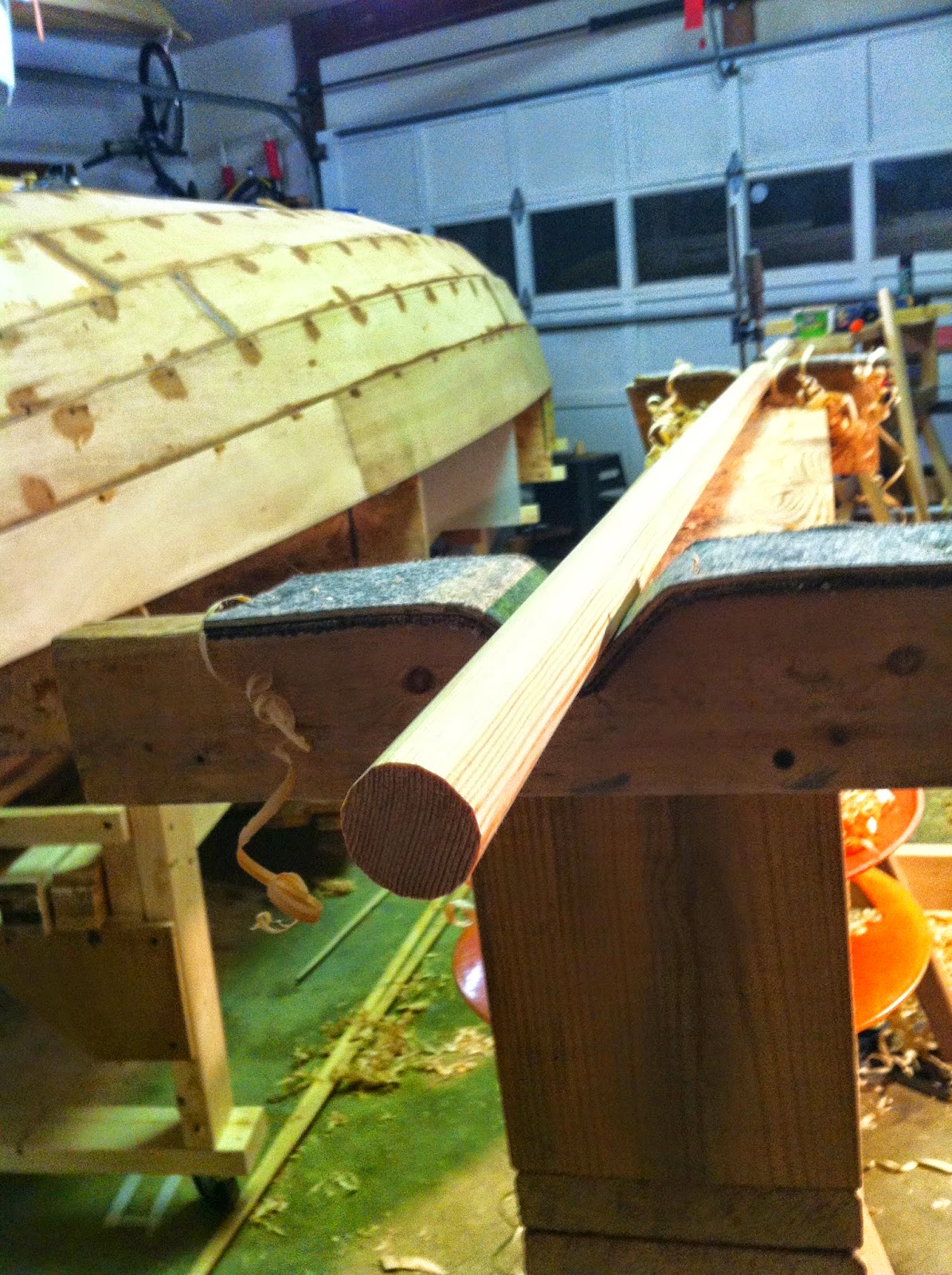
  • I fabricated the jaws for the mizzen boom from cherry scraps. I decided to angle them to better receive the mast. Ganging them together allowed for easy belt sanding. Glued, screwed and plugged here:
Jaws ganged for sanding.


Starboard jaw attached.


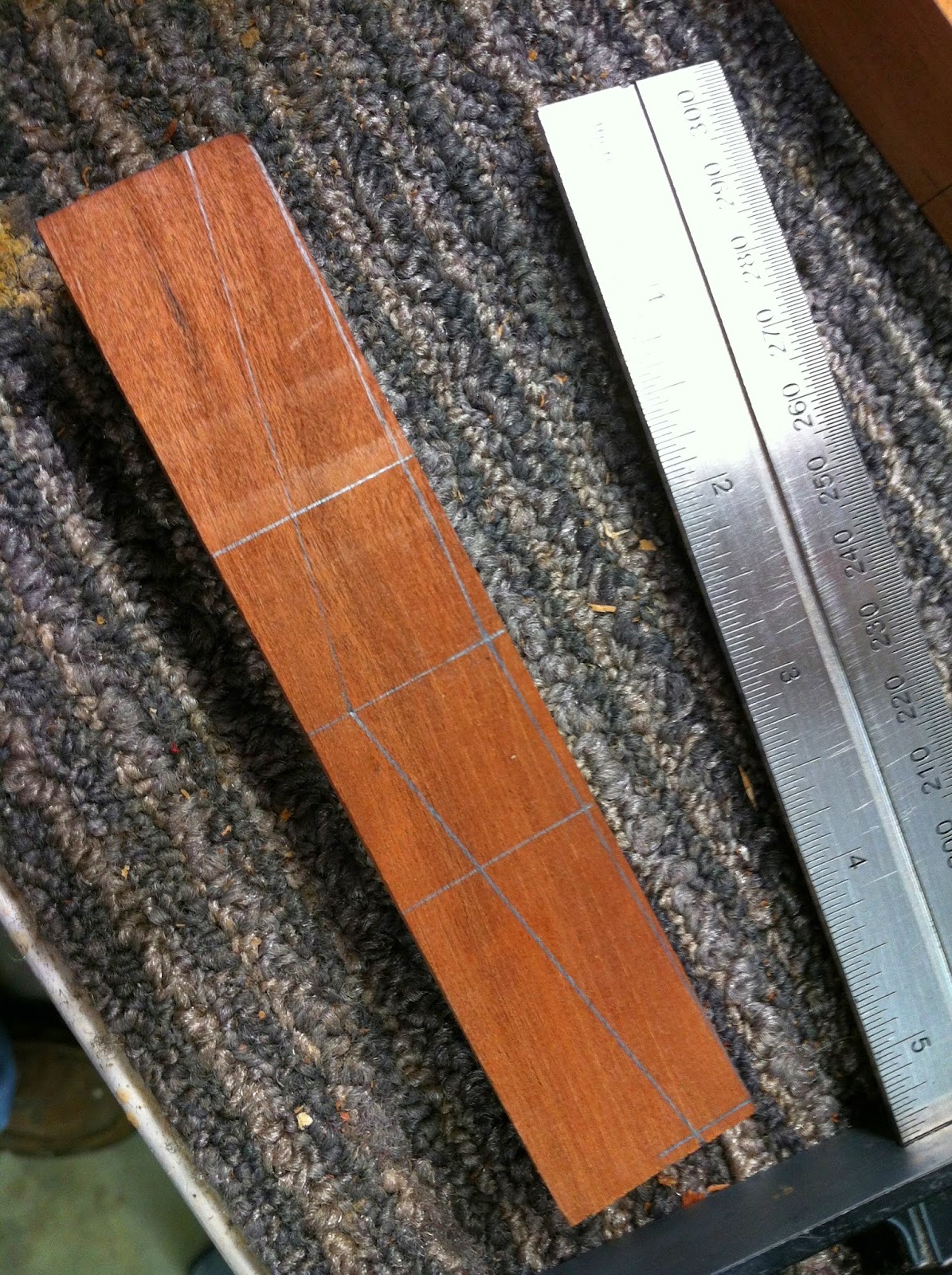
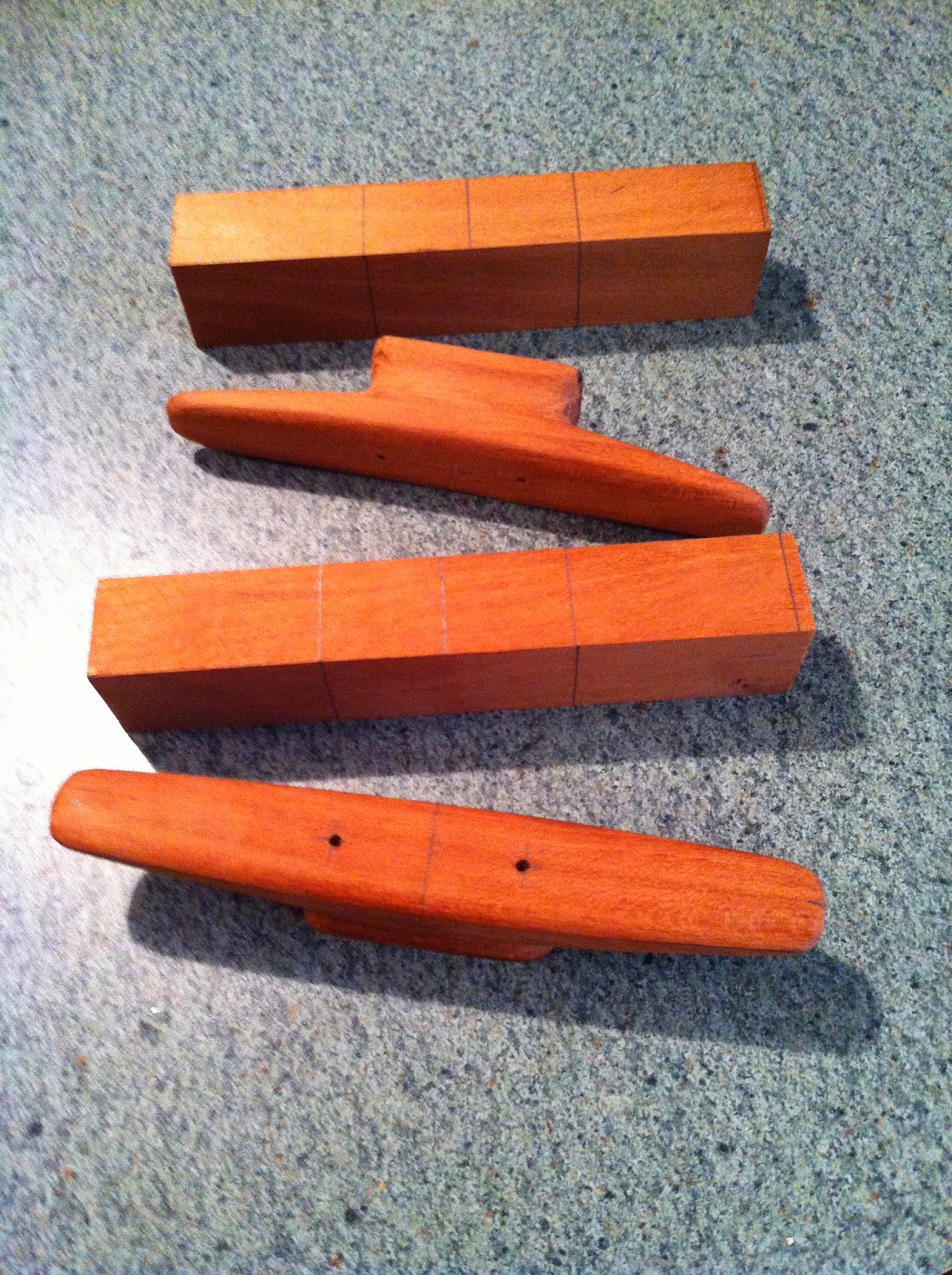
  • I’ve a couple old Herreshoff open base cleats that I’ll likely use bow and stern, but there are a few jam and thumb cleats needed for the 2 booms. I found a photo online that I adapted for this application. All done with drill press, jig saw, belt sander, file and sanding block. A final hand sanding will precede shellac and varnish.
Jam cleats.


Thumb cleats.


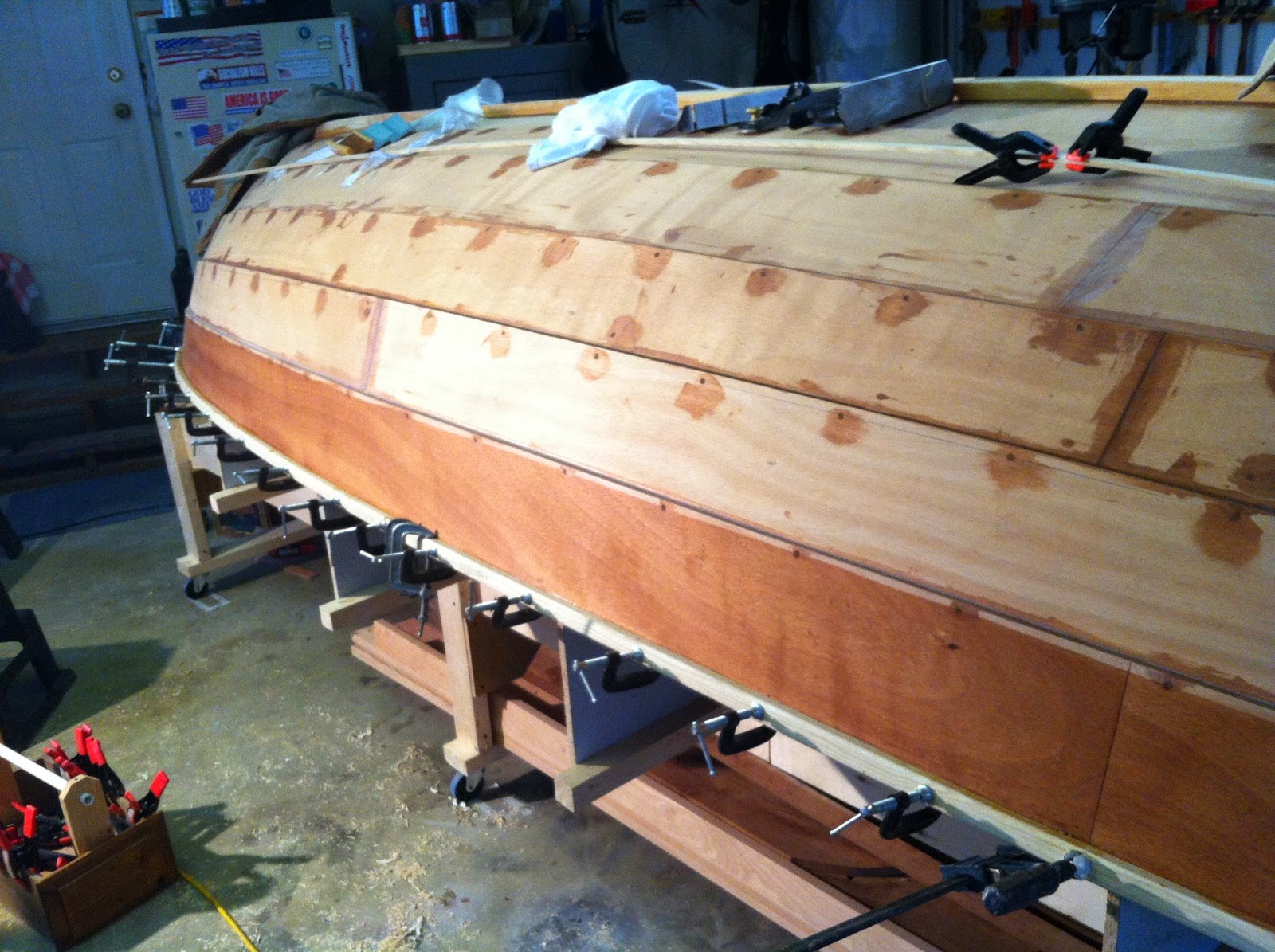
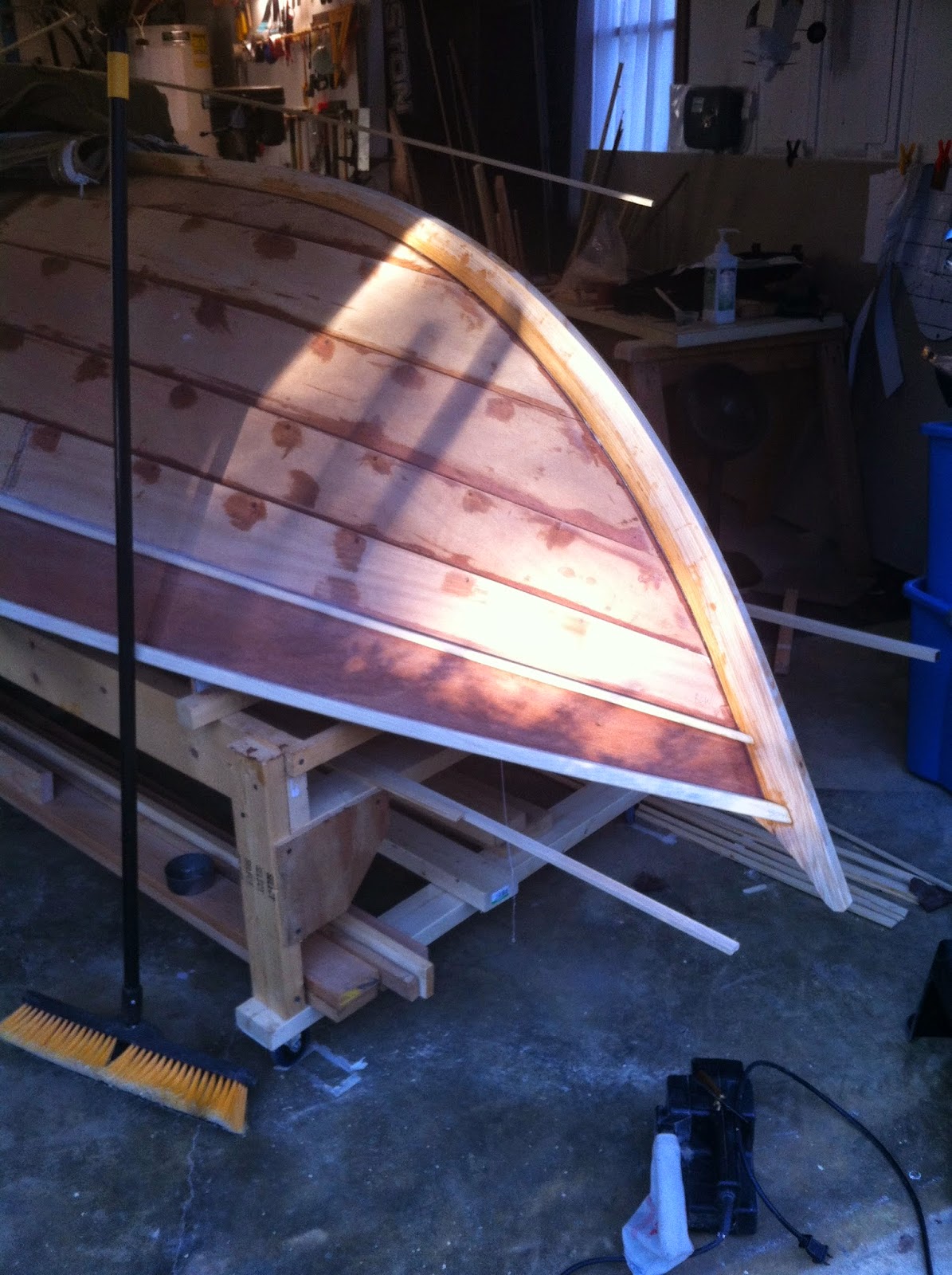
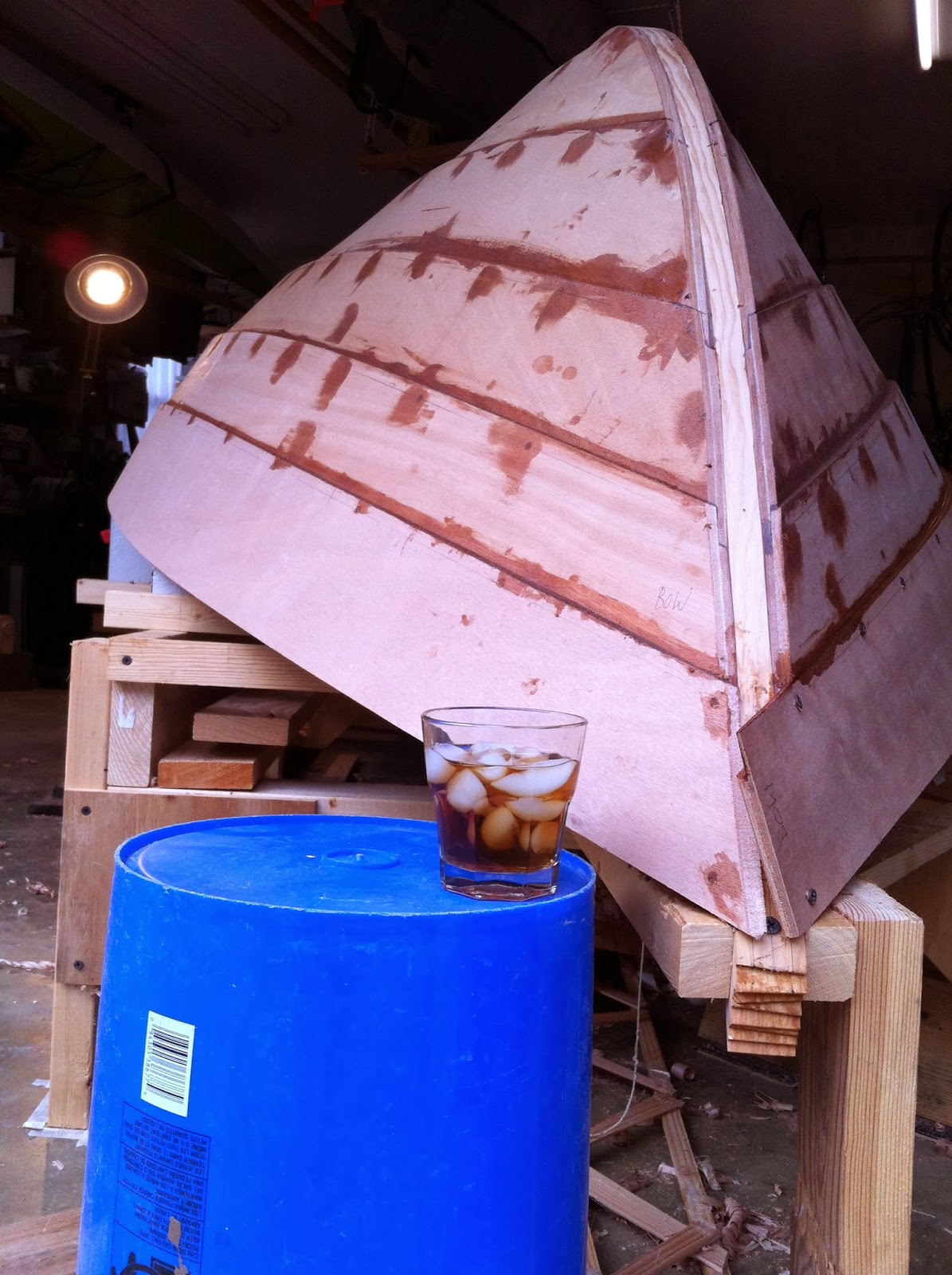
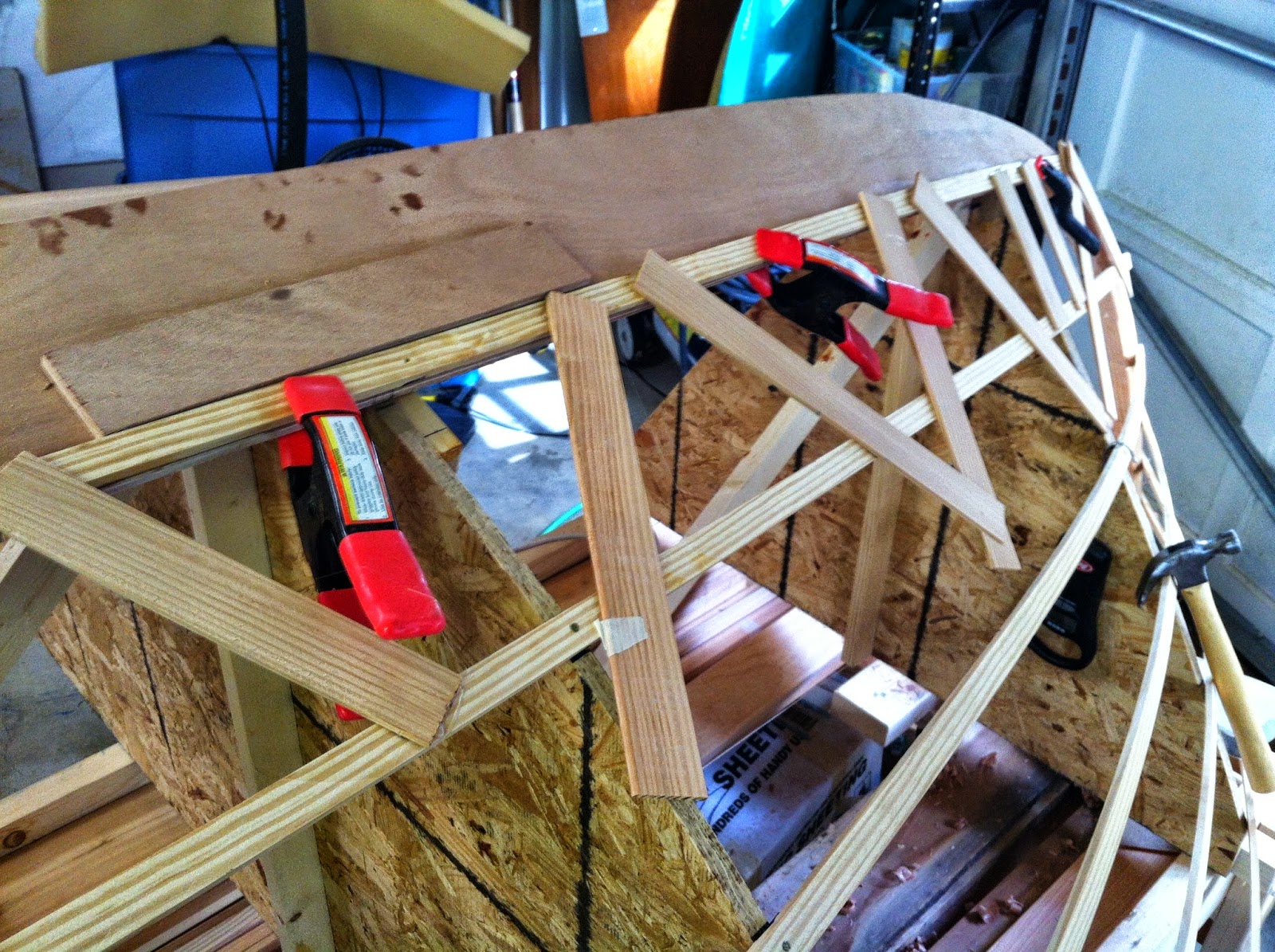
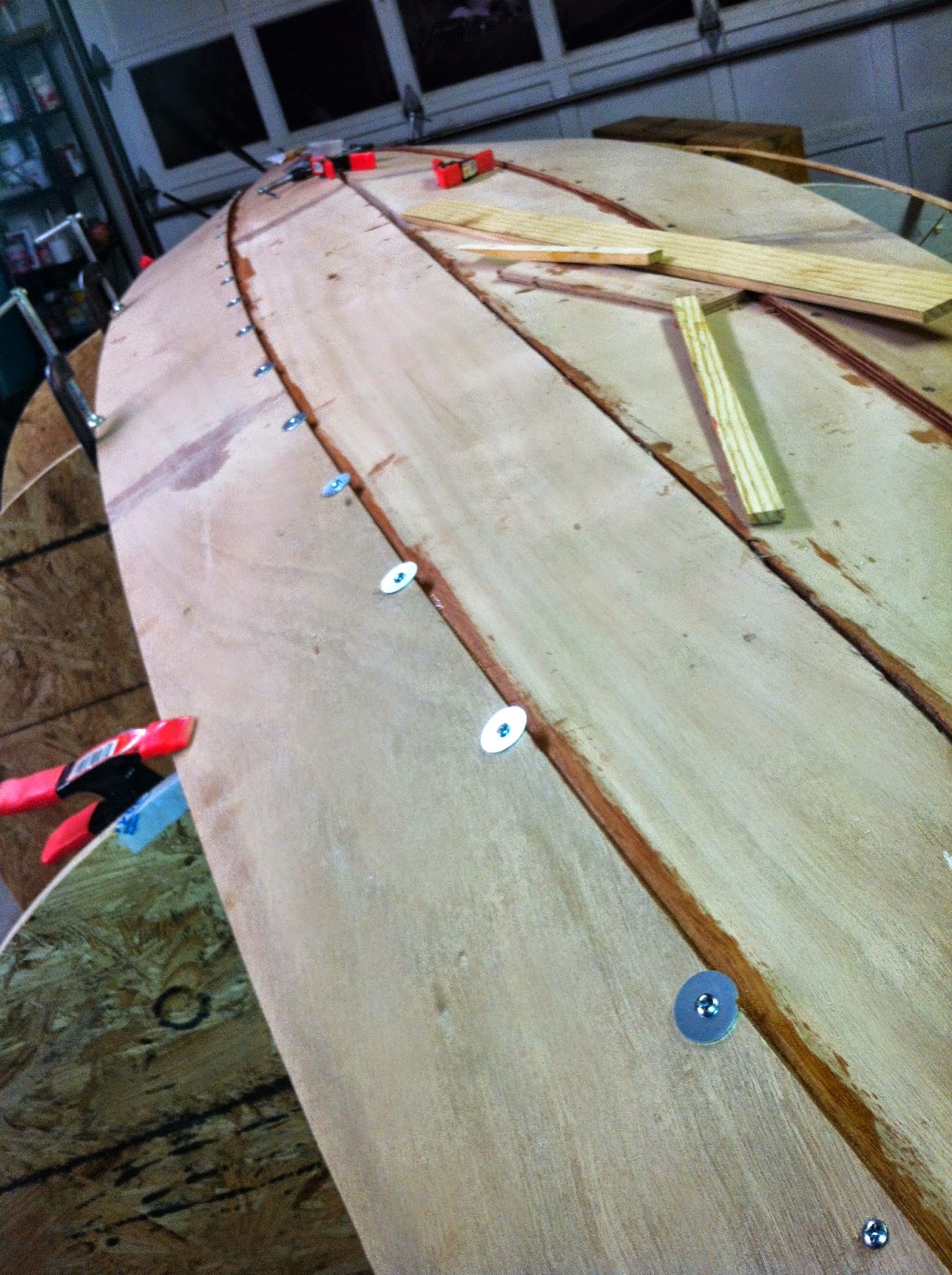
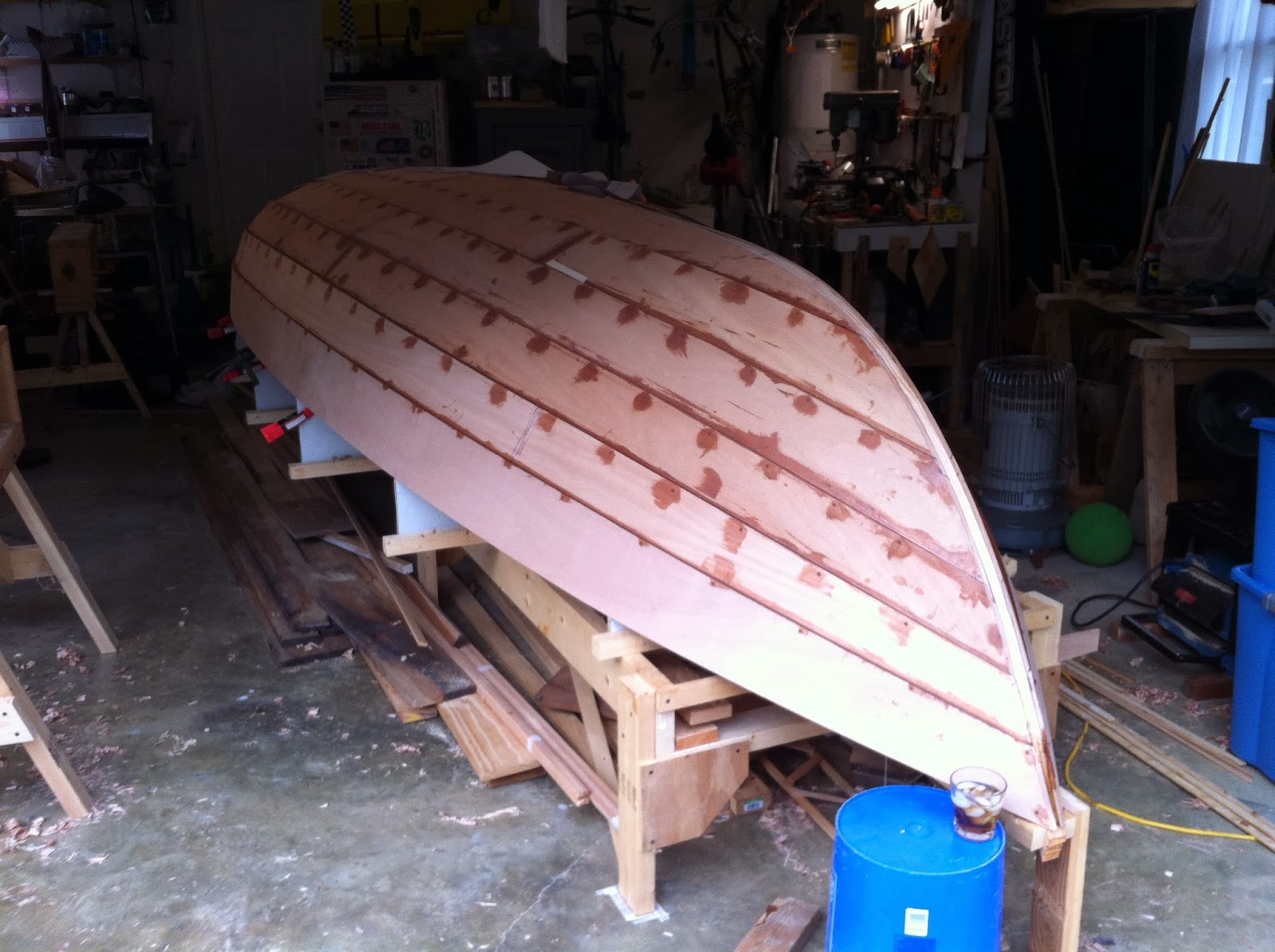
  • Lastly, I got a coat of epoxy on. Mike at RAKA suggested heating up the boat and then cooling it down as epoxy is brushed on. He said the wood pores would open and soak up the goo. This I did with about a 10% thinning with denatured alcohol. A few areas got a bit thick and exhibit some sagging which will require more sanding. The random orbital sander should make it quick work. I may be able  to then prime for paint. We’ll see.
Stern.
Dark laps are where the “purple” fairing compound is.

So, Its the New Year! Where are we?

Happy New Year! We’re looking forward to longer days and the eventual warming trend. The Holidays were busy and good. Enjoyed seeing the family.

I did slip in some work on the boat here and there. Save for the starboard outwale, I’m right where I had hoped to be. She is ready for some finishing and really looking like a boat! A sweet one at that. The thought of that first sail drives me onward.

I’ll list the tasks:

  1. a 3/16″ x 1/4″ (6mm) strip of ash was epoxied after trimming the shear.
  2. out wale edges were rounded over with a 1/4″ rounding bit on the jury rigged router table. Thankfully the plunge router stayed still. It has “adjusted” itself before to terrible results. None this time. I will further shape the top outer edge once boat is upright. That edge is about 1/2″ round, but has some rolling bevel to it. Hard to judge it upside down.
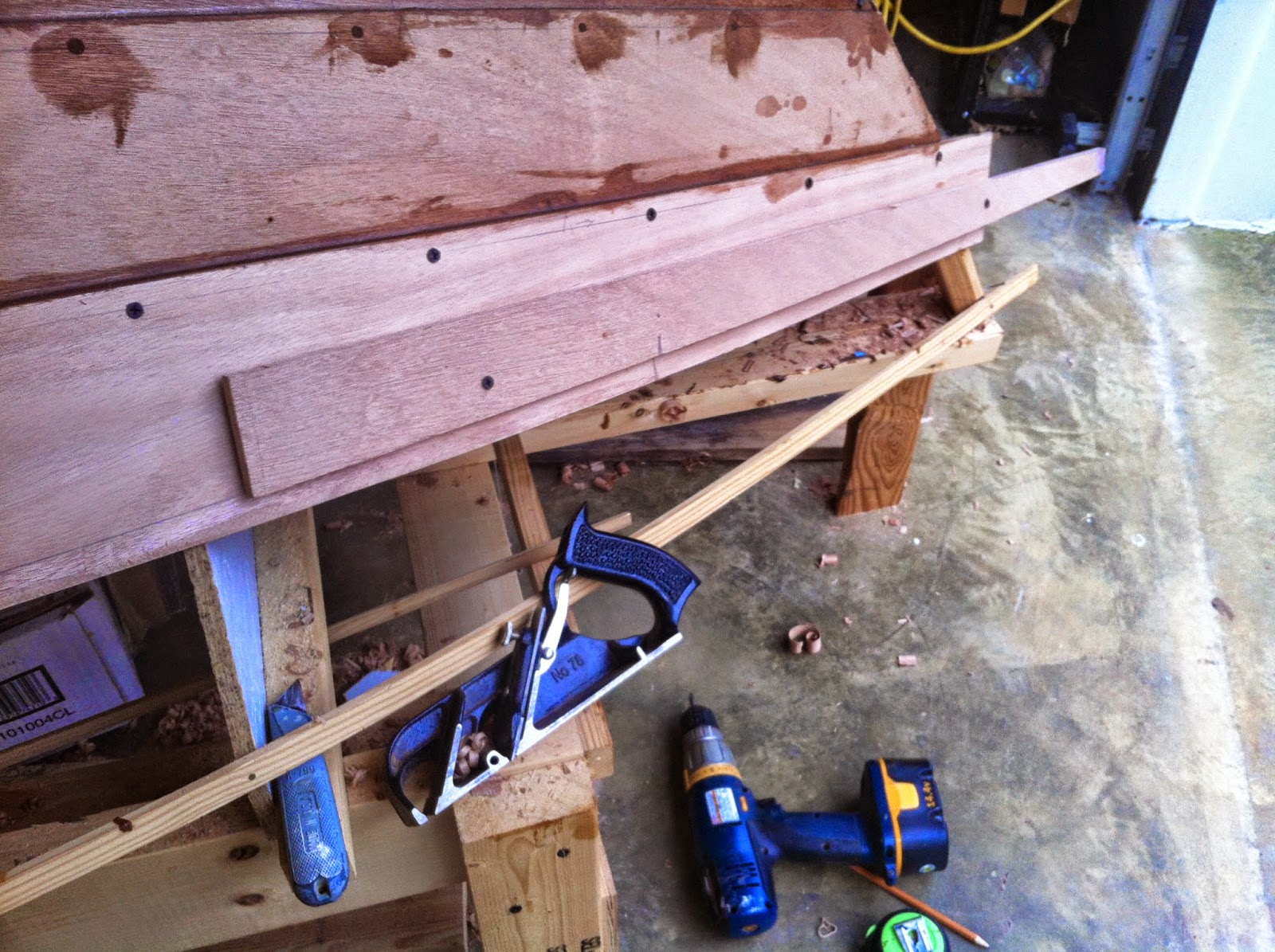
  3. outwales were scarfed with a step after some practice in pine. I used a combination of hand saw, hand plane, file, and belt sander for final fit. Got good results sneaking up on the fit.
  4. out wale ends were fitted to stems with small bevel and belt sander finesse.
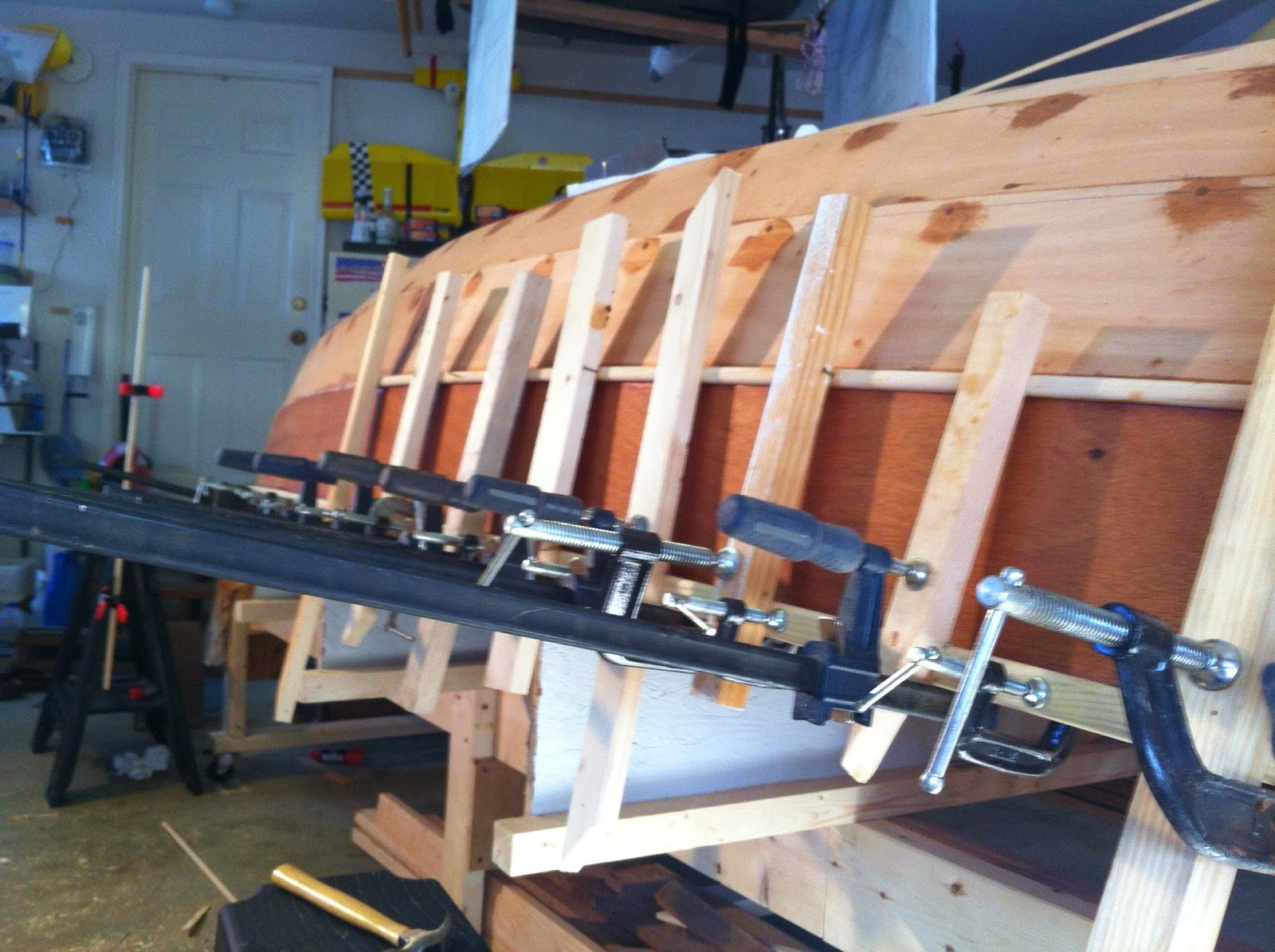
  5. I epoxied the outwales on and then could reach the small 1/2″ rubstrake I added. A first attempt to nail the strake on was a fail. The hammer just bounced, even after drilling pilot holes. Aesthetically I did continue the holes every 12″ for accent. The solution was to overreach the out wale with a clamp and 2x material every 8″. Worked fine.
Ash shear trim to hide and protect shear ply edge.


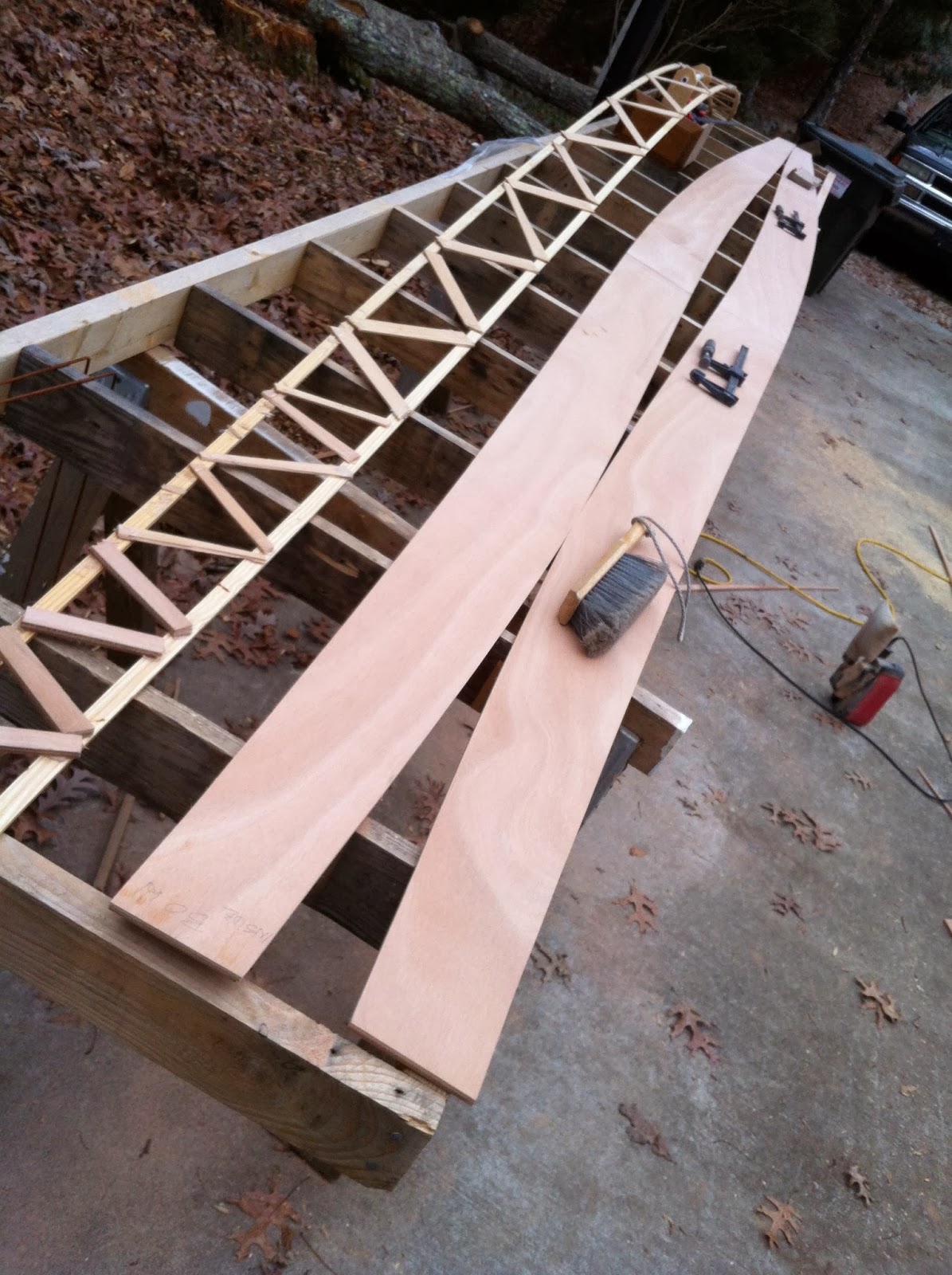
Long shot of outwale clamping and stained shear plank.


Fitted outwale at bow


Outwale clamped.


Rubstrake clamping.


Clamping and nails. Nails failed really.


Port aft quarter.


Port bow.


Looking like a boat.
Graphite powder for the centerboard and reddish phenolic micro balloons arrived for fairing. That is the next step really. Tally-ho!


Keel, Stems and Boomkin

Got some key things accomplished on the “you know what” this weekend. They are:

  1. trimmed the shear back 1/4″ for a sliver of ash to cover the ply edge.
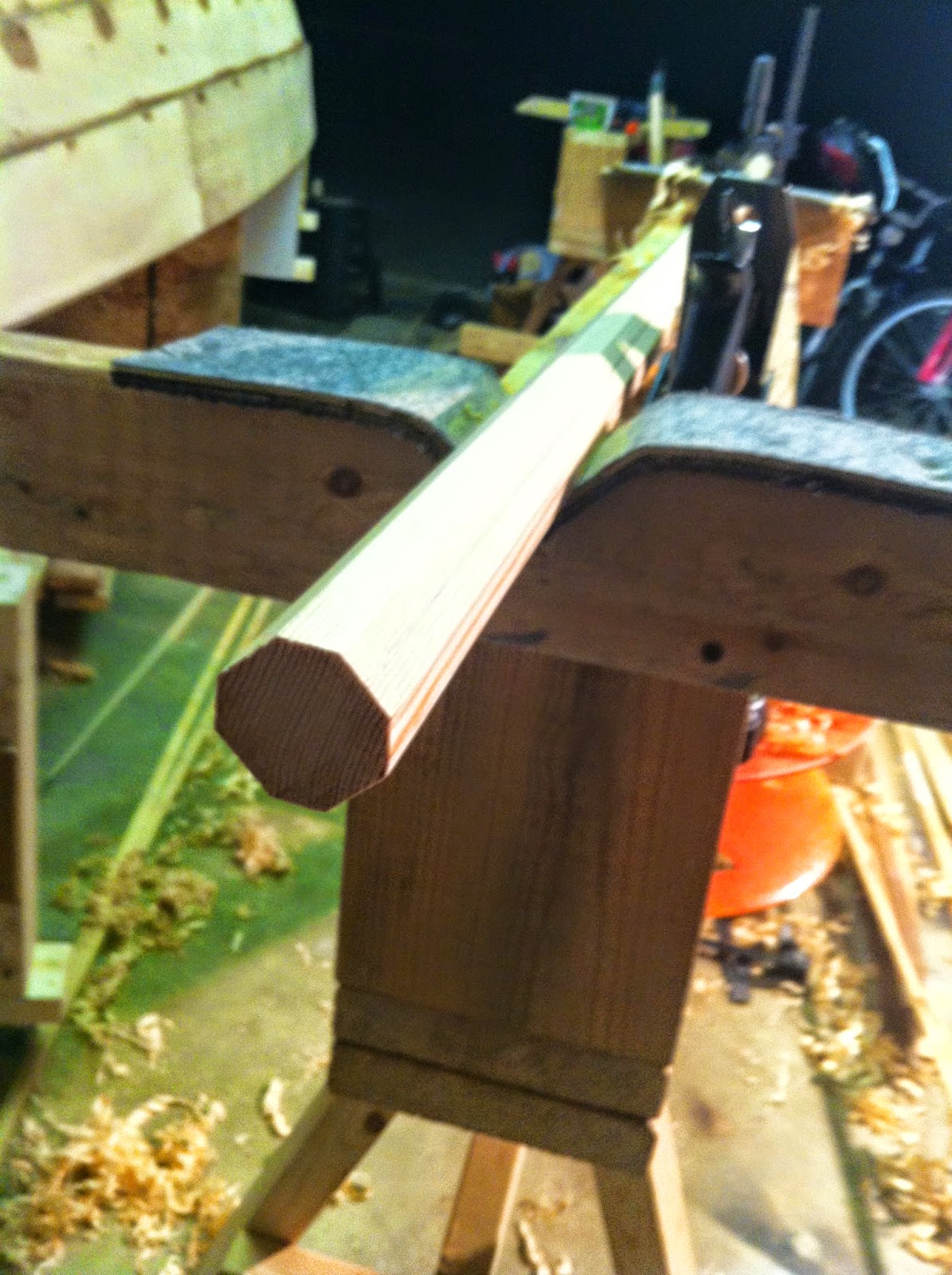
  2. cut, planed, shaped and sanded the boom kin.
  3. attached stems and keel. Shaped both.
  4. watched the Redskins choke again.
So, here are some photos.
BOOMKIN
Bench with boomkin stock.
Boomkin 8-sided.
Boomkin 16-sided.


STEMS

Bow stem and template.
Markings from template
Rough cut of stem.


KEEL
 

Saw witnesses and chiseling.
Keel and raindrops.
Bow stem and keel shaped.


Oh, I also ordered filler for final fairing, primer, and paint. I’m dying to roll the boat over, but I’d like to get a coat of paint on while she is secured to the moulds. Much to do before that happens. C’est tout.

She’s Got Her Wheels On …

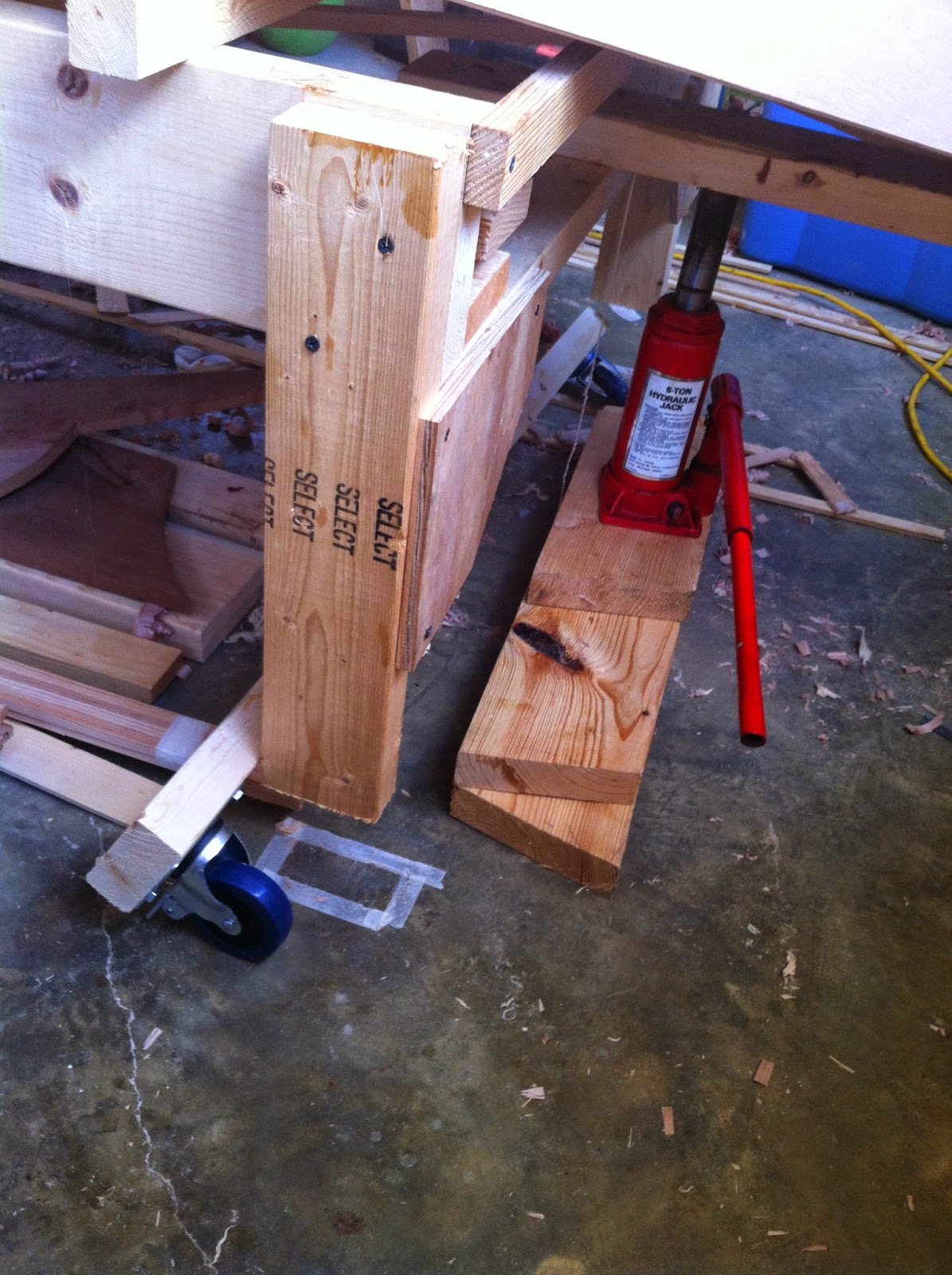
About 20 years ago one of my brothers gave me a 6 ton jack. I thought it was neat, but didn’t know when I’d get a chance to use it. Well, today was the day. I just couldn’t quite lift the end of the boat to slip in these roller skates quick enough. I dug through the shed, found the jack, and up, up, up she went. Thanks Bro!

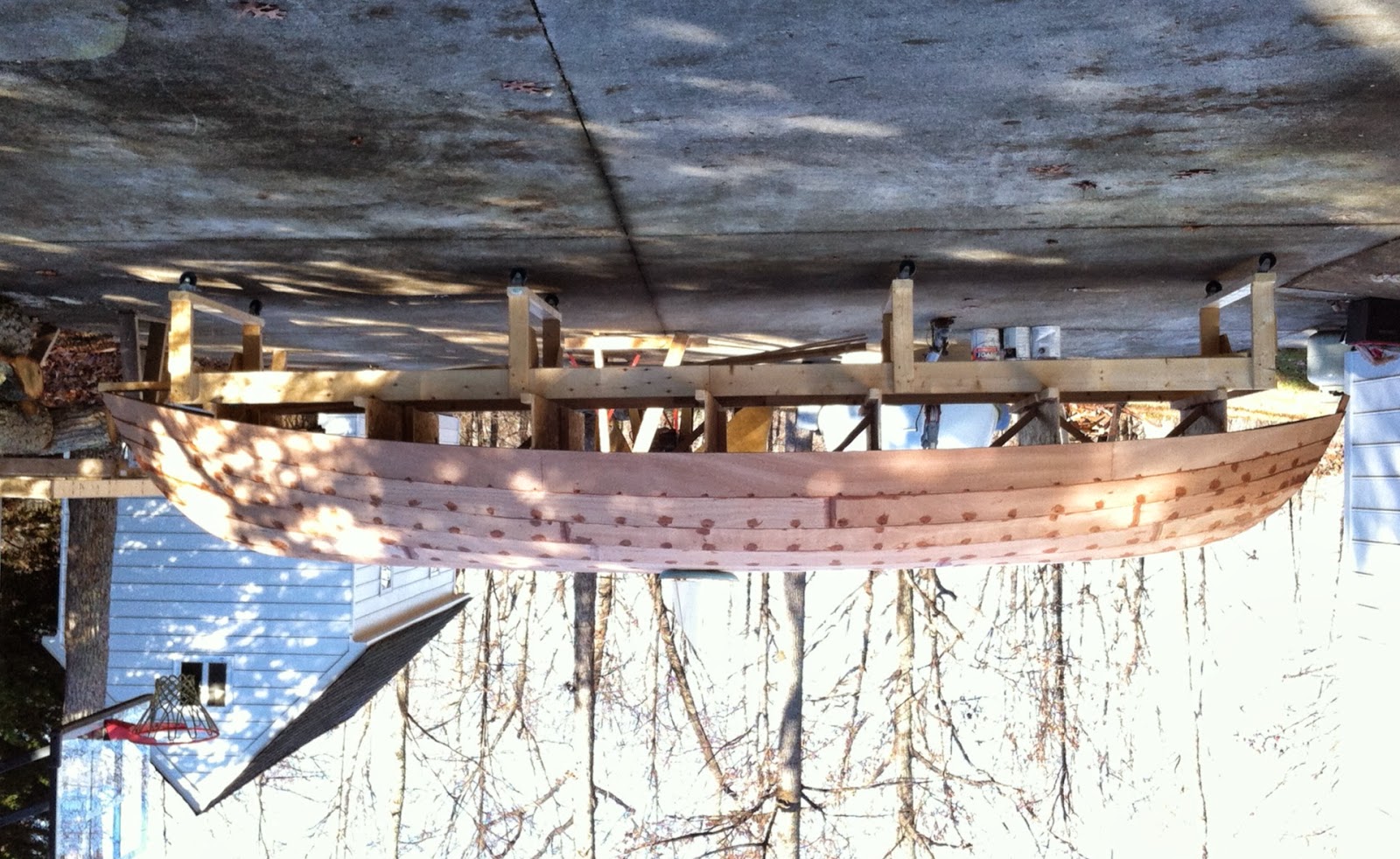
I don’t feel like pecking at this keyboard, but here are some pics from the “maiden voyage”.

Jack and skateboard


1st daylight.


port side
Inverted. Bow to left


bow


stern


That Plank

Whiskey Plank

Effort in and of itself can generate a sense of accomplishment, that a project is moving forward. There are, however, certain milestones that are particularly rewarding. Yesterday afternoon the last plank, the whiskey plank, was mounted and permanently cemented to join all those that came before it. A glass was raised in celebration and long views were attempted out in the driveway looking back into the cavern of the garage. The frame will grow wheels today and the boat will see daylight. I want a 360 degree inspection at proper distances before attaching the gunwales.

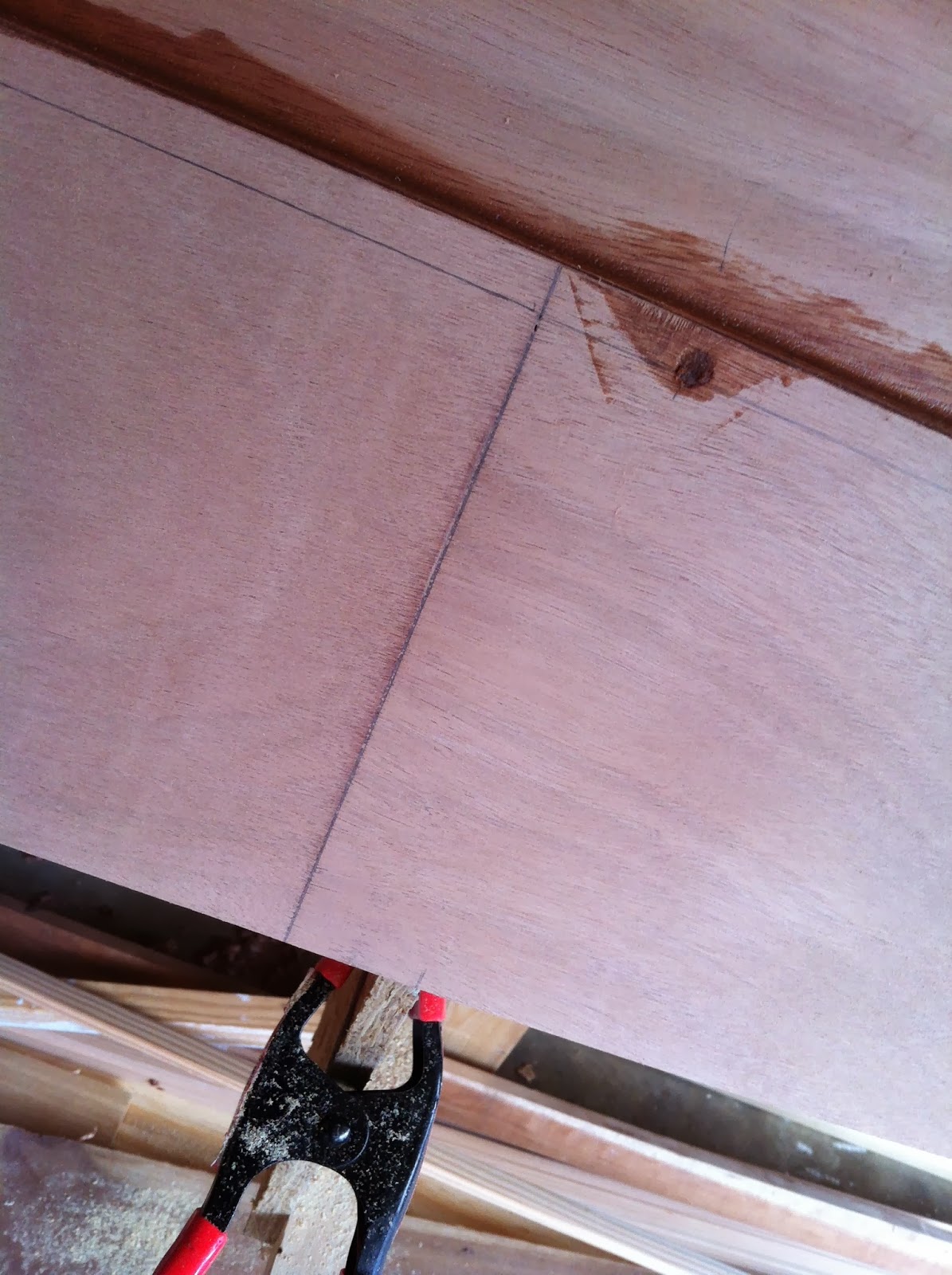
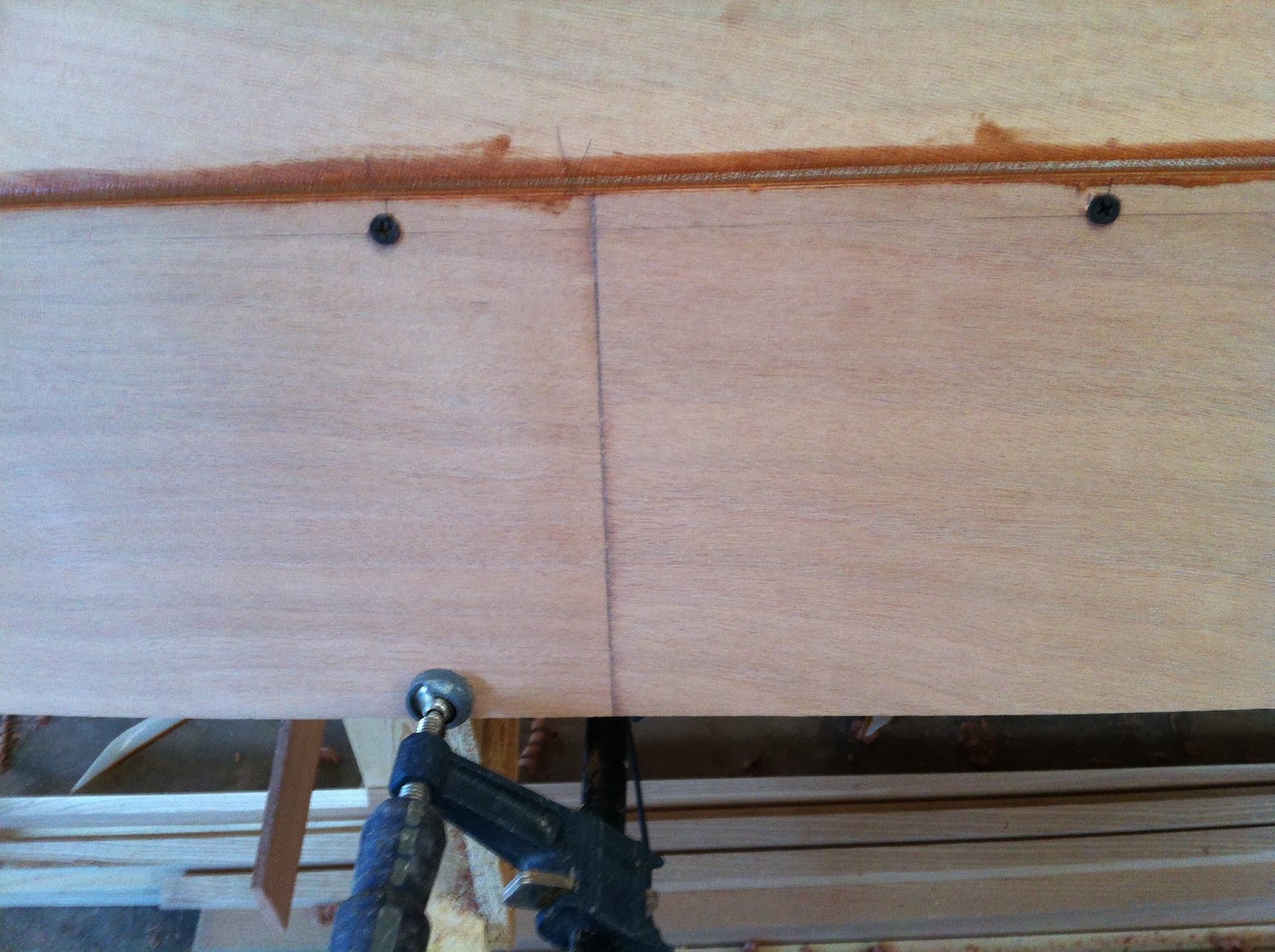
Here are a few of the cutting out process and the scarfs which should stain and finish nicely.

Port and starboard whiskey curves


typical scarf


You can tell the end grain of the ply soaked up some epoxy (can’t be avoided), but a light stain should reduce the joint’s visibility.

Screws are inside the rub strake’s footprint.

quarter view


bow view

Despite all her pocked screw holes, I think she is looking good. Now the beginning stages of finishing can begin.

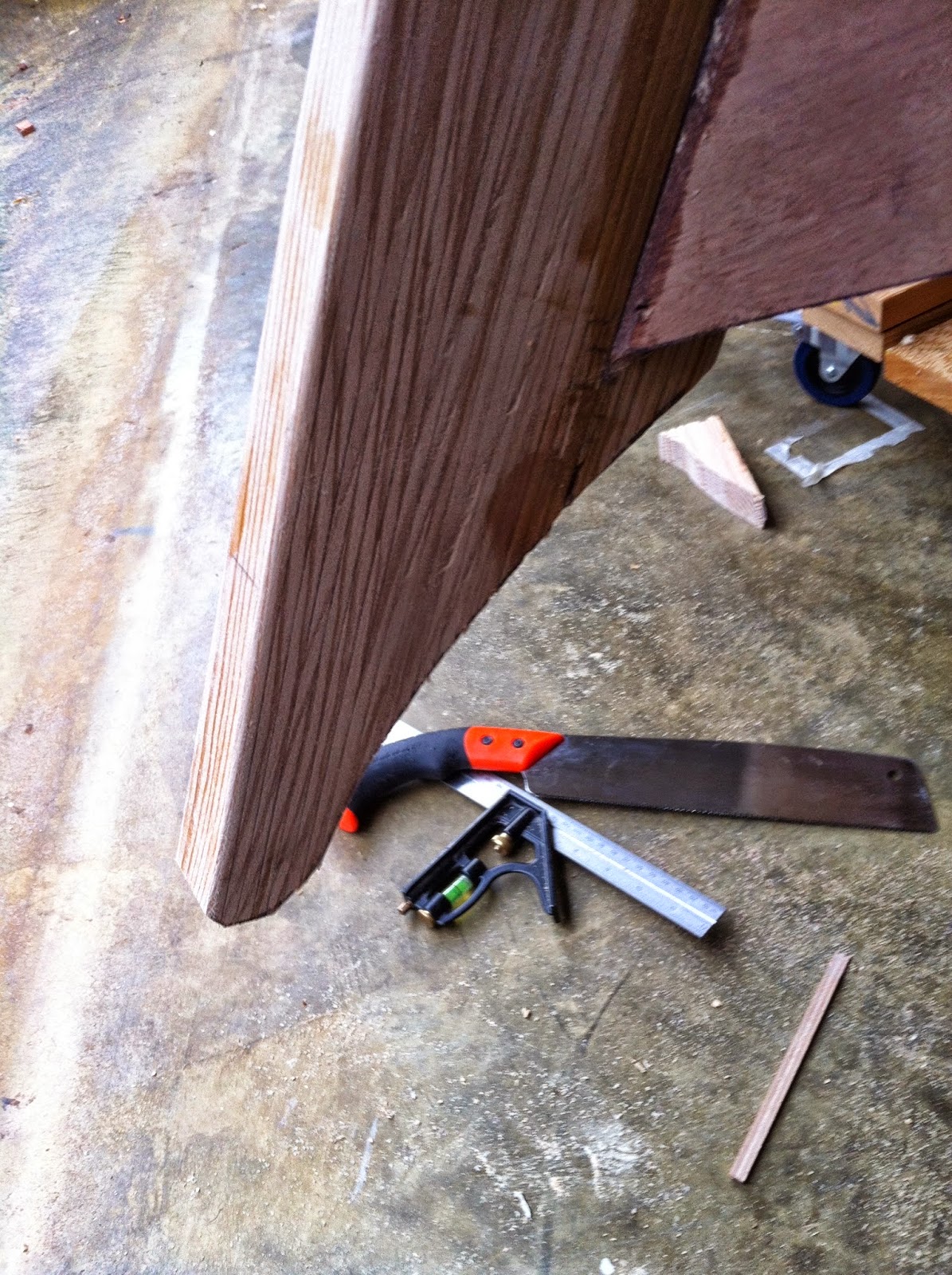
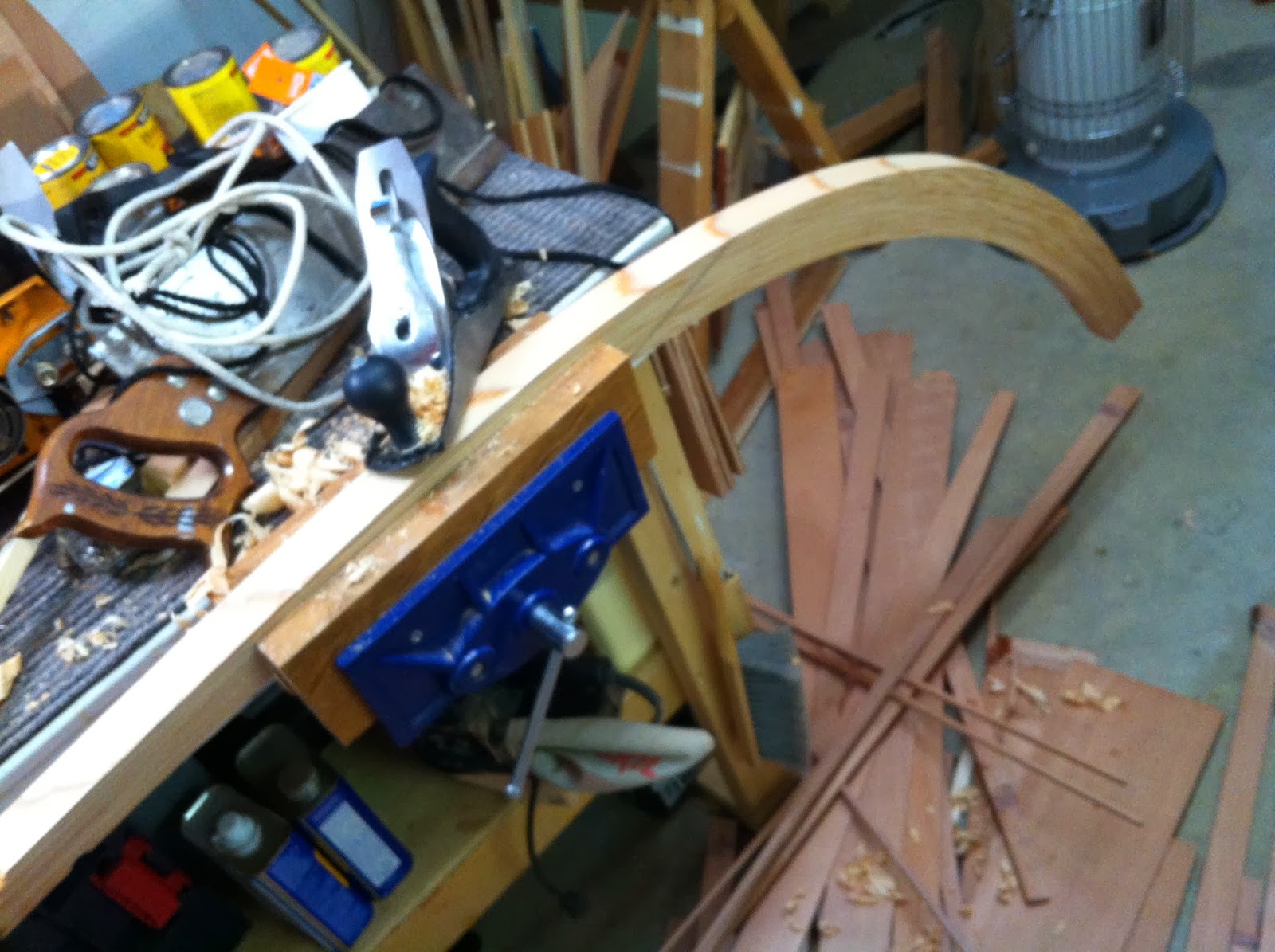
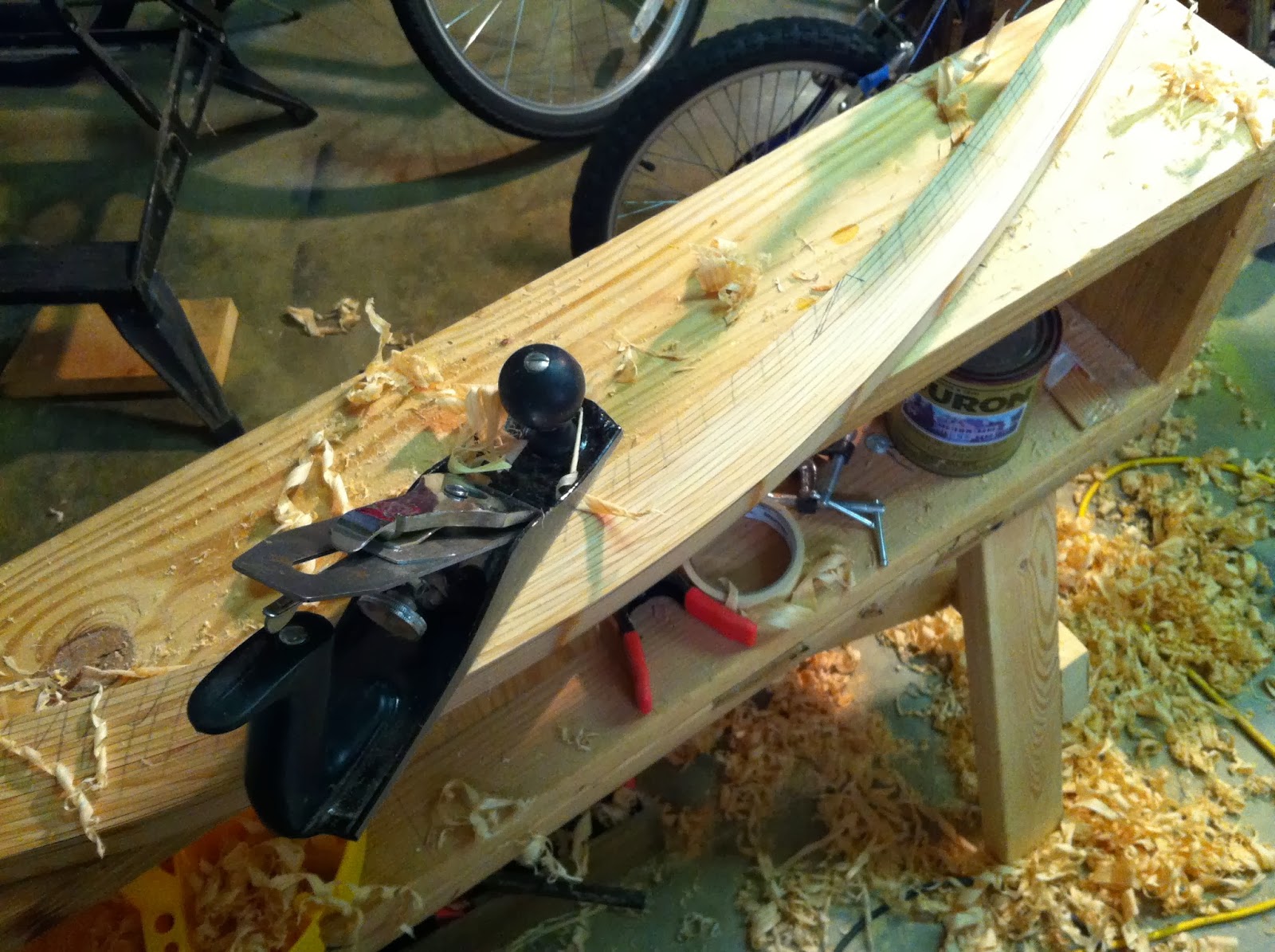
The stems have been laminated for some time. Would have been nice to have a functional band saw to cut their taper to the keel, but the hand saw got it done … eventually.

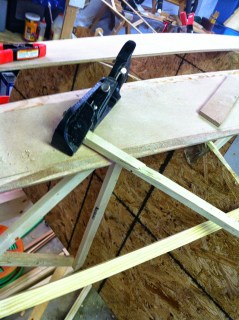
Jack plane bevelled the sides.


The belt sander with 80 grit did the initial smoothing. That’s that. More next time.

The Boat Goes On

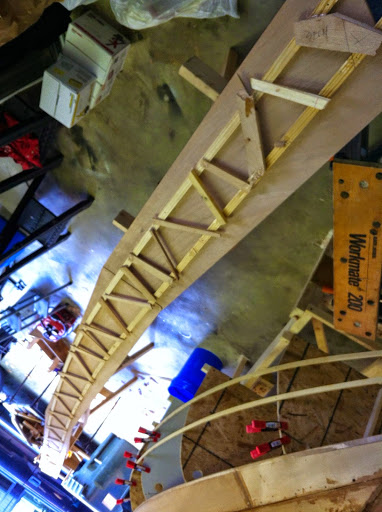
Absent, but not out … I’m close to scarfing the whiskey/shear plank. I pulled the last “truss” template last night. It is proper that this plank is last for it provides the most “show” for the boat. As the uppermost and outer edge, it has all those previous laps lifting it up. I’m frankly still not convinced that all my tweaking of the shear batten is right. A distant view isn’t possible in the now tight garage, or for that matter, out on the drive. We’ll have to wheel her out once the whiskey is down. In the meantime I’ll add 1/4″ to the shear line for safety and scribe a batten once upright and in the drive for good eyeballing.

So, planks 4 & % are on. Only the shear planks remain, and I am pausing on this. My intention is to bright finish this plank inside and out. Scarfs need to be best. The balance of the hull will be painted. I’ve made a mix from 2 MinWax satins that looks happy. I mocked up a test panel for confirmation.

Sample panel.

Paint is “Sky Blue” semi-gloss by Marshalls Cove. Bill Thomas on OCH seemed to like the ease of application for his Fox canoe. Seems to have an easier workability from the can vs. Brightsides, plus I like their color choices better. The stain is a 50/50 mix of Minwax “Golden Oak” and “Golden Pecan”. It goes well with the various cherry accents I’ve planned. I’m going to use ash for the gunwales, but model has pine now (a close color match).

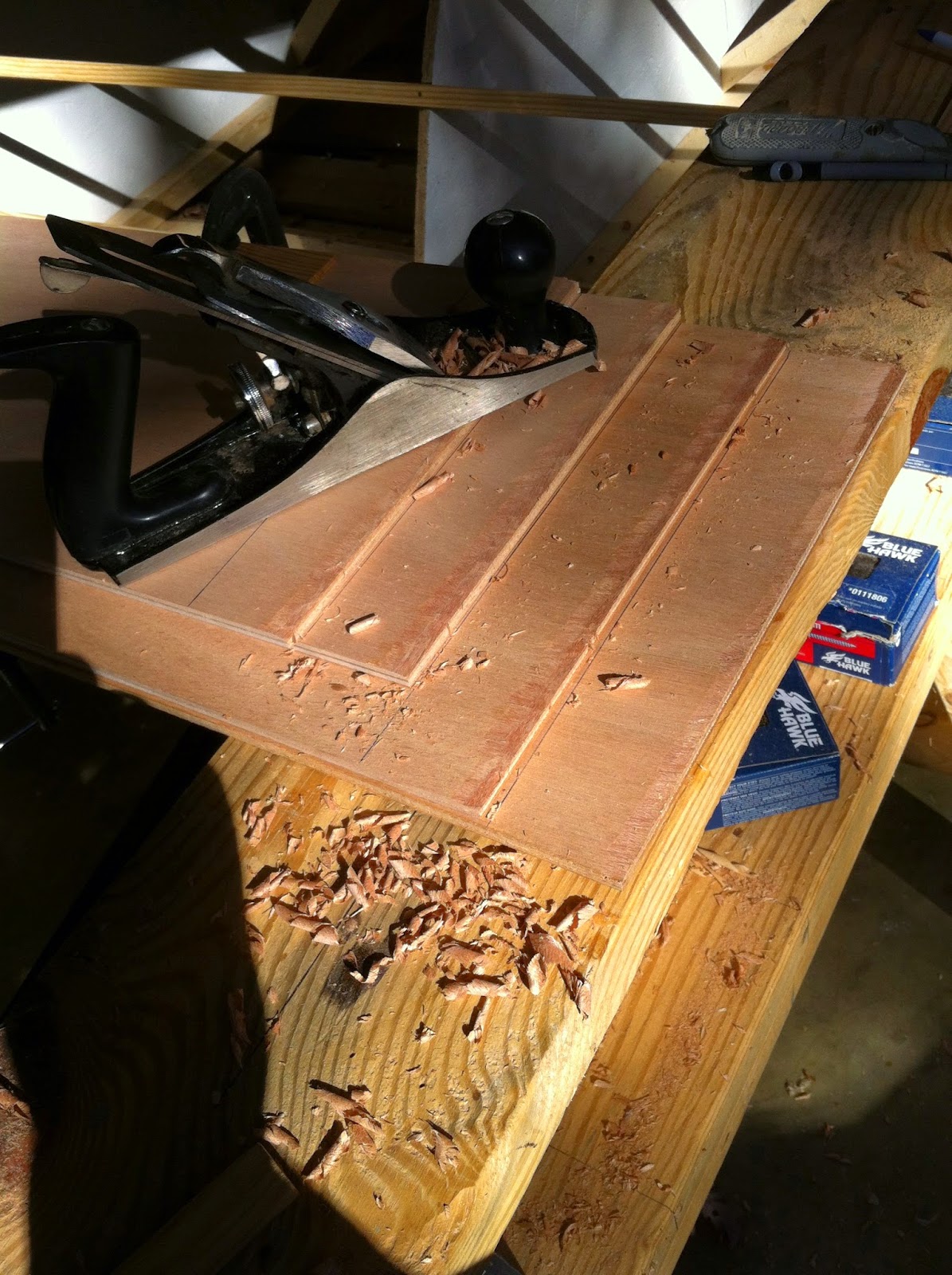
What else? Centercase slabs are cut. Here is a photo of the gain fence and rabbet plane. Works just as easily as on the manning benches. I do scribe the gain edge with a utility knife against the fence to help keep the edge clean. I had gotten some tear out previously.

 
Rabbet fence.

And one more looking forward from aft. I have 2 scarf joints together which was unintended. No issue I don’t think, but I had intended to skip a beat. I’ve maybe 145-150 hrs now from nothing to something. I’m jacked. I think I can have a new boat come Spring.

 
Tail view.
I know she looks kind of brutal with all those filled holes and roughed up stem, but finishing will smooth and make all that go away.


The shear is still vexing me (though it looks good in this photo to my eye). I’m not confident it is where it needs to be. It does match the moulds. Perhaps I should trust the drawings? Well, I think I’ll roll the whole works into the drive, paint the shear batten black or grey and study from a distance. As I say, this plank does mean the most aesthetically. Having fun!
 

Chopping Block Cinderella

As I’ve said, it is good to have other pieces of the boat to offer relief when certain tasks lose some interest. After getting some work done early this morning, I went to inspect the latest plank glue up. They were solid, but I lacked motivation to take them on. Then a look at the rudder blank proved to egg me on. I took the blank with paper template spray mounted on to the Skil bandsaw. What a piece of junk. Even a new blade couldn’t move through the 1″ stock. Just not enough horsepower. The Bosch scroll saw wins again.

Blank and template.

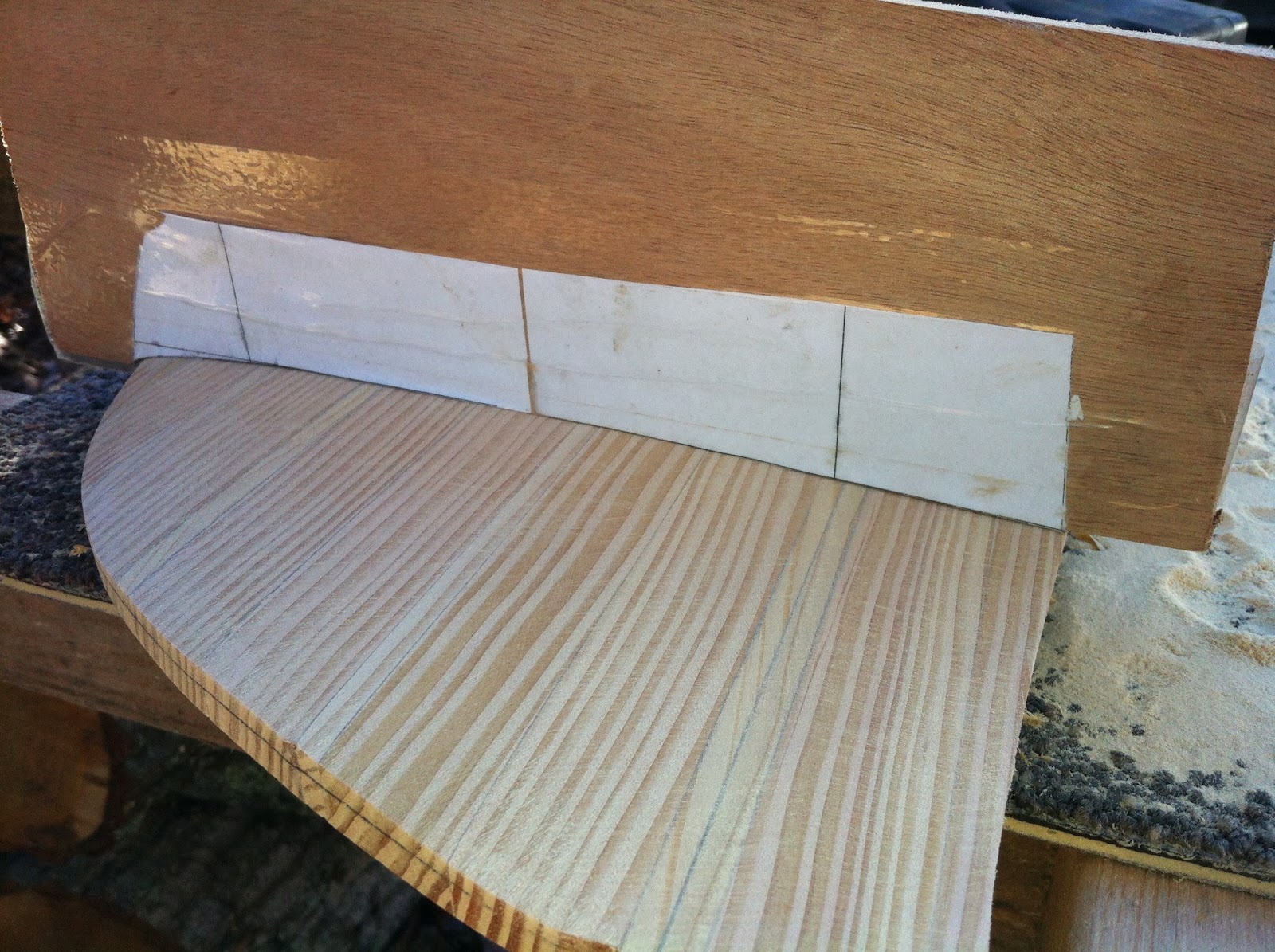
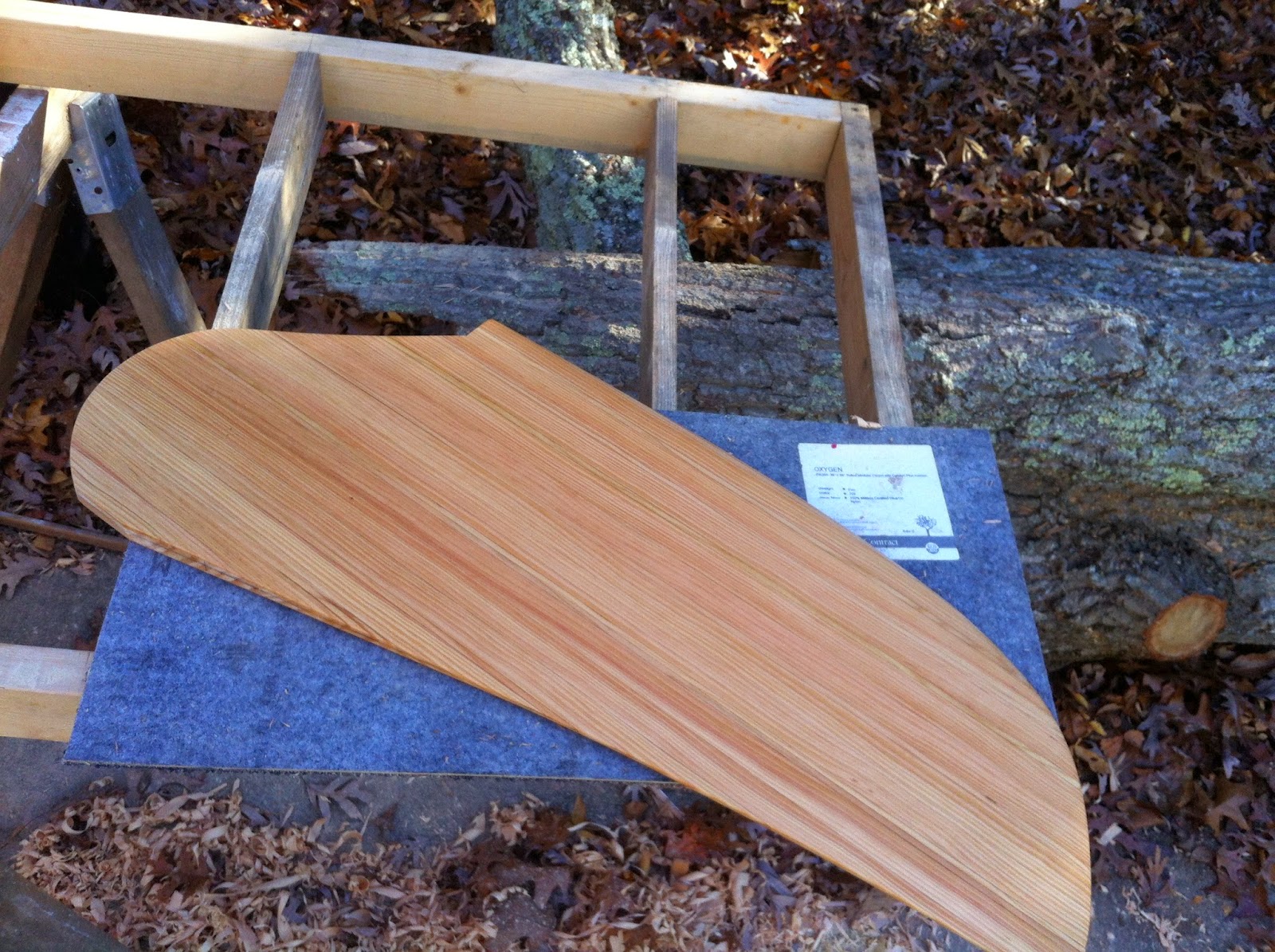
Templates for a NACA 007 foil proved a right fit for the slab thickness of 31/32″. These were paper outlines glued to 1/4″ ply, saw cut and filed to the outline. Loads of jack planing approximated the shape well enough for a controlled sanding of 80 grit in the belt sander. The result: a tapered foil that is ready for final finish sanding and glass. I’m very happy with this. What a transformation. She is now a princess.

The day is gorgeous, 68 degrees, sunny and breezy. Being outdoors for a couple hours made for a nice break. Don’t think sailing wasn’t contemplated.

Now back to designing mundane buildings. Pay is still better!

Foil template testing.


Near done shaping. Some final sanding needed.


Another shot with mineral spirit rub.


3 Planks Down, 3 To Go

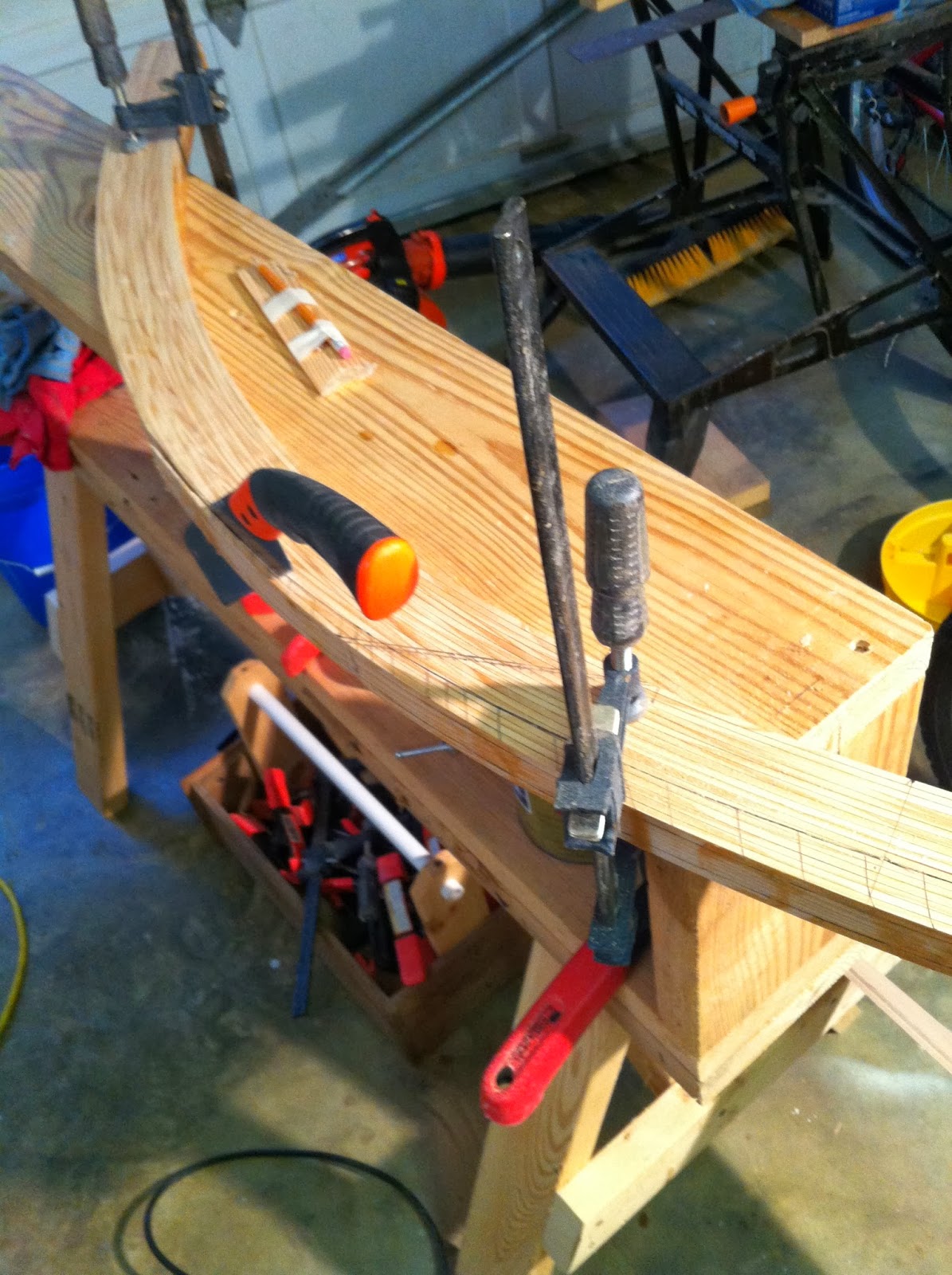
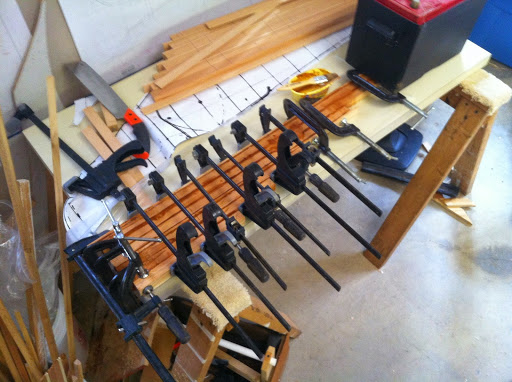
A cold front has moved in and the garage temps were so low that Friday’s scarfing hadn’t quite set. So, I fired up the kerosene heater and began work on the rudder foil. I elected to make the bladed out of epoxy laminated douglas fir. No real reason other than I thought this plywood boat deserved something other than plywood foils. From a 5/4 x 3x 10′ board I was just shy of completing the rudder’s width. Since I had some cut offs from the spar staves, I slipped those in to complete the required width. End grain was altered to eliminate any warping of the final blade. I also am planning to glass the whole affair as added protection. My intention is to varnish the end result. since my planer is limited to 10″ widths, two halves were glued up, planed and after a pass through the jointer, glued together. A full sized template helped in the layout.

Rudder half clamped.


Paper template on stock.

I’ve bought new blades for my 9″ Skil bandsaw and I’ll be curious to see how well it cuts. The blade that came with it was rot. It dulled after a few cuts in plywood. We’ll see what Bosch blades do.

Otherwise the planking went on. I’ve got it down now. The laddered batten templates are very accurate. I cut 2 full planks at a time taking care to just skirt the penciled trace of the template. Judicious use of the jack plane and belt sander provides a gentle curve. The beveling and cutting of gains has now got a rhythm too. Waiting for the epoxy is what is holding back now, but I do glue both plank stocks at the same time.


Stock laid out and template set to confirm fit.


Nails in pilot holes confirm positions of scarfs.


wetting scarf before thickened epoxy.


Wax paper separates 2 planks for simultaneous clamping.
I dorked the corner of 2 scarfs. Luckily they are outside the final plank outline.The Manning benches are awesome. At 36″ they handily make a convenient work surface and can be easily maneuvered for planking operations. Perfect height. Slipping a block of wood under one plank panel helps register the joint with the nails mentioned above. There is also adequate room for slopping in the thickened epoxy after the initial wet-out. I’ve noted some don’t bother with this step, but I want as deep a bond as possible.

I’ve now 1/2 a hull. 3 planks on, 3 to go, and number 4’s stock is curing.

Went back to drywall screws.
3 planks on.
Epoxy distorts appearance, but boat is true so far.
Bow and template beyond.

Not pictured, but started are the centerboard case and the planing for the outer stem and keel. Again, I climbed up on the boat to work. She is sturdy. I expect to be done planking come Thanksgiving. I’d like to show her off to family then. Ah, one other thing to note. I gave up on washered screws to pull the planks together. The washers sometimes stuck in the epoxy taking bits of wood in their removal. Drywall screws leave a conical hole which I rationalize is easier to fill and offers more surface area for the epoxy to fill and stick to.  … OK! its easier too. What’s wrong with that?

Planking at 33%

Lesson number 1: make darn sure any planks are fully inside the garage before shutting the overhead. No sooner had I walked into the house after a good day of bat work did I hear a loud “crack!” The last 12″ of my recent plank was effectively guillotined by the closing garage door. Since it was clamped to one of the manning benches, it had no place to go. Man, that hurt.

Alas, some heavy epoxy and glassing on the inside face seem to have mended the damage. We won’t be bright finishing this area. I’m otherwise too embarrassed to show a pic of that.

The good news is that we are done with 1/3 of the planking. Four planks on and 8 to go. She’s taking shape and, aside from self inflicted wounds, the technique is evolving.

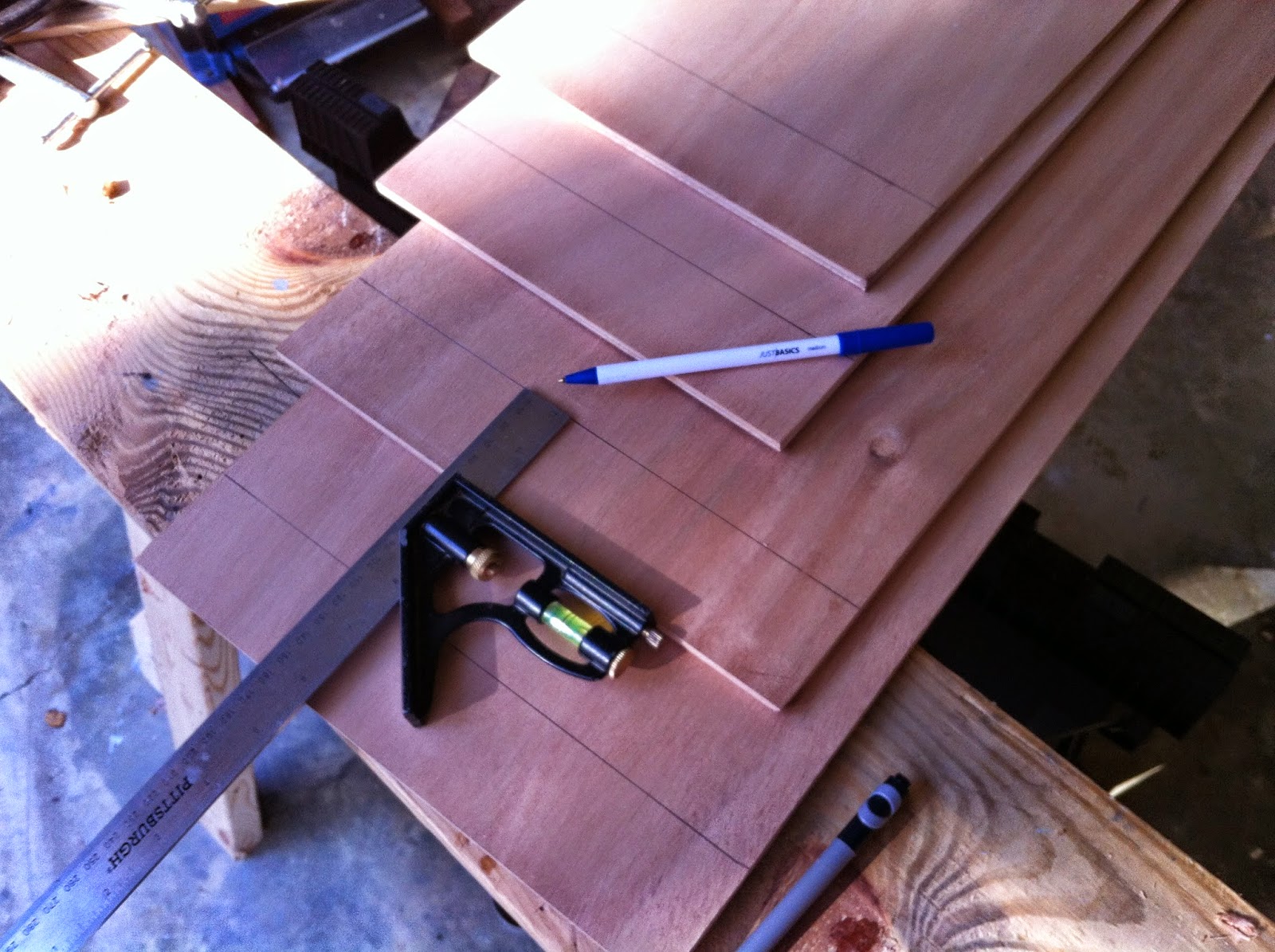
To back up, here are a couple shots of the scarfing marking, stacking, and trimming. The jack plane makes fairly quick work and the last touch of the belt sander makes it all right.
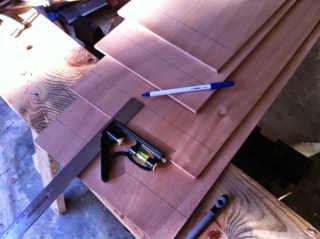
marked at 2″ for 8:1 scarf.
stacked for planing


near done.


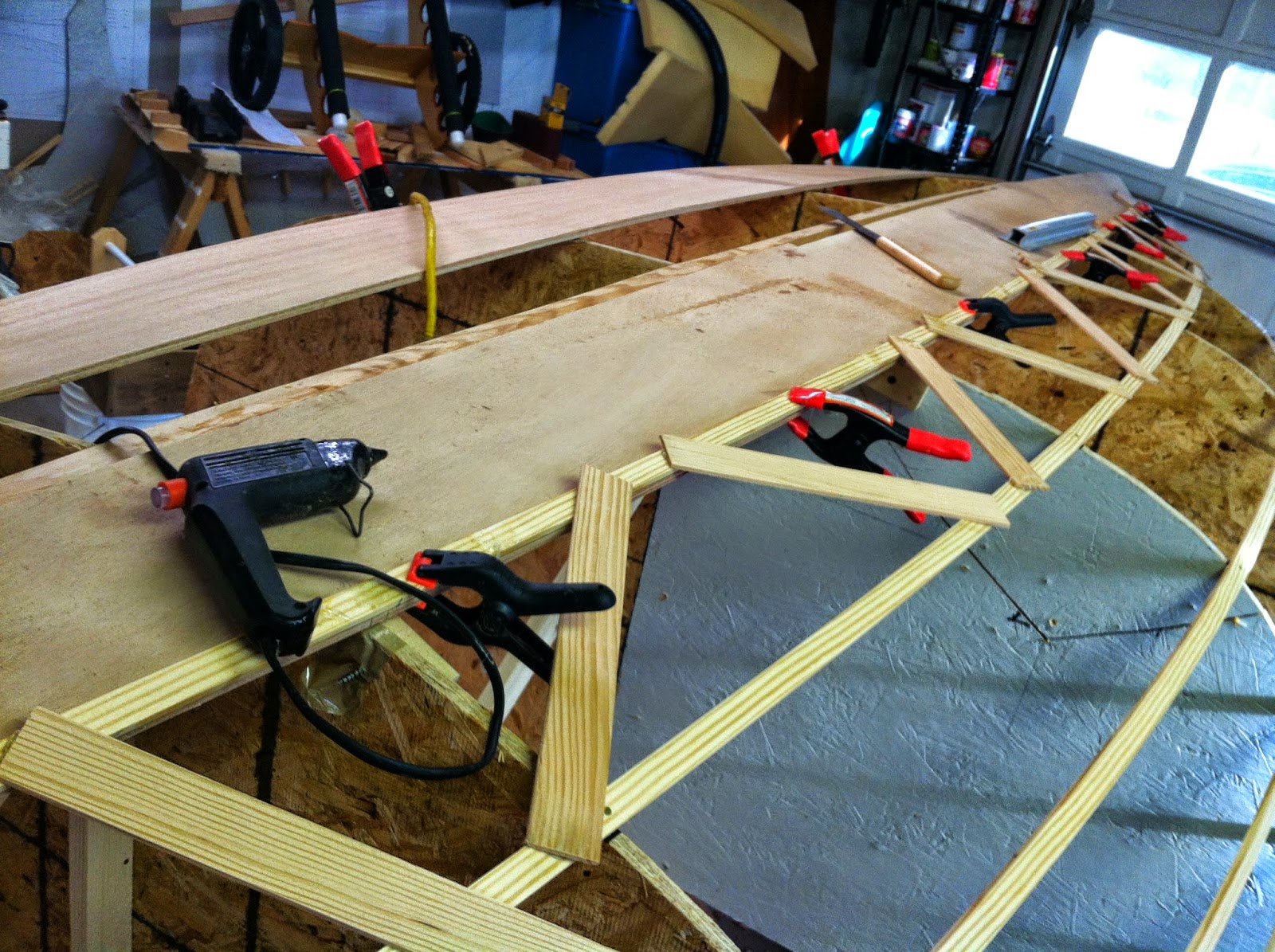
The trussed templates continue to be accurate. After cutting the 2 opposite planks together I set template again on the planks to confirm shape and either sand or plane the edges true to the template as a last check. No adjustments have been necessary on the moulds so far.
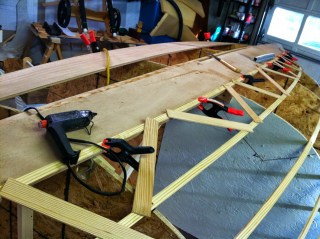
hot glued truss template.


another view of same.
rabbet plane with wood strut for beveling.
After much fussing with the “clothes pin” clamps (several broke and some were short), I resorted to using screws and fender washers (drywall screws bit too far into the planks). The resulting holes will require filling, but this will be nothing after all the nail holes I fixed on my strip kayak. Holes bored in the moulds under the other plank edges provided for positive clamping there. I see the epoxy stains distort the lines, but they are fair.
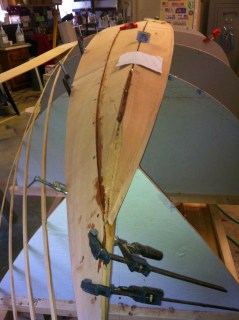
 

drywall screw method was discarded.
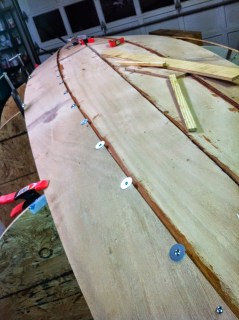
3/4″ #8 screws and fender washers.
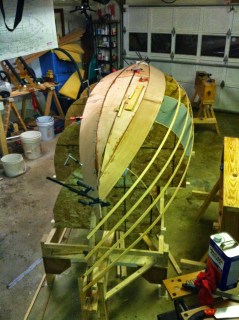
1/3 planking done.
And so, we’ve 1/3 a hull.


Cherry Cleats

The pieces and parts of this boat provide some interesting tasks offering some diversion from what may seem at times routine in the construction. Or, they can be just the right sized project completed while waiting for epoxy to cure. One such time filler was a pair of wooden cleats I decided to manufacture from that cherry I have hauled around ever since living in Houston years ago.  Combine that with the discovery of a good article from Harry Bryan called, imagine this, “Making Wooden Cleats”.
From WoodenBoat No. 192 (Sept/Oct 2006)


They are easy to do. This instruction makes it simple. I made 2 for now using the chart he provides for specific dimensions based on the line to be used.

  • From cut offs discarded from the rudder head, 3/4″ cherry was cut to 1″ height in my case and then cut to 5″ lengths. These cleats will be fastened to the 2 masts for halyards ( or halliards per an Englishman).
Cherry blanks.
  • a 9″ bandsaw (with a dull blade) eventually made it through the stock to give a rough shape.
  • flat and tail files, the belt sander and final hand sanding delivered the product. 45 minutes a piece?
Rough cut lines.
A pair with stock for 2.
One of two with added turpentine for effect.

There still remains some slight “perfection sanding”, but they look suitable for the task.