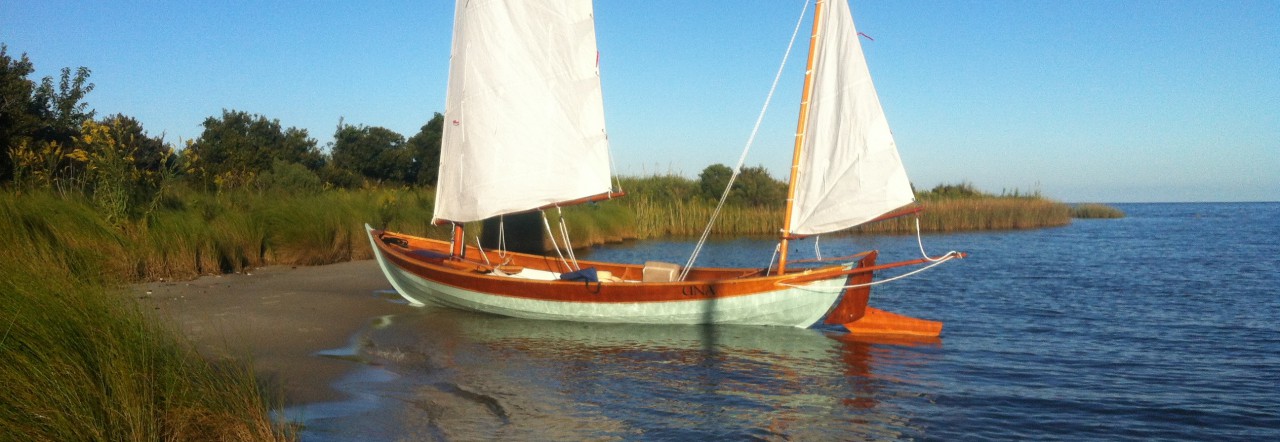
Tumbling On …

Been on a roll of late. Decisions have been easy. Not so much deliberating. Just execution … and concentrated time.

I’m now the king of the hot melt gun. The crude tool allows for quick bulkhead spilling and many floor templates. After cutting the moulds to slip past the partial inhales, I used scrap wood strips to locate the hull laps and faces. Tracing to the plywood from there was a piece of cake.

Station 6.


Glued scraps.


New bulkhead in place.


Station 2.


Points for tracing to ply.

From there I moved to the mast steps. Carving a few pieces of oak for the mizzen fried me. Alas, I came up with a better idea. The step is still supported by the keel, but I added a short floor to accept the lateral load. This all allows for any water dripping down the mast to pass into the bilge from the bottom of the step. Arrangement is quite stout.

Mast step and hot melt template.


Bolted floor ready for epoxy.


Floors with wide weeps.

I shortened the weeps from what was shown in the plans. They are still 1 1/2″x 3/8″ and provide longer attachment to the hull.

Elliptical hatch in forward bulkhead.


Centercase is epoxied and clamped into place.


Main mast step and 1/2″ copper drain tube.

A coating of epoxy was put on the interior of the centercase, drywall screws used to aid clamping, and the whole deal screwed to the keel. A cross support monitors the athwart ship level and helped keep the center case square while drying.

Oak thwart cutting.

A band saw is now high on my list for next tool purchase. After my last jig saw blade snapped, I was left with a workout for the old wing. By hand makes a better square cut, but boy did it take time.

Assorted templates for all the floors.


Gluing up of thwart cleats.


Cleat close up.


View from the “forepeak”.

All steps and floors are in. Both bulkheads secured with fat fillets (tongue depressor) on the inside and smaller outside (Popsicle stick).

Next up I think will be laying out the floor boards. This will allow for adding any turn button placement and locating side seat supports.  Moving on …

Cheeks, Arms, Mortise and Tenons

This part of the construction has been the most challenging. Many weeks ago I shaped the rudder foil (fine sanding and glassing still remain to be done). Weeks before that the rudder cheeks were cut from cherry and set aside. Now it must all come together … and work!
A model was made in SketchUp:

The hardware I selected rabbeted the rudder gudgeons and employed cherry wedges to align a 5/16″ rod through stem gudgeons.


This allowed for precise location of rabbets needed in cheeks which were routed with a clamped fence.
router/fence set up.


Stop block to left.


Finished routed fit.
Single cheek and gudgeons.

Before cheeks and inner spacer (1″ douglas fir) were glued, brass sheaves for control lines were located, and pilot holes for these lines were bored. One hole went astray and required plugging.

Rudder head clamp up. Rod positioned for square alignment.
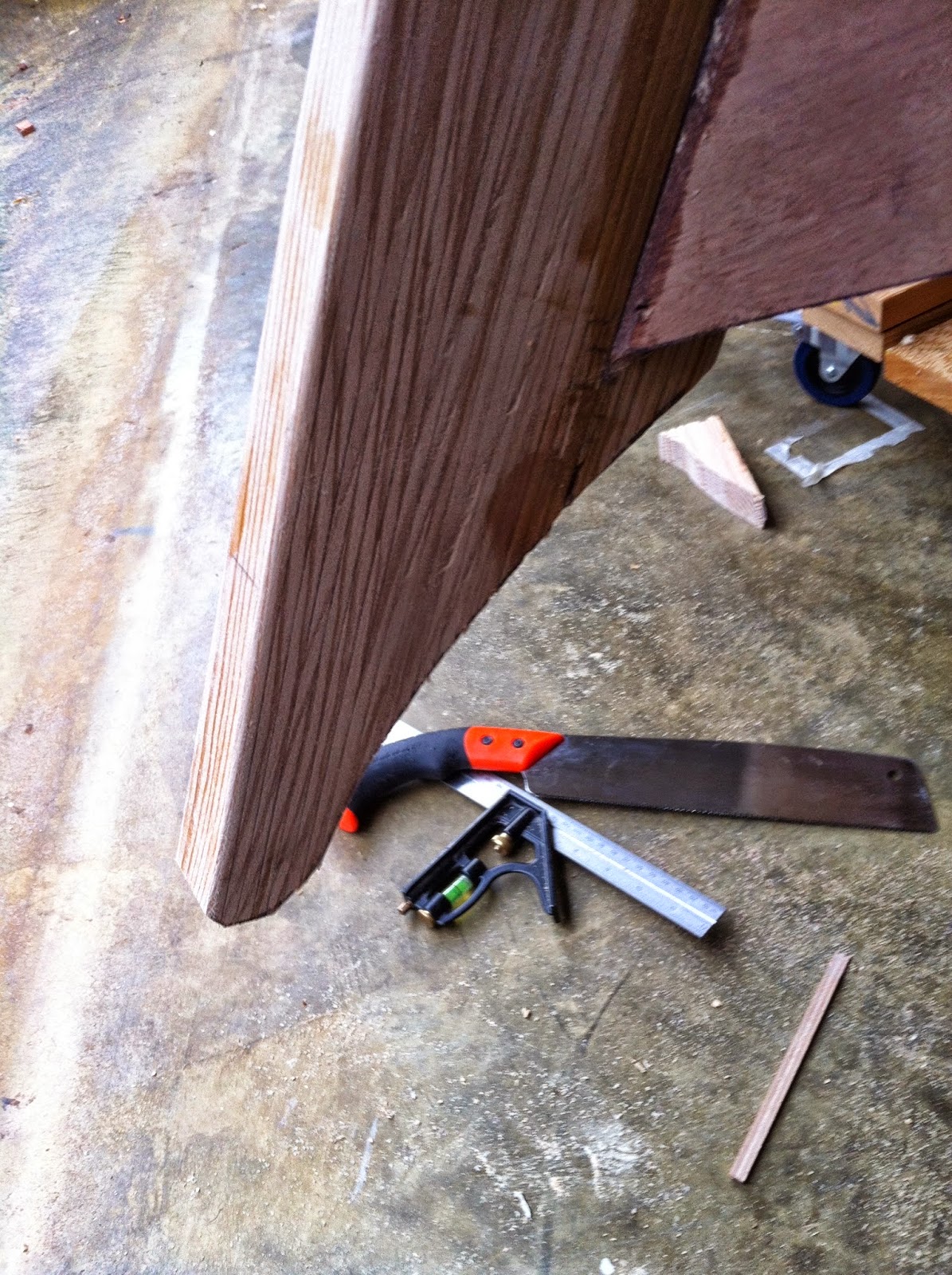
For the tiller arm  a 5 degree “advance” was given to the arm instead of making it perpendicular to the rudder. Made of white oak, it is some hard stuff to cut, rasp, plane and file. This was really my first use of the spokeshave which proved a fun tool for sculpting the underside of the arm.
Rudder mortise and arm tenon.
Arm fitted after much filing.
A mortise in the tiller arm accommodates a wedge of cherry. This is an amazingly tight combination. The wedge has a hole for securing with line and I exaggerated the head for easier removal.
Wedge and sheave holes.
Tiller arm sweep.

One of the wonderful aspects of this build has been the ability to individualize it as one’s own. Sculpting these pieces has been especially rewarding. A challenge accepted with some clean up still needed.

Next? I’m thinking mast steps and breasthooks.

First Cruise (Closer to the Dream)


Went for a short sail today, or at least dreamt of doing so.
With some helpers, we flipped the hull last night. The volume in this boat amazed me. Since September I have been looking at her from the keel. Once flipped, it is a whole different perspective. I think she’s got capacity to carry a tent and some grub.
All last evening I was chomping at the bit to start work on the interior, but hadn’t decided on how to support the boat for work. I finally chocked her up with female moulds edged with a plywood cradle and carpet. The hull is very secure and I felt no give while walking and sitting in there.
Cradle with 1/4 ply scrap.


Installed with bracing.
I chose stations 2 and 6 for the cradles. This is where the 2 bulkheads will be installed. I clamped braces across the gunwales at stations 6, 4 and 2. Little effort was required to pull the beam in line. It had opened up about 3/4″. This structural system is amazingly rigid.
Here are a few photos of the upright hull. I’m happy with the shear after all the contortions to view it upside down. I don’t think I was more than 1/8″ off from any of Iain’s marks after it was all done.
Starboard.


Starboard quarter.


Further aft.


Interior looking aft.


Bow stem.
The rest of the afternoon was spent trimming the inhales to fit and experimenting with lining a hole with copper pipe bushing for wear. I’m inclined to have a simple hole in the bow stem in lieu of a “nose ring”. I got good results with a parallel sided chunk of wood, but the stem is trapezoidal. I flared the pipe by wiggling a large screw driver in the hole and hammering with a grommet tool. More tests are going to be required before risking on the actual boat, but I like the appearance.
Test copper bushing.

She’s Got A New Dress On

Well, I’d like to think all the sanding has paid off. After applying 2 coats of primer and sanding after each coat, I’m all sanded out for awhile. I had intended to use the foam roller and brush tipping method, but the white “hot dog” rollers kept falling apart after half the boat was coated and left foam trash in the primer which required extra sanding.

Bow and 2 coats of primer.
Primed stern.

So, after almost 3 hours of the first top coat, she is starting to appear the lady.

Bow with 1 coat.
Stern and 1 coat.

Originally I intended to bright finish the stems,  but I sensed it would appear too fussy and elected to paint them instead. I lost control of one of the gains at the top of the broad plank at the stern, but all others look fine. This gain is likely at the waterline and will escape notice.
Collecting the rudder hardware took 3 separate orders from Hamilton Marine, WoodenBoat, and Duck Trap. Nobody had a pair of anything. The rudder gudgeons are actually Wilcox-Crittenden parts. That company’s hardware business is long gone. Classic Marine did have all the pieces, but at perhaps at 2.5 times the cost.
I may elect to cut the pintels off and use a rod a la Jim Luton’s method. The unpolished transom gudgeons are from Duck Trap.
I’m planning on turning her over this weekend and add another finish coat at the end of the job. On to more construction in the meantime.

Sand Jam Thumb Cleat Epoxy

Boat work has been sporadic. Things are getting done, but when so much of it has been fairing and sanding … what is there to report? Nonetheless, here are some items for the record.

  • I bought this little paint scraper that is fantastic in combination with careful use of the heat gun.
1.5″ wide scraper. Good addition.
  • I fabricated the jaws for the mizzen boom from cherry scraps. I decided to angle them to better receive the mast. Ganging them together allowed for easy belt sanding. Glued, screwed and plugged here:
Jaws ganged for sanding.


Starboard jaw attached.


  • I’ve a couple old Herreshoff open base cleats that I’ll likely use bow and stern, but there are a few jam and thumb cleats needed for the 2 booms. I found a photo online that I adapted for this application. All done with drill press, jig saw, belt sander, file and sanding block. A final hand sanding will precede shellac and varnish.
Jam cleats.


Thumb cleats.


  • Lastly, I got a coat of epoxy on. Mike at RAKA suggested heating up the boat and then cooling it down as epoxy is brushed on. He said the wood pores would open and soak up the goo. This I did with about a 10% thinning with denatured alcohol. A few areas got a bit thick and exhibit some sagging which will require more sanding. The random orbital sander should make it quick work. I may be able  to then prime for paint. We’ll see.
Stern.
Dark laps are where the “purple” fairing compound is.

Boat Hookie

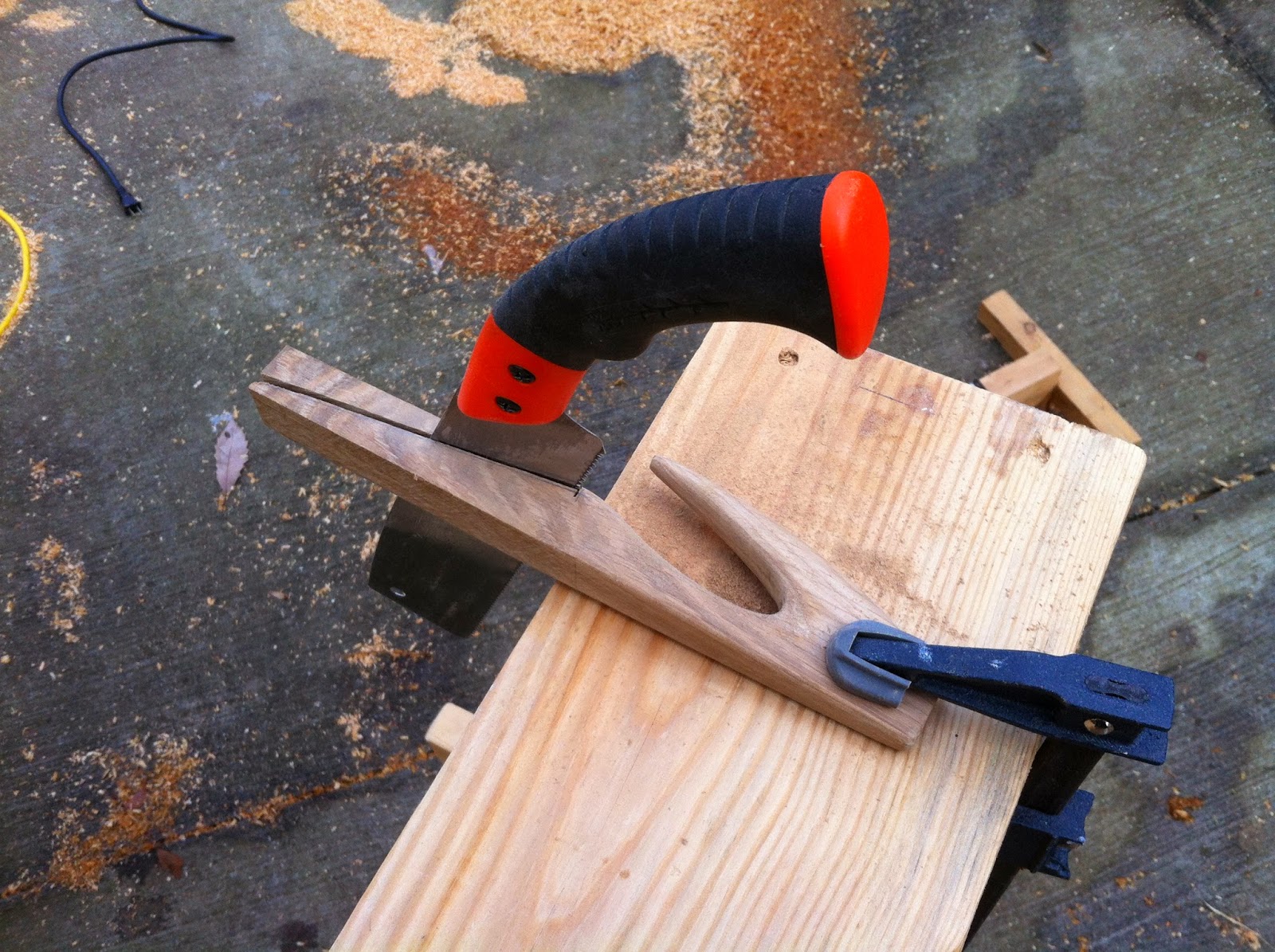
Sometimes you can get tired of laying on long epoxy parts. The sentiment hit me 2 days ago. As a diversion I picked up the rudder construction again, fiddled with the kick up controls, but didn’t come to a happy resolution yet so, I decided to craft a boat hook.

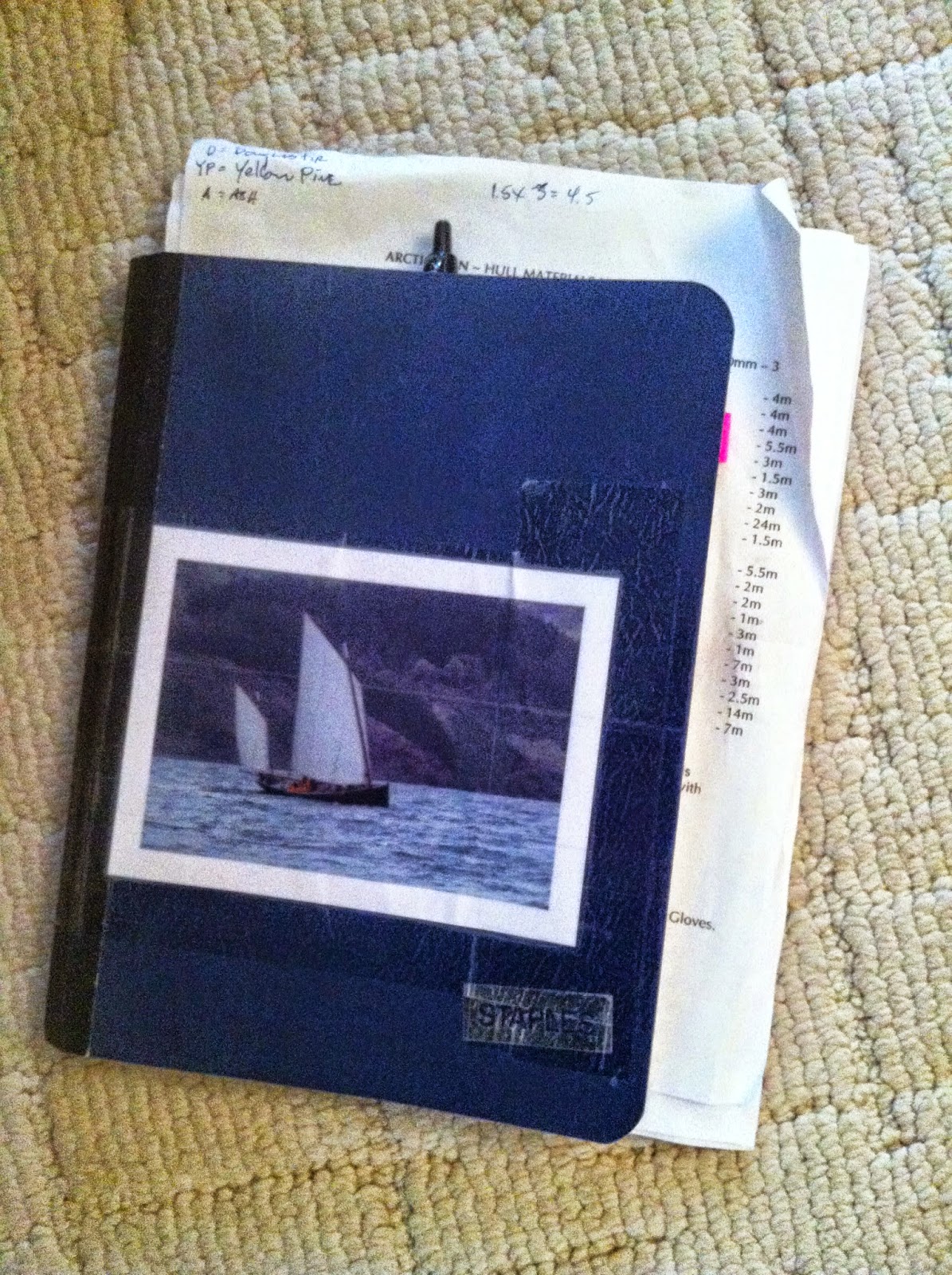
Most of my computations, receipts, notes and drawings for this project have been kept in this notebook.

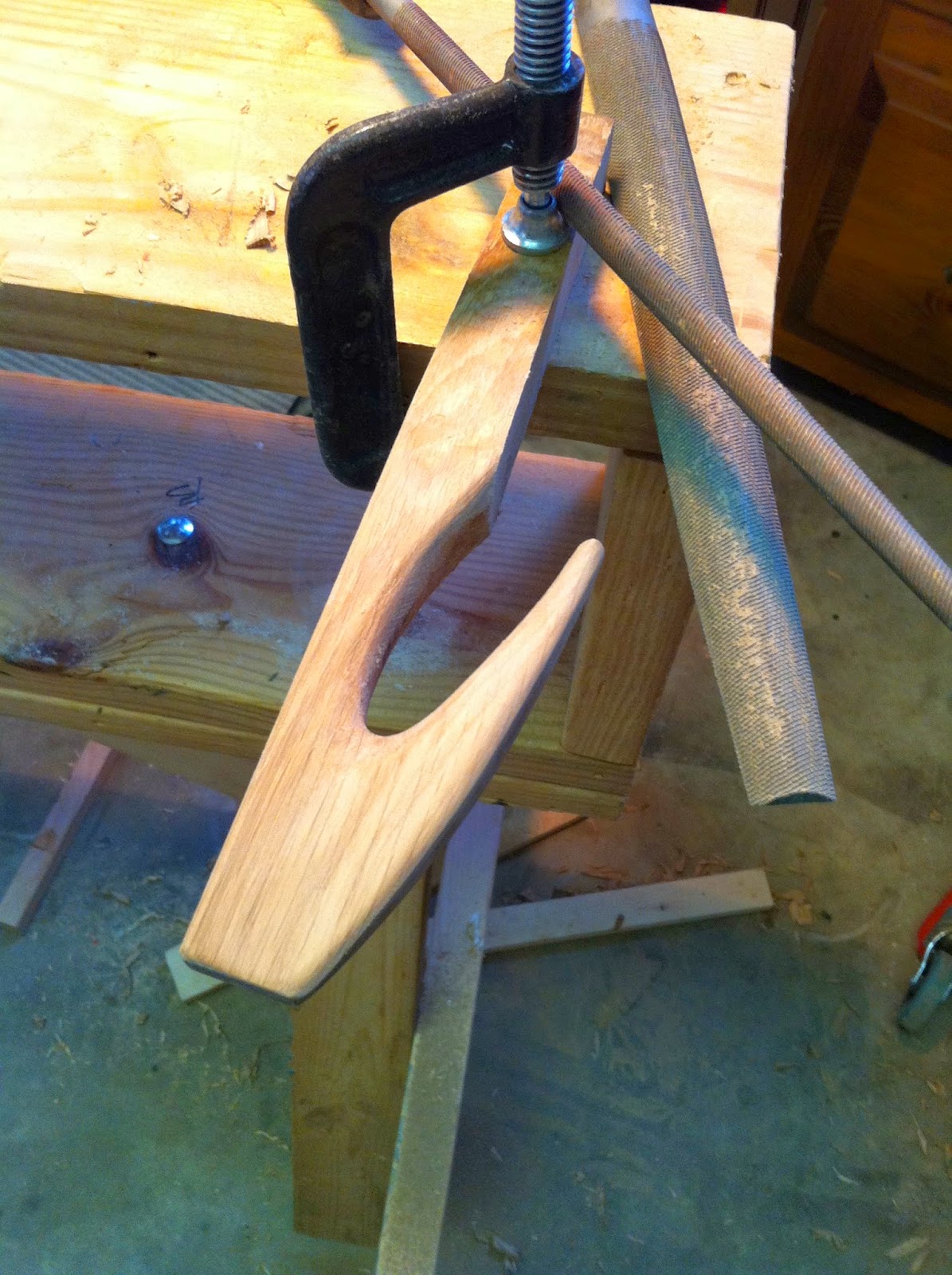
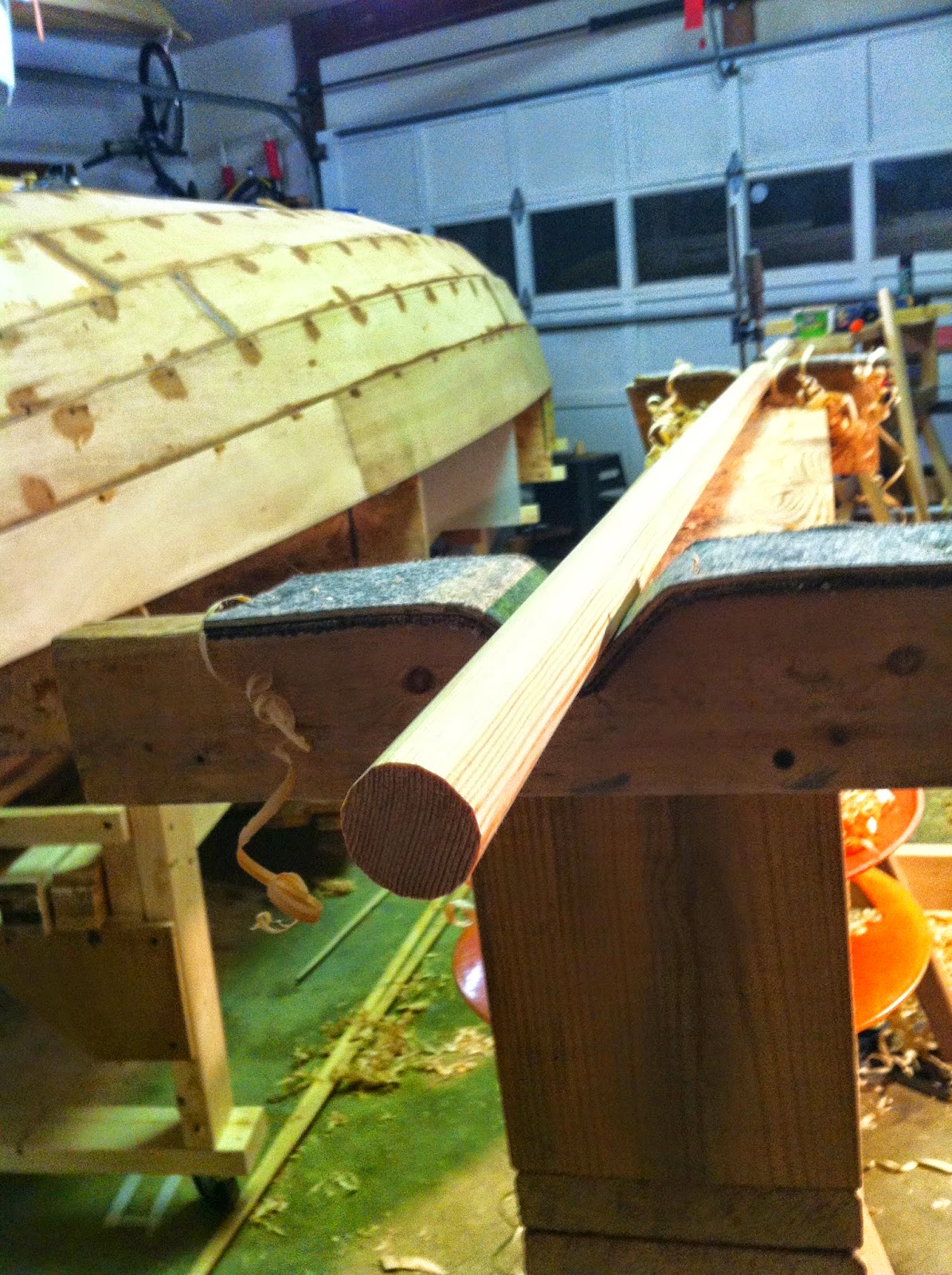
In it is my rough sketch of a long, light and sturdy boat hook. The hook is a scrap of hard oak and the shaft is of glued cedar. At just over 8′ it should store well in the boat and float handle end up if dropped overboard. We’ll see about that.

I had thought about lashing the parts, but dowelled things instead. I gave it a flat blunt nose for more pushing off surface. Some progress pics:

Rough cut with jig saw.

tapered with jack plane and belt sander

Finessing with files.

Rough cut for scarf.

Joined, dowelled and coated with “soup”.

Shaped end.

All in all I have maybe 3 hours in this thing. It is handier, lighter and I think prettier than any of the several aluminum and telescopic versions I currently own. With a single coat of the “soup” (equal parts turpentine, tung oil, and pine tar). It is not the best smelling sauce, but it can grow on you. Maybe not for the rest of the family.

The kayak paddles I’ve put it on have worn very well. It also won’t give you blisters like varnish can. Easy to apply, it simply wipes on and buffs off after 20-30 minutes. These pictures show it wet, but after a few coats there is a nice satin sheen developed.

Well, back to the long epoxy parts.

So, Its the New Year! Where are we?

Happy New Year! We’re looking forward to longer days and the eventual warming trend. The Holidays were busy and good. Enjoyed seeing the family.

I did slip in some work on the boat here and there. Save for the starboard outwale, I’m right where I had hoped to be. She is ready for some finishing and really looking like a boat! A sweet one at that. The thought of that first sail drives me onward.

I’ll list the tasks:

  1. a 3/16″ x 1/4″ (6mm) strip of ash was epoxied after trimming the shear.
  2. out wale edges were rounded over with a 1/4″ rounding bit on the jury rigged router table. Thankfully the plunge router stayed still. It has “adjusted” itself before to terrible results. None this time. I will further shape the top outer edge once boat is upright. That edge is about 1/2″ round, but has some rolling bevel to it. Hard to judge it upside down.
  3. outwales were scarfed with a step after some practice in pine. I used a combination of hand saw, hand plane, file, and belt sander for final fit. Got good results sneaking up on the fit.
  4. out wale ends were fitted to stems with small bevel and belt sander finesse.
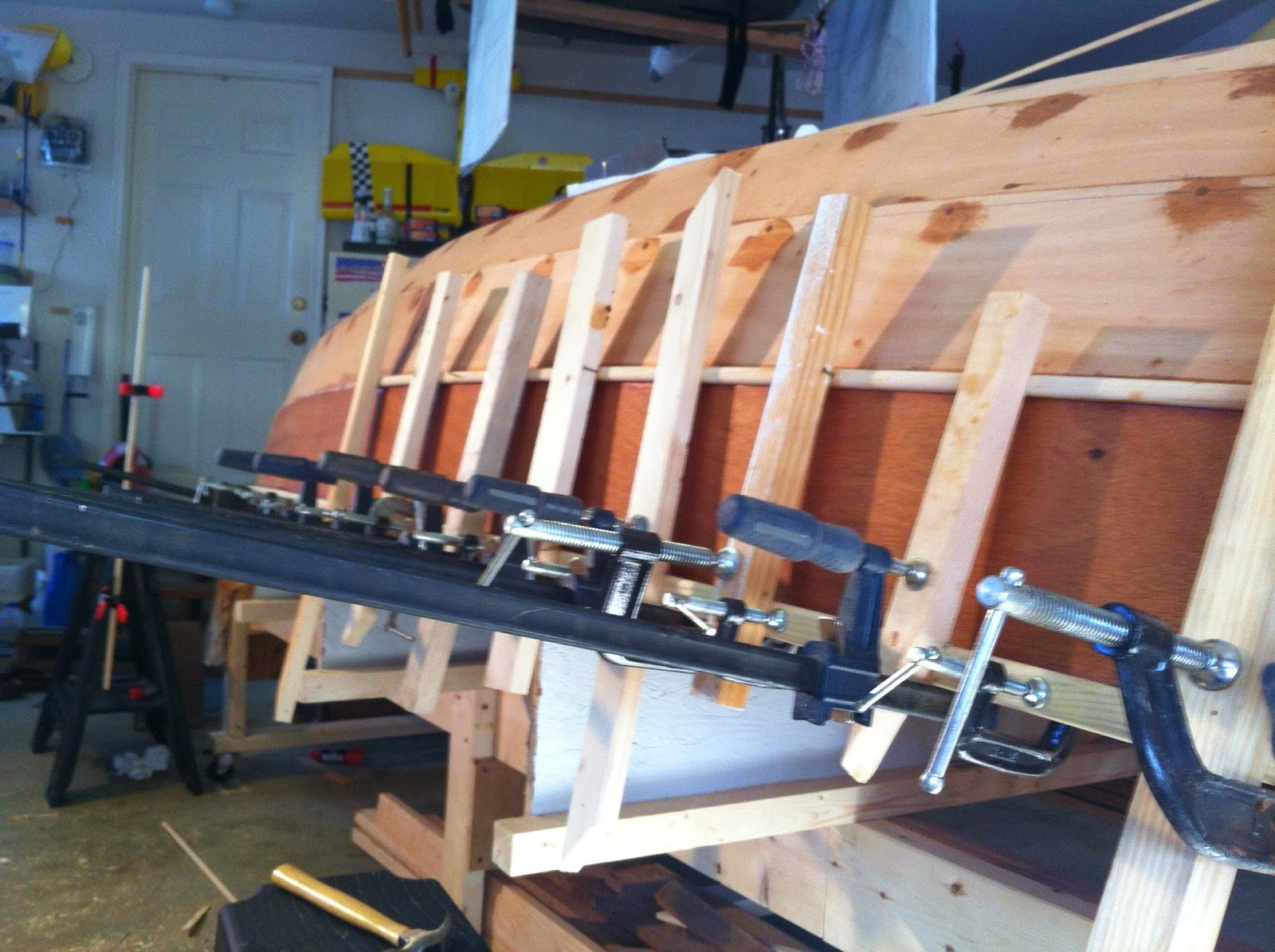
  5. I epoxied the outwales on and then could reach the small 1/2″ rubstrake I added. A first attempt to nail the strake on was a fail. The hammer just bounced, even after drilling pilot holes. Aesthetically I did continue the holes every 12″ for accent. The solution was to overreach the out wale with a clamp and 2x material every 8″. Worked fine.
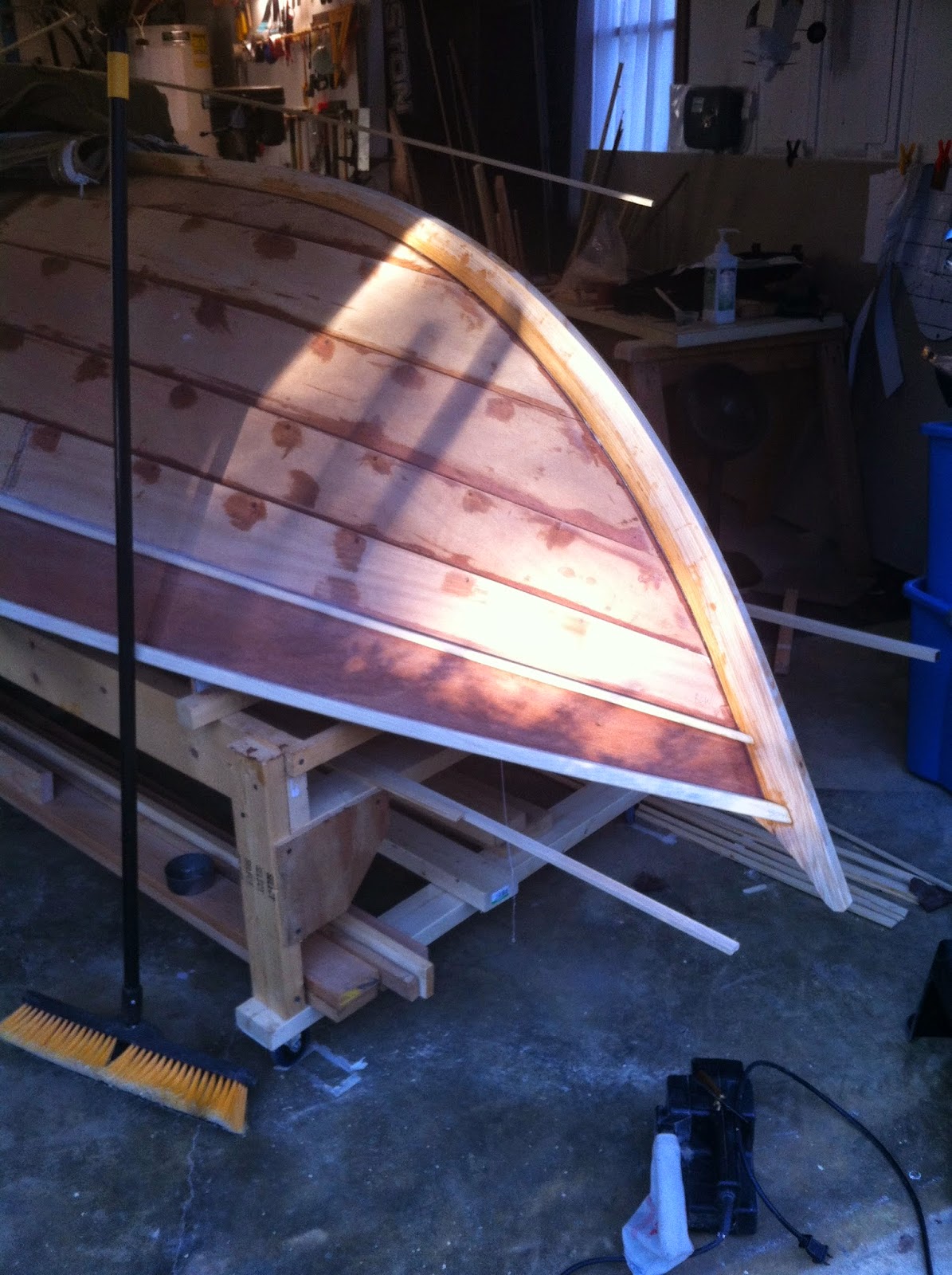
Ash shear trim to hide and protect shear ply edge.


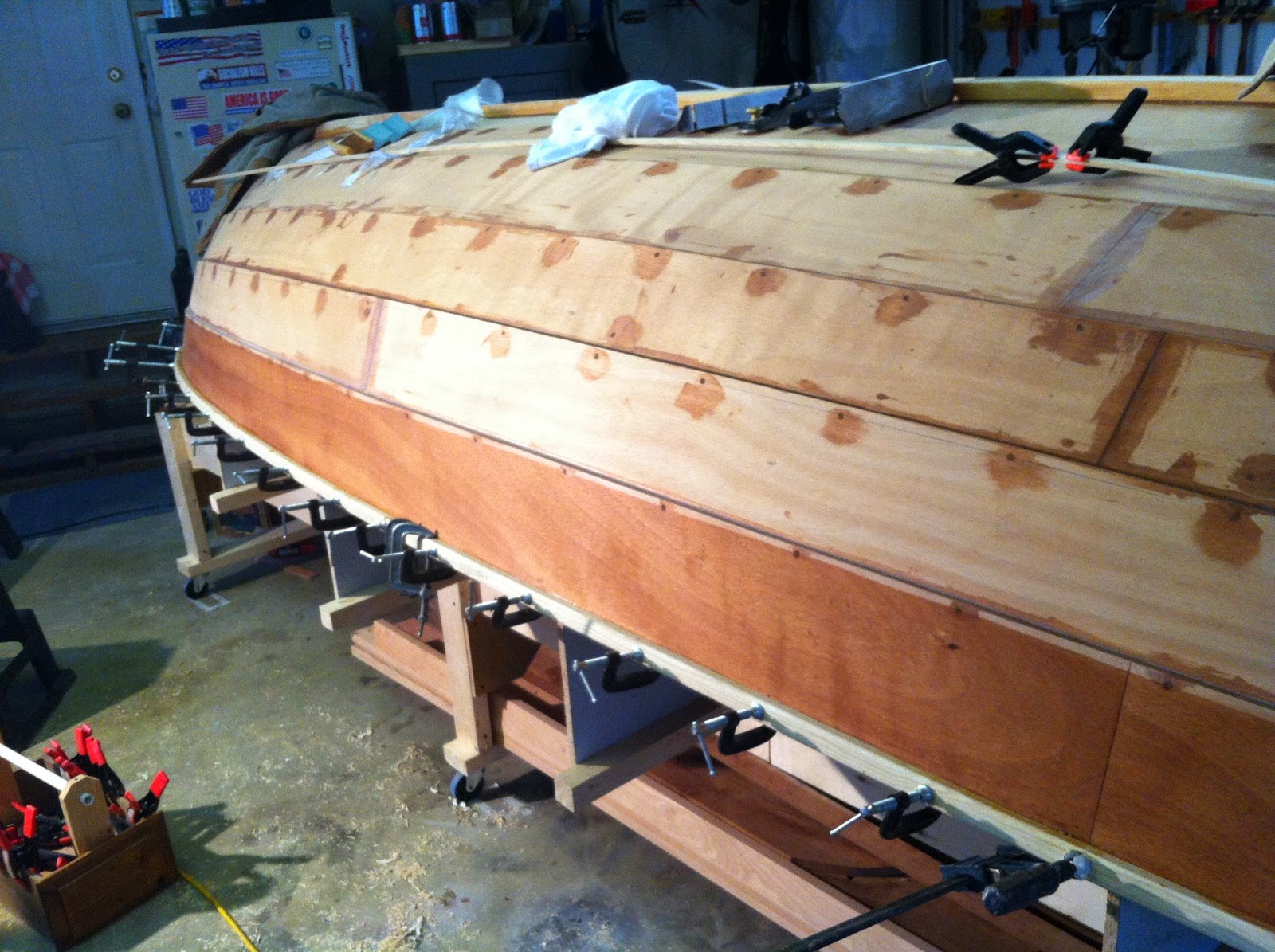
Long shot of outwale clamping and stained shear plank.


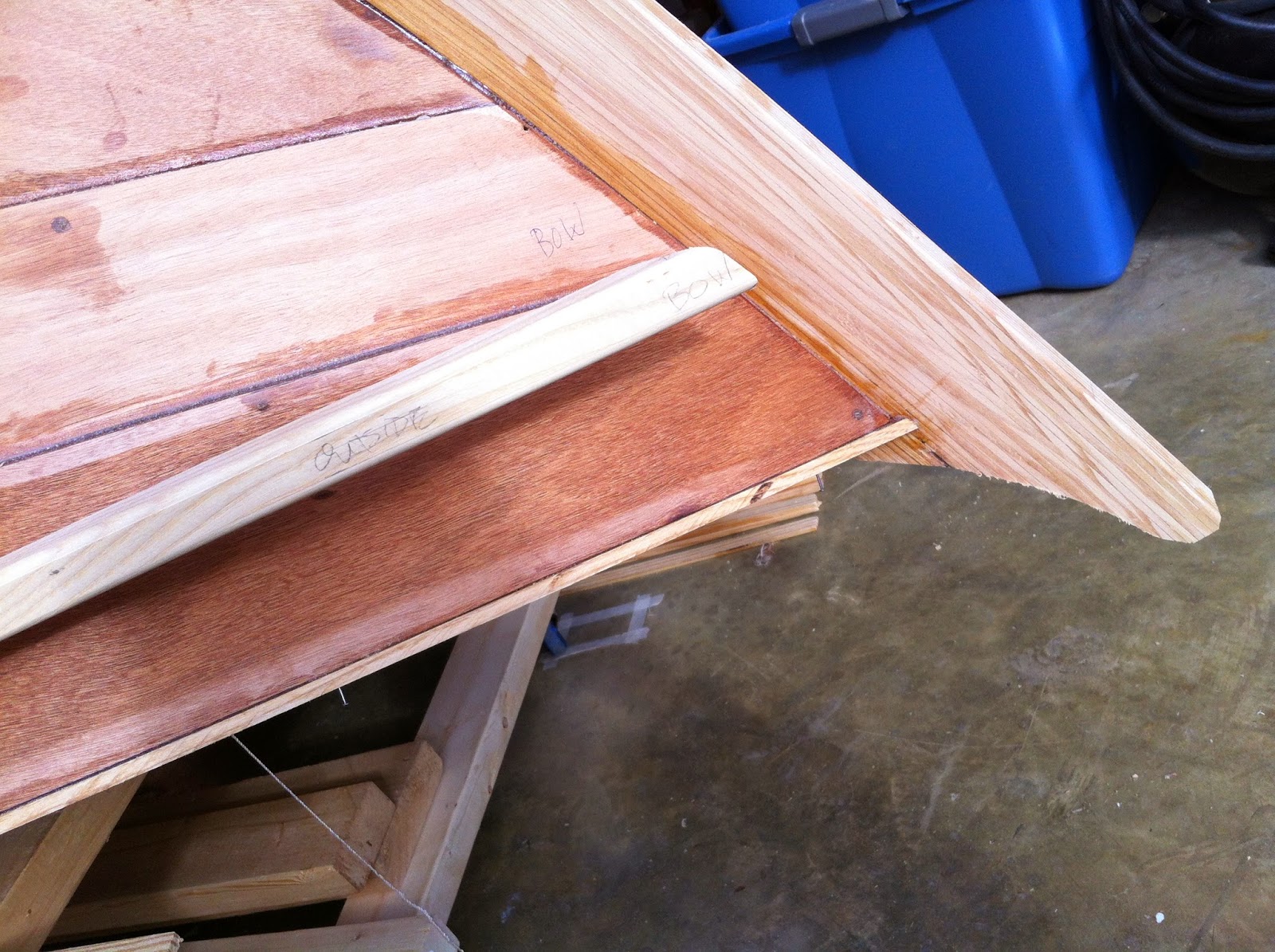
Fitted outwale at bow


Outwale clamped.


Rubstrake clamping.


Clamping and nails. Nails failed really.


Port aft quarter.


Port bow.


Looking like a boat.
Graphite powder for the centerboard and reddish phenolic micro balloons arrived for fairing. That is the next step really. Tally-ho!


Chesapeake Deadrise Build

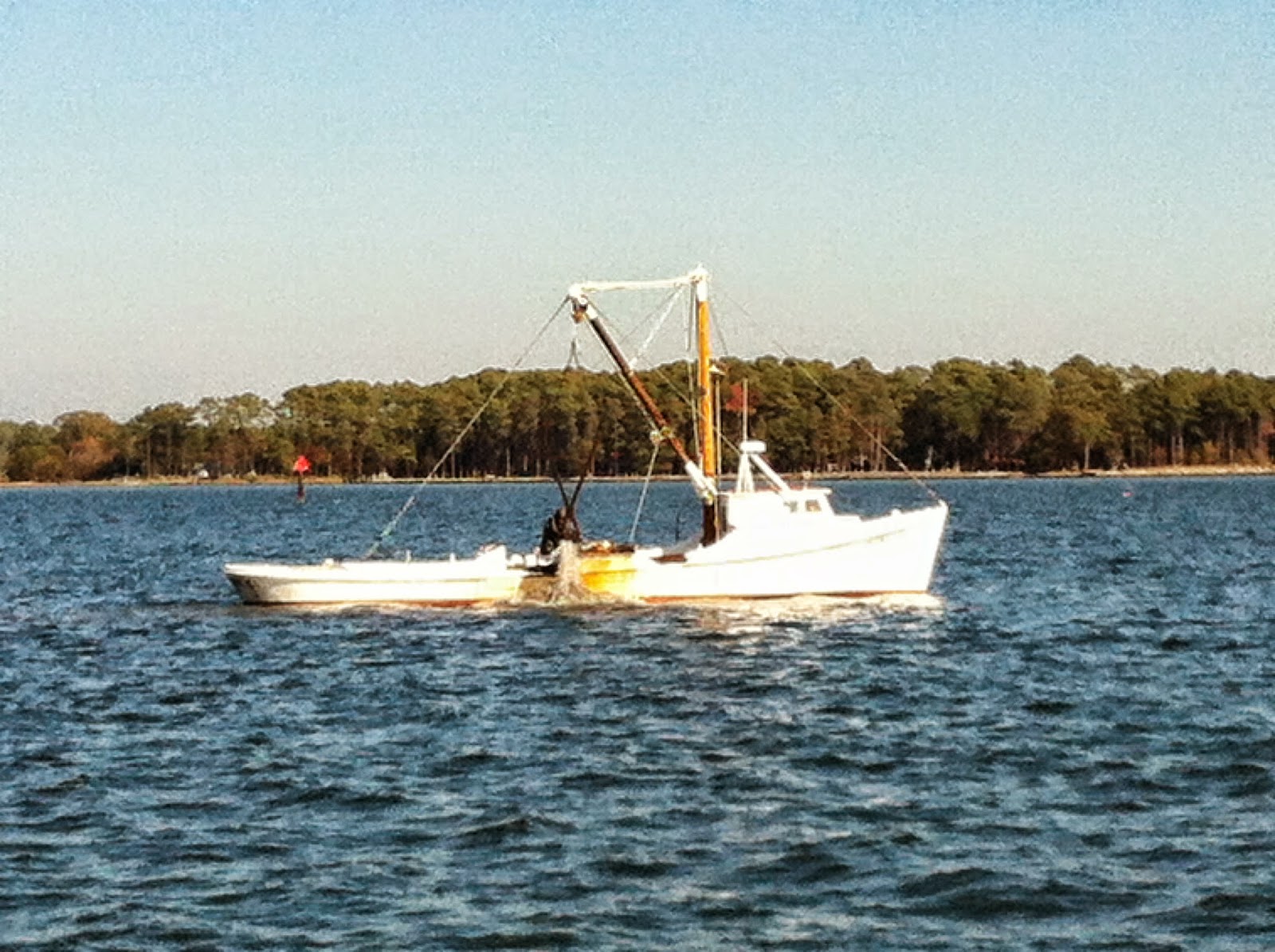
East River – Mobjack Bay
In St. Michaels Chesapeake Bay Museum

The watermen on the Bay have some of the most elegant vessels which, in many cases, are build by themselves though now perhaps not so much. The Mariner’s Museum in Newport News, Va did capture one such build all done by eye, no plans. Amazing really. 

Keel, Stems and Boomkin

Got some key things accomplished on the “you know what” this weekend. They are:

  1. trimmed the shear back 1/4″ for a sliver of ash to cover the ply edge.
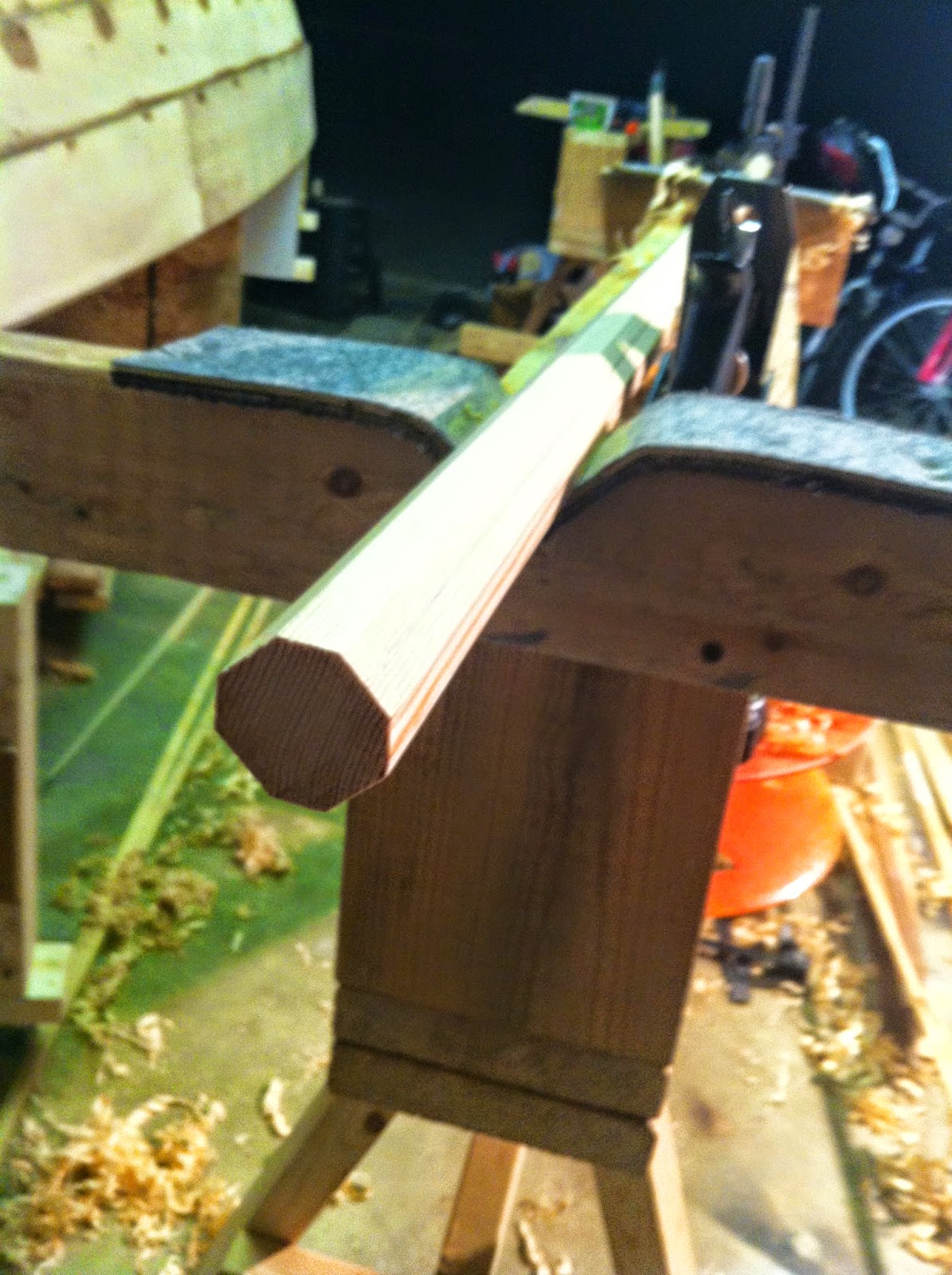
  2. cut, planed, shaped and sanded the boom kin.
  3. attached stems and keel. Shaped both.
  4. watched the Redskins choke again.
So, here are some photos.
BOOMKIN
Bench with boomkin stock.
Boomkin 8-sided.
Boomkin 16-sided.


STEMS

Bow stem and template.
Markings from template
Rough cut of stem.


KEEL
 

Saw witnesses and chiseling.
Keel and raindrops.
Bow stem and keel shaped.


Oh, I also ordered filler for final fairing, primer, and paint. I’m dying to roll the boat over, but I’d like to get a coat of paint on while she is secured to the moulds. Much to do before that happens. C’est tout.

She’s Got Her Wheels On …

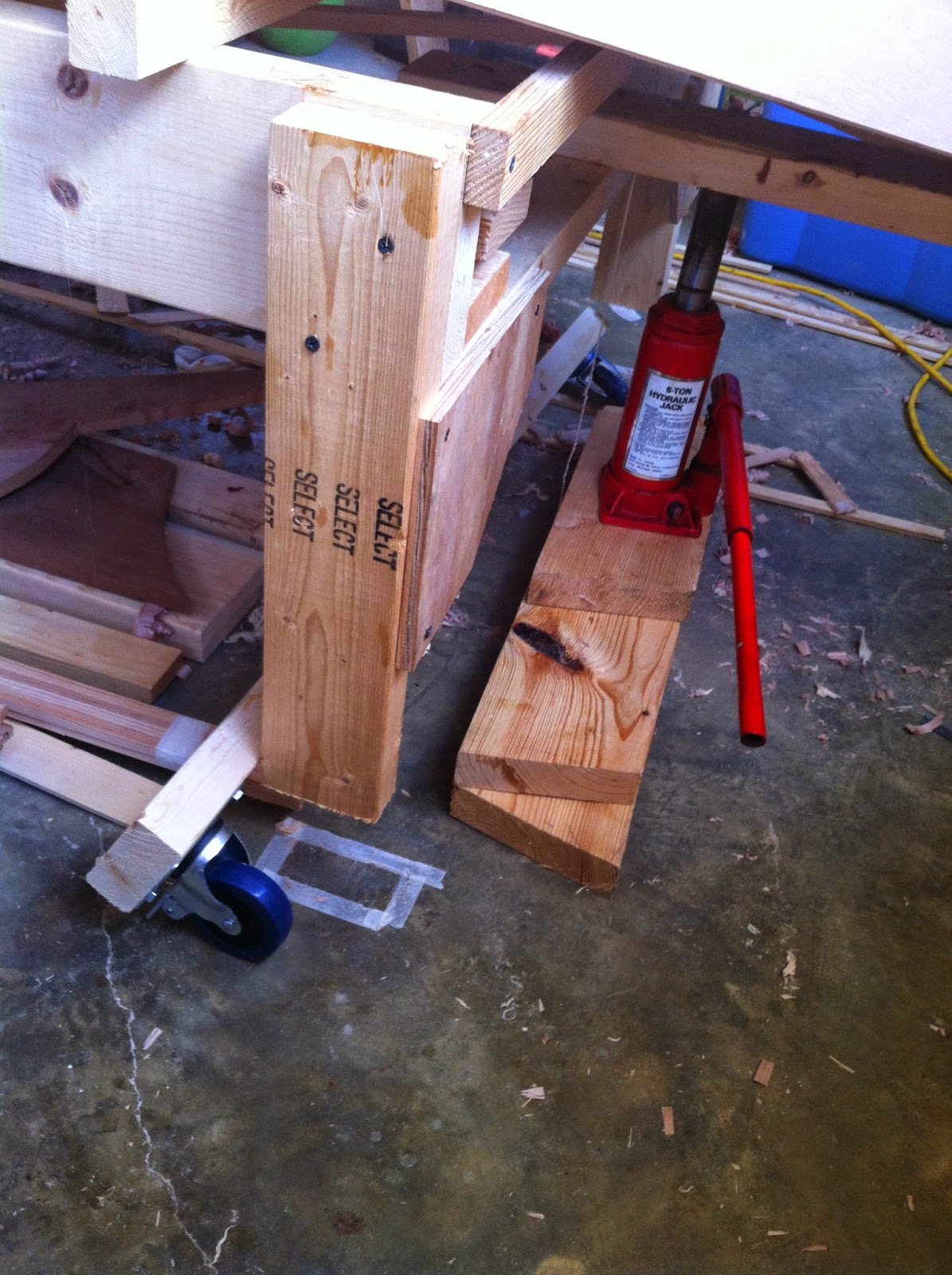
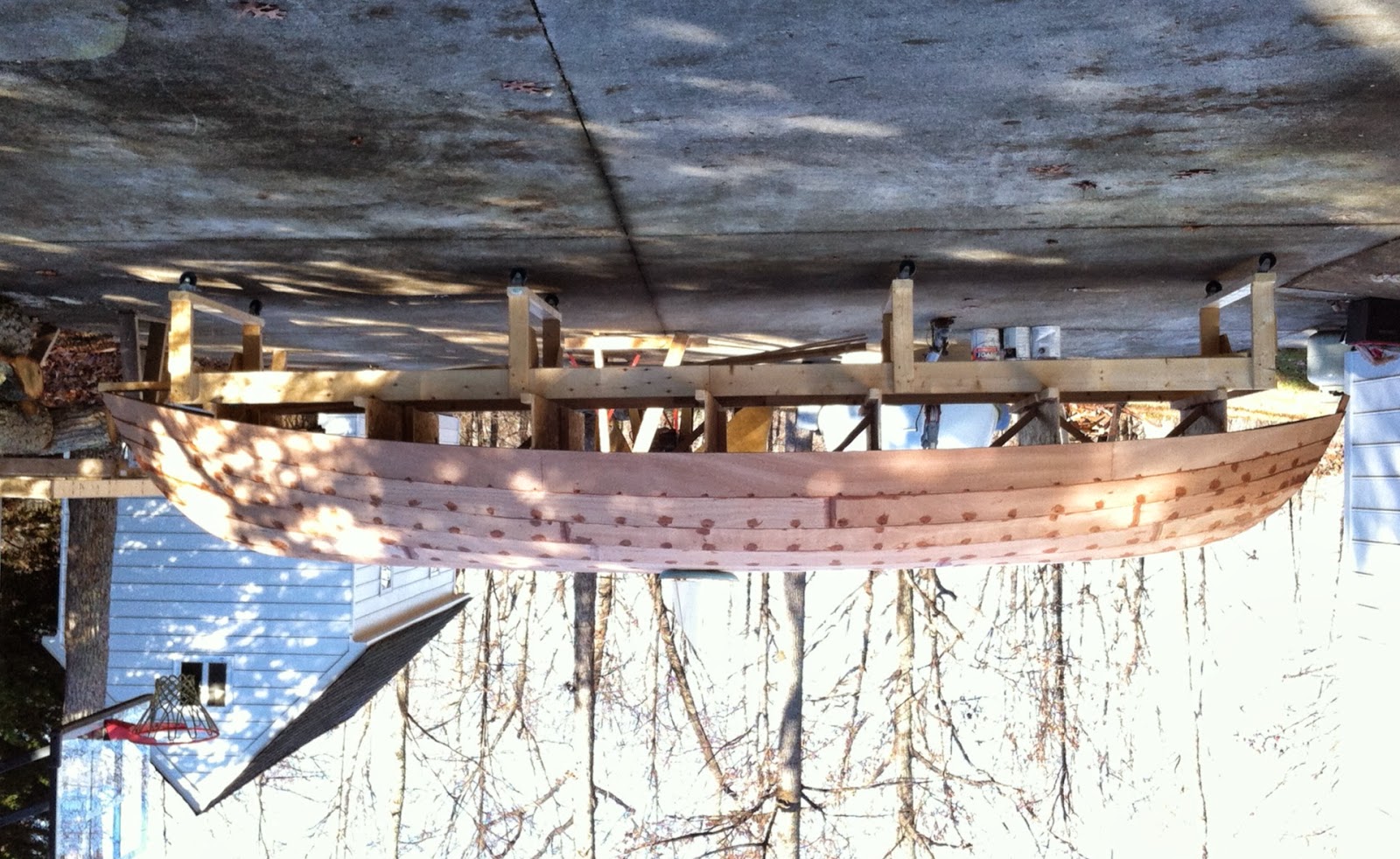
About 20 years ago one of my brothers gave me a 6 ton jack. I thought it was neat, but didn’t know when I’d get a chance to use it. Well, today was the day. I just couldn’t quite lift the end of the boat to slip in these roller skates quick enough. I dug through the shed, found the jack, and up, up, up she went. Thanks Bro!

I don’t feel like pecking at this keyboard, but here are some pics from the “maiden voyage”.

Jack and skateboard


1st daylight.


port side
Inverted. Bow to left


bow


stern